In a move that has sent shockwaves through Silicon Valley and global markets, NVIDIA (NASDAQ: NVDA) has officially finalized a landmark $20 billion strategic transaction to acquire the core intellectual property (IP) and top engineering talent of Groq, the high-speed AI chip startup. Announced in the closing days of 2025 and finalized as the industry enters 2026, the deal is being hailed as the most significant consolidation in the semiconductor space since the AI boom began. By absorbing Groq’s disruptive Language Processing Unit (LPU) technology, NVIDIA is positioning itself to dominate not just the training of artificial intelligence, but the increasingly lucrative and high-stakes market for real-time AI inference.
The acquisition is structured as a comprehensive technology licensing and asset transfer agreement, designed to navigate the complex regulatory environment that has previously hampered large-scale semiconductor mergers. Beyond the $20 billion price tag—a staggering three-fold premium over Groq’s last private valuation—the deal brings Groq’s founder and former Google TPU lead, Jonathan Ross, into the NVIDIA fold as Chief Software Architect. This "quasi-acquisition" signals a fundamental pivot in NVIDIA’s strategy: moving from the raw parallel power of the GPU to the precision-engineered, ultra-low latency requirements of the next generation of "agentic" and "reasoning" AI models.
The Technical Edge: SRAM and Deterministic Computing
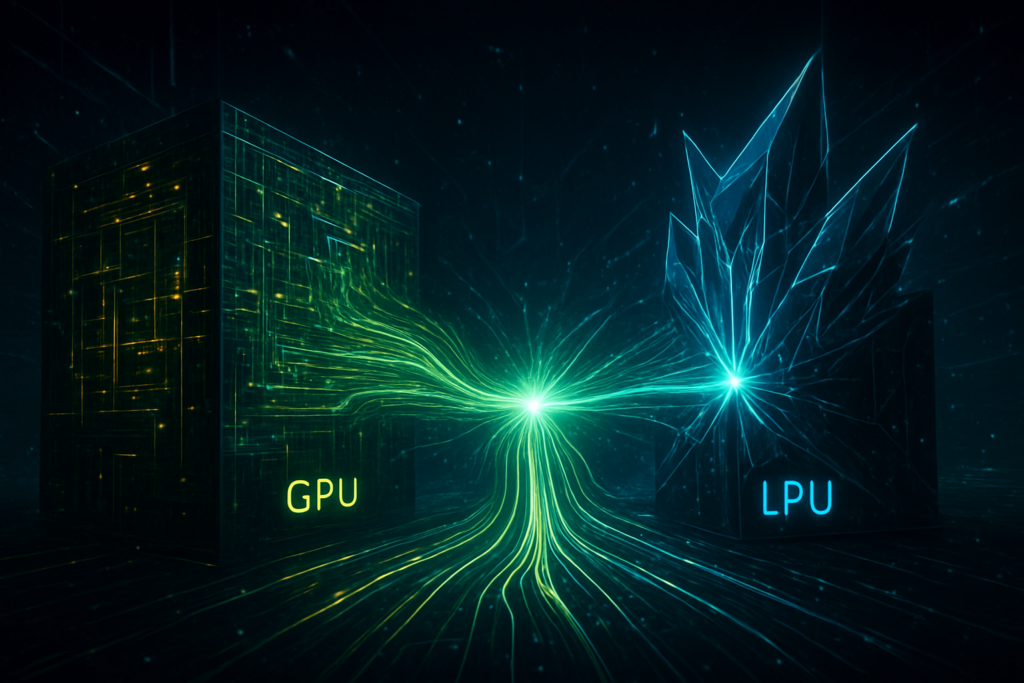
The technical crown jewel of this acquisition is Groq’s Tensor Streaming Processor (TSP) architecture, which powers the LPU. Unlike traditional NVIDIA GPUs that rely on High Bandwidth Memory (HBM) located off-chip, Groq’s architecture utilizes on-chip SRAM (Static Random Access Memory). This architectural shift effectively dismantles the "Memory Wall"—the physical bottleneck where processors sit idle waiting for data to travel from memory banks. By placing data physically adjacent to the compute cores, the LPU achieves internal memory bandwidth of up to 80 terabytes per second, allowing it to process Large Language Models (LLMs) at speeds previously thought impossible, often exceeding 500 tokens per second for complex models like Llama 3.
Furthermore, the LPU introduces a paradigm shift through its deterministic execution. While standard GPUs use dynamic hardware schedulers that can lead to "jitter" or unpredictable latency, the Groq architecture is entirely controlled by the compiler. Every data movement is choreographed down to the individual clock cycle before the program even runs. This "static scheduling" ensures that AI responses are not only incredibly fast but also perfectly predictable in their timing. This is a critical requirement for "System-2" AI—models that need to "think" or reason through steps—where any variance in synchronization can lead to a collapse in the model's logic chain.
Initial reactions from the AI research community have been a mix of awe and strategic concern. Industry experts note that while NVIDIA’s Blackwell architecture is the gold standard for training massive models, it was never optimized for the "batch size 1" requirements of individual user interactions. By integrating Groq’s IP, NVIDIA can now offer a specialized hardware tier that provides instantaneous, human-like conversational speeds without the massive energy overhead of traditional GPU clusters. "NVIDIA just bought the fast-lane to the future of real-time interaction," noted one lead researcher at a major AI lab.
Shifting the Competitive Landscape
The competitive implications of this deal are profound, particularly for NVIDIA’s primary rivals, AMD (NASDAQ: AMD) and Intel (NASDAQ: INTC). For years, competitors have attempted to chip away at NVIDIA’s dominance by offering cheaper or more specialized alternatives for inference. By snatching up Groq, NVIDIA has effectively neutralized its most credible architectural threat. Analysts suggest that this move prevents a competitor like AMD from acquiring a "turnkey" solution to the latency problem, further widening the "moat" around NVIDIA’s data center business.
Hyperscalers like Alphabet Inc. (NASDAQ: GOOGL) and Meta Platforms (NASDAQ: META), who have been developing their own in-house silicon to reduce dependency on NVIDIA, now face a more formidable incumbent. While Google’s TPU remains a powerful force for internal workloads, NVIDIA’s ability to offer Groq-powered inference speeds through its ubiquitous CUDA software stack makes it increasingly difficult for third-party developers to justify switching to proprietary cloud chips. The deal also places pressure on memory manufacturers like Micron Technology (NASDAQ: MU) and SK Hynix (KRX: 000660), as NVIDIA’s shift toward SRAM-heavy architectures for inference could eventually reduce its insatiable demand for HBM.
For AI startups, the acquisition is a double-edged sword. On one hand, the integration of Groq’s technology into NVIDIA’s "AI Factories" will likely lower the cost-per-token for low-latency applications, enabling a new wave of real-time voice and agentic startups. On the other hand, the consolidation of such critical technology under a single corporate umbrella raises concerns about long-term pricing power and the potential for a "hardware monoculture" that could stifle alternative architectural innovations.
Broader Significance: The Era of Real-Time Intelligence
Looking at the broader AI landscape, the Groq acquisition marks the official end of the "Training Era" as the sole driver of the industry. In 2024 and 2025, the primary goal was building the biggest models possible. In 2026, the focus has shifted to how those models are used. As AI agents become integrated into every aspect of software—from automated coding to real-time customer service—the "tokens per second" metric has replaced "teraflops" as the most important KPI in the industry. NVIDIA’s move is a clear acknowledgment that the future of AI is not just about intelligence, but about the speed of that intelligence.
This milestone draws comparisons to NVIDIA’s failed attempt to acquire ARM in 2022. While that deal was blocked by regulators due to its potential impact on the entire mobile ecosystem, the Groq deal’s structure as an IP acquisition appears to have successfully threaded the needle. It demonstrates a more sophisticated approach to M&A in the post-antitrust-scrutiny era. However, potential concerns remain regarding the "talent drain" from the startup ecosystem, as NVIDIA continues to absorb the most brilliant minds in semiconductor design, potentially leaving fewer independent players to challenge the status quo.
The shift toward deterministic, LPU-style hardware also aligns with the growing trend of "Physical AI" and robotics. In these fields, latency isn't just a matter of user experience; it's a matter of safety and functional success. A robot performing a delicate surgical procedure or navigating a complex environment cannot afford the "jitter" of a traditional GPU. By owning the IP for the world’s most predictable AI chip, NVIDIA is positioning itself to be the brains behind the next decade of autonomous machines.
Future Horizons: Integrating the LPU into the NVIDIA Ecosystem
In the near term, the industry expects NVIDIA to integrate Groq’s logic into its upcoming 2026 "Vera Rubin" architecture. This will likely result in a hybrid chip that combines the massive parallel processing of a traditional GPU with a dedicated "Inference Engine" powered by Groq’s SRAM-based IP. We can expect to see the first "NVIDIA-Groq" powered instances appearing in major cloud providers by the third quarter of 2026, promising a 10x improvement in response times for the world's most popular LLMs.
The long-term challenge for NVIDIA will be the software integration. While the acquisition includes Groq’s world-class compiler team, making a deterministic, statically-scheduled chip fully compatible with the dynamic nature of the CUDA ecosystem is a Herculean task. If NVIDIA succeeds, it will create a seamless pipeline where a model can be trained on Blackwell GPUs and deployed instantly on Rubin LPUs with zero code changes. Experts predict this "unified stack" will become the industry standard, making it nearly impossible for any other hardware provider to compete on ease of use.
A Final Assessment: The New Gold Standard
NVIDIA’s $20 billion acquisition of Groq’s IP is more than just a business transaction; it is a strategic realignment of the entire AI industry. By securing the technology necessary for ultra-low latency, deterministic inference, NVIDIA has addressed its only major vulnerability and set the stage for a new era of real-time, agentic AI. The deal underscores the reality that in the AI race, speed is the ultimate currency, and NVIDIA is now the primary printer of that currency.
As we move further into 2026, the industry will be watching closely to see how quickly NVIDIA can productize this new IP and whether regulators will take a second look at the deal's long-term impact on market competition. For now, the message is clear: the "Inference-First" era has arrived, and it is being led by a more powerful and more integrated NVIDIA than ever before.
This content is intended for informational purposes only and represents analysis of current AI developments.
TokenRing AI delivers enterprise-grade solutions for multi-agent AI workflow orchestration, AI-powered development tools, and seamless remote collaboration platforms.
For more information, visit https://www.tokenring.ai/.