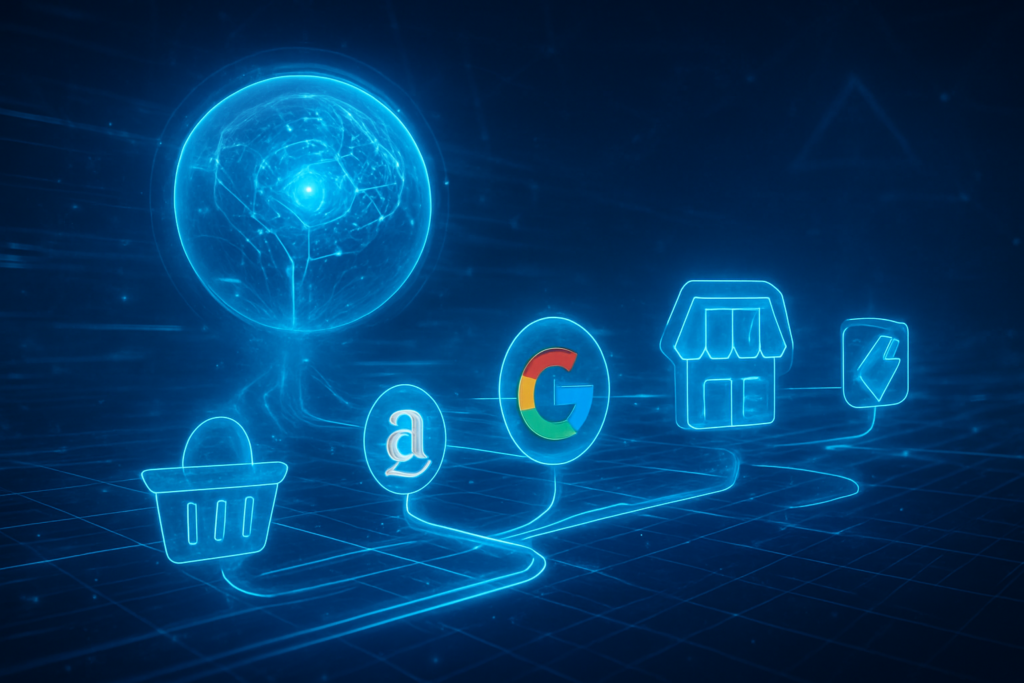
In a landmark announcement at the National Retail Federation (NRF) conference on January 11, 2026, Alphabet Inc. (NASDAQ: GOOGL) officially launched the Universal Commerce Protocol (UCP), an open-source standard designed to enable AI agents to execute autonomous purchases across the web. Developed in collaboration with retail powerhouses like Shopify Inc. (NYSE: SHOP) and Walmart Inc. (NYSE: WMT), UCP acts as a "common language" for commerce, allowing AI assistants to move beyond simple product recommendations to managing the entire transaction lifecycle—from discovery and price negotiation to secure checkout and delivery coordination.
The significance of this development cannot be overstated, as it marks the definitive transition from "search-based" e-commerce to "agentic commerce." For decades, online shopping has relied on human users navigating fragmented websites, manually filling carts, and entering payment data. With UCP, an AI agent—whether it is Google’s Gemini, a specialized brand assistant, or an autonomous personal shopper—can now "talk" directly to a merchant’s backend, understanding real-time inventory levels, applying loyalty discounts, and finalizing orders without the user ever having to visit a traditional storefront.
The Technical Architecture of Autonomous Buying
At its core, UCP is a decentralized, "transport-agnostic" protocol published under the Apache 2.0 license. Unlike previous attempts at standardized shopping, UCP does not require a central marketplace. Instead, it utilizes a "server-selects" model for capability negotiation. When an AI agent initiates a commerce request, it queries a merchant’s standardized endpoint (typically located at /.well-known/ucp). The merchant’s server then "advertises" its capabilities—such as support for guest checkout, subscription management, or same-day delivery via the "Trust Triangle" framework. This intersection algorithm ensures that the agent and the retailer can synchronize their features instantly, regardless of the underlying platform.
Security is handled through a sophisticated cryptographic "Trust Triangle" involving the User (the holder), the Business (the verifier), and the Payment Credential Provider (the issuer). Rather than handing over raw credit card details to an AI agent, users authorize a "mandate" via the Agent Payments Protocol (AP2). This mandate grants the agent a temporary, tokenized digital key to act within specific constraints, such as a $200 spending limit. This architecture ensures that even if an AI agent is compromised, the user’s primary financial data remains secure within a "Credential Provider" like Google Wallet or Apple Pay, which is managed by Apple Inc. (NASDAQ: AAPL).
Industry experts have compared the launch of UCP to the introduction of HTTP in the early 1990s. "We are moving from an N×N problem to a 1×N solution," noted one lead developer on the project. Previously, five different AI agents would have needed thousands of bespoke integrations to work with a thousand different retailers. UCP collapses that complexity into a single interoperable standard, allowing any compliant agent to shop at any compliant store. This is bolstered by the protocol's compatibility with the Model Context Protocol (MCP), which allows AI models to call these commercial tools as native functions within their reasoning chains.
Initial reactions from the AI research community have been largely positive, though some caution remains regarding the "agentic gap." While the technical pipes are now in place, researchers at firms like Gartner and Forrester point out that consumer trust remains a hurdle. Gartner predicts that while 2026 is the "inaugural year" of this technology, it may take until 2027 for multi-agent frameworks to handle the majority of end-to-end retail functions. Early testers have praised the protocol's ability to handle complex "multi-stop" shopping trips—for instance, an agent buying a specific brand of organic flour from Walmart and a niche sourdough starter from a Shopify-powered boutique in a single voice command.
A New Competitive Landscape for Retail Giants
The rollout of UCP creates a powerful counter-weight to the "walled garden" model perfected by Amazon.com, Inc. (NASDAQ: AMZN). While Amazon has dominated e-commerce by controlling the entire stack—from search to logistics—UCP empowers "open web" retailers to fight back. By adopting the protocol, a small merchant on Shopify can now be just as accessible to a Gemini-powered agent as a massive wholesaler. This allows retailers to remain the "Merchant of Record," retaining their direct customer relationships, branding, and data, rather than ceding that control to a third-party marketplace.
For tech giants, the strategic advantages are clear. Google is positioning itself as the primary gateway for the next generation of intent-based traffic. By hosting the protocol and integrating it deeply into the Gemini app and Google Search's "AI Mode," the company aims to become the "operating system" for commerce. Meanwhile, Shopify has already integrated UCP into its core infrastructure, launching a new "Agentic Plan" that allows even non-Shopify brands to list their products in a UCP-compliant catalog, effectively turning Shopify into a massive, agent-friendly database.
The competitive pressure is most visible in the partnership between Walmart and Google. By linking Walmart+ accounts directly to Gemini via UCP, users can now receive personalized recommendations based on their entire omnichannel purchase history. If a user tells Gemini, "I need the usual groceries delivered in two hours," the agent uses UCP to check Walmart's local inventory, apply the user's membership benefits, and trigger a same-day delivery—all within a chat interface. This seamlessness directly challenges Amazon’s "Buy with Prime" by offering a similarly frictionless experience across a much broader array of independent retailers.
However, the protocol also raises significant antitrust questions. Regulators in the EU and the US are already scrutinizing whether Google’s role as both the protocol’s architect and a major agent provider creates an unfair advantage. There are concerns that Google could prioritize UCP-compliant merchants in search results or use the data gathered from agent interactions to engage in sophisticated price discrimination. As AI agents begin to negotiate prices on behalf of users, the traditional concept of a "list price" may vanish, replaced by a dynamic, agent-to-agent bidding environment.
The Broader Significance: From Web to World
UCP represents a fundamental shift in the AI landscape, moving large language models (LLMs) from being "knowledge engines" to "action engines." This milestone is comparable to the release of the first mobile App Store; it provides the infrastructure for a whole new class of applications. The move toward agentic commerce suggests that the primary way humans interact with the internet is shifting from "browsing" to "delegating." In this new paradigm, the quality of a retailer’s API and its UCP compliance may become more important than the aesthetic design of its website.
The impact on consumer behavior could be profound. With autonomous agents handling the drudgery of price comparison and checkout, "cart abandonment"—a trillion-dollar problem in e-commerce—could be virtually eliminated. However, this raises concerns about impulsive or unauthorized spending. The "Trust Triangle" and the use of verifiable credentials are intended to mitigate these risks, but the social impact of removing the "friction" from spending money remains a topic of intense debate among behavioral economists.
Furthermore, UCP's introduction highlights a growing trend of "Model-to-Model" (M2M) interaction. We are entering an era where a user’s AI agent might negotiate with a merchant’s AI agent to find the best possible deal. This "Agent2Agent" (A2A) communication is a core component of the UCP roadmap, envisioning a world where software handles the complexities of supply and demand in real-time, leaving humans to simply set the high-level goals.
The Road Ahead: Global Rollout and Challenges
In the near term, the industry can expect a rapid expansion of UCP capabilities. Phase 1, which launched this month, focuses on native checkout within the U.S. market. By late 2026, Google and its partners plan to roll out Phase 2, which will include international expansion into markets like India and Brazil, as well as the integration of post-purchase support. This means AI agents will soon be able to autonomously track packages, initiate returns, and resolve customer service disputes using the same standardized protocol.
One of the primary challenges moving forward will be the standardization of "Product Knowledge." While UCP handles the transaction, the industry still lacks a universal way for agents to understand the nuanced attributes of every product (e.g., "Will this couch fit through my specific door frame?"). Future developments are expected to focus on "Spatial Commerce" and more advanced "Reasoning APIs" that allow agents to query a product’s physical dimensions and compatibility with a user’s existing environment before making a purchase.
Experts also predict the rise of "Vertical Agents"—AI shoppers specialized in specific categories like high-end fashion, hardware, or groceries. These agents will leverage UCP to scan the entire web for the best value while providing expert-level advice. As these specialized agents proliferate, the race will be on for retailers to ensure their backend systems are "agent-ready," moving away from legacy databases toward real-time, UCP-enabled inventories.
Summary of the New Commerce Era
The launch of the Universal Commerce Protocol is a defining moment in the history of artificial intelligence. By standardizing the way AI agents interact with the global retail ecosystem, Google and its partners have laid the tracks for a multi-trillion-dollar agentic economy. The key takeaways from this announcement are the move toward decentralized, open standards, the empowerment of independent retailers against "walled gardens," and the introduction of "Trust Triangle" security to protect autonomous transactions.
As we look toward the coming months, the industry will be watching for the first wave of "Agent-First" shopping apps and the potential response from competitors like Amazon. The significance of UCP lies not just in its code, but in its ability to turn the dream of a "personal digital assistant" into a practical reality that can navigate the physical and commercial world on our behalf. For businesses and consumers alike, the era of "browsing" is ending; the era of "doing" has begun.
This content is intended for informational purposes only and represents analysis of current AI developments.
TokenRing AI delivers enterprise-grade solutions for multi-agent AI workflow orchestration, AI-powered development tools, and seamless remote collaboration platforms.
For more information, visit https://www.tokenring.ai/.