
Analog chips maker onsemi (NASDAQ: ON) met Wall Street’s revenue expectations in Q4 CY2025, but sales fell by 11.2% year on year to $1.53 billion. On the other hand, next quarter’s revenue guidance of $1.49 billion was less impressive, coming in 1.4% below analysts’ estimates. Its non-GAAP profit of $0.64 per share was 2.5% above analysts’ consensus estimates.
Is now the time to buy onsemi? Find out by accessing our full research report, it’s free.
onsemi (ON) Q4 CY2025 Highlights:
- Revenue: $1.53 billion vs analyst estimates of $1.54 billion (11.2% year-on-year decline, in line)
- Adjusted EPS: $0.64 vs analyst estimates of $0.62 (2.5% beat)
- Revenue Guidance for Q1 CY2026 is $1.49 billion at the midpoint, below analyst estimates of $1.51 billion
- Adjusted EPS guidance for Q1 CY2026 is $0.47 at the midpoint, below analyst estimates of $0.61
- Operating Margin: 13.1%, down from 23.7% in the same quarter last year
- Free Cash Flow Margin: 31.7%, up from 24.5% in the same quarter last year
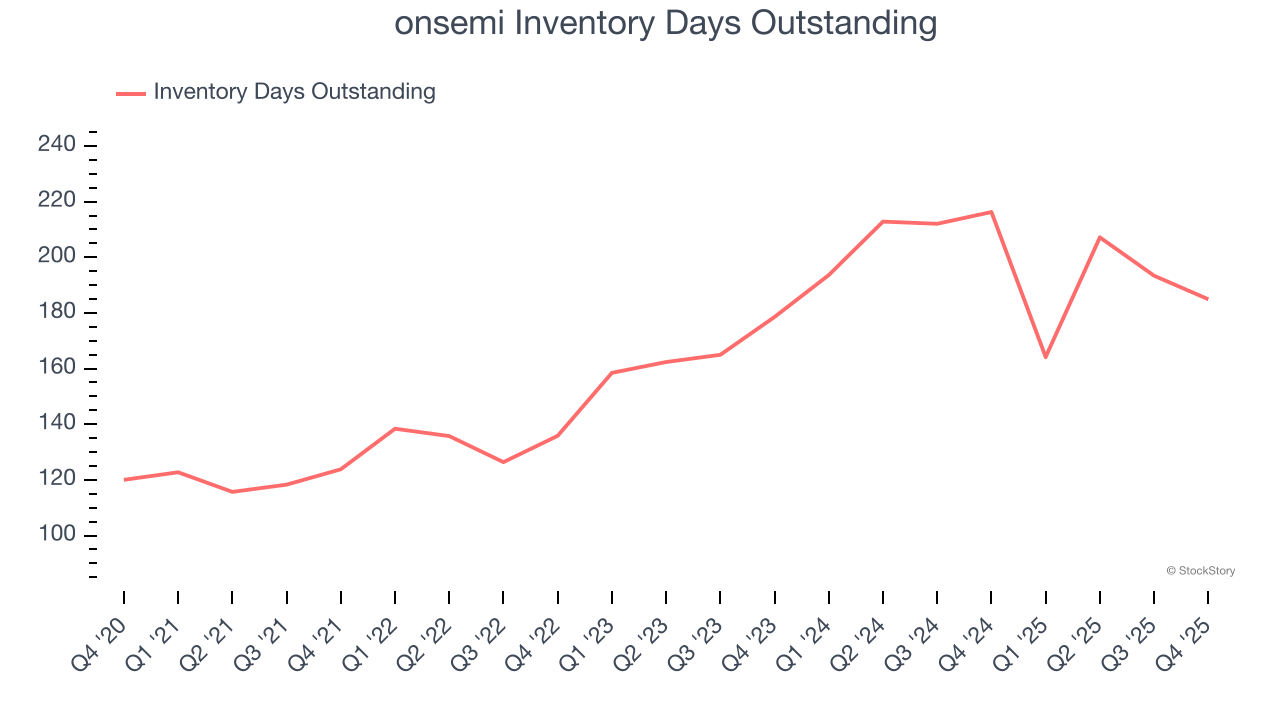
- Inventory Days Outstanding: 185, down from 193 in the previous quarter
- Market Capitalization: $26.24 billion
“We remained disciplined in our execution and met expectations in the fourth quarter as we saw increasing signs of stabilization in our key markets,” said Hassane El-Khoury, President and CEO, onsemi.
Company Overview
Spun out of Motorola in 1999 and built through a series of acquisitions, onsemi (NASDAQ: ON) is a global provider of analog chips specializing in autos, industrial applications, and power management in cloud data centers.
Revenue Growth
A company’s long-term performance is an indicator of its overall quality. Any business can put up a good quarter or two, but the best consistently grow over the long haul. Over the last five years, onsemi grew its sales at a tepid 2.7% compounded annual growth rate. This was below our standards and is a poor baseline for our analysis. Semiconductors are a cyclical industry, and long-term investors should be prepared for periods of high growth followed by periods of revenue contractions.
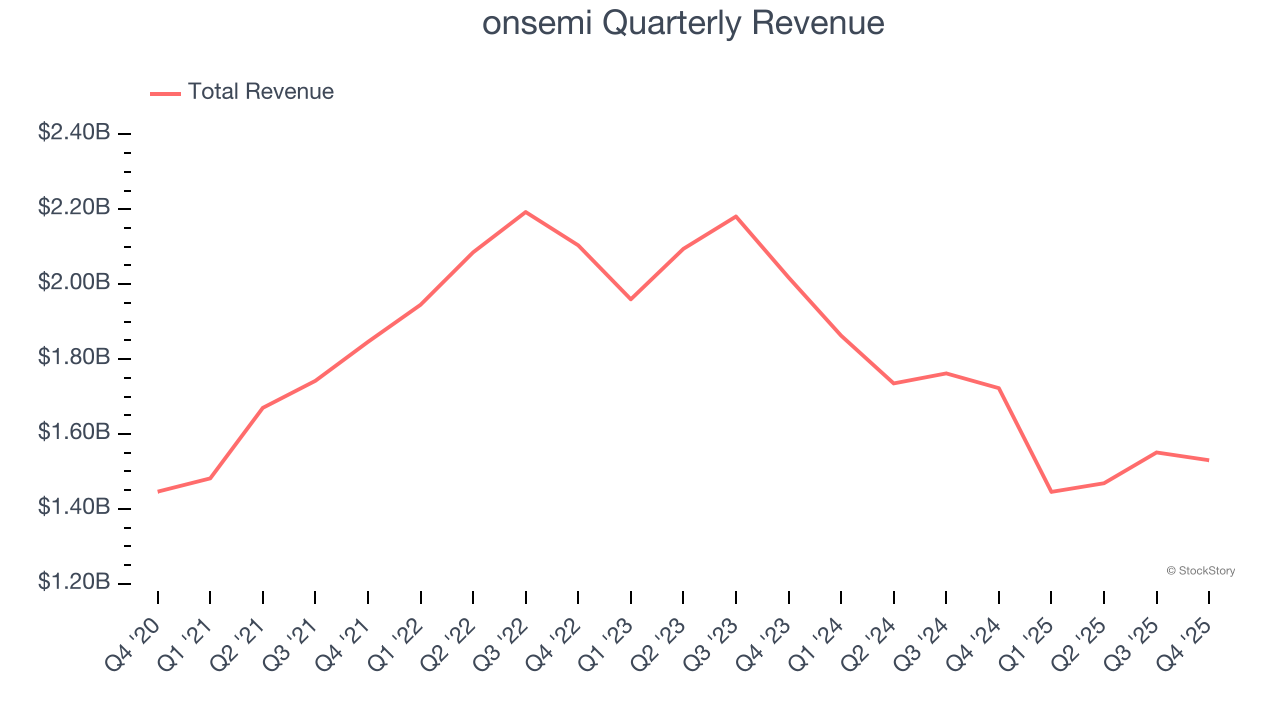
We at StockStory place the most emphasis on long-term growth, but within semiconductors, a half-decade historical view may miss new demand cycles or industry trends like AI. onsemi’s performance shows it grew in the past but relinquished its gains over the last two years, as its revenue fell by 14.8% annually. 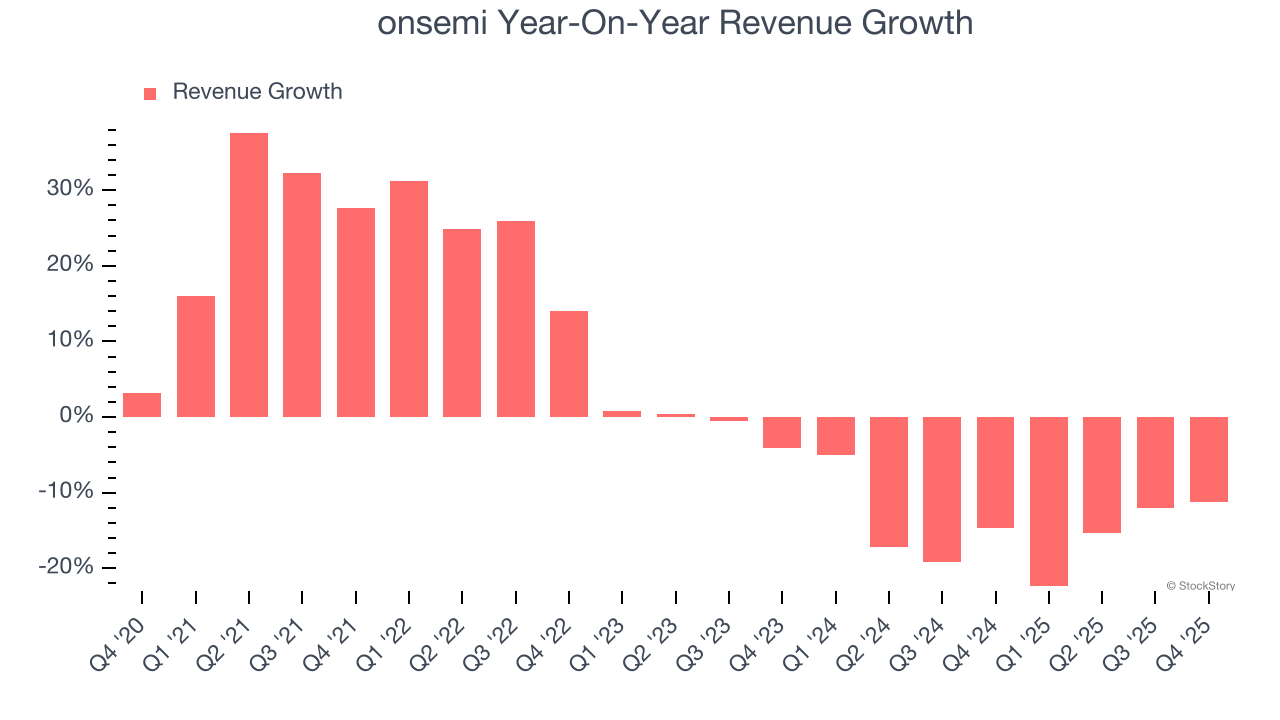
This quarter, onsemi reported a rather uninspiring 11.2% year-on-year revenue decline to $1.53 billion of revenue, in line with Wall Street’s estimates. Despite meeting estimates, the drop in sales could mean that the current downcycle is deepening. Company management is currently guiding for a 2.7% year-on-year increase in sales next quarter.
Looking further ahead, sell-side analysts expect revenue to grow 5.5% over the next 12 months. While this projection indicates its newer products and services will spur better top-line performance, it is still below the sector average.
The 1999 book Gorilla Game predicted Microsoft and Apple would dominate tech before it happened. Its thesis? Identify the platform winners early. Today, enterprise software companies embedding generative AI are becoming the new gorillas. a profitable, fast-growing enterprise software stock that is already riding the automation wave and looking to catch the generative AI next.
Product Demand & Outstanding Inventory
Days Inventory Outstanding (DIO) is an important metric for chipmakers, as it reflects a business’ capital intensity and the cyclical nature of semiconductor supply and demand. In a tight supply environment, inventories tend to be stable, allowing chipmakers to exert pricing power. Steadily increasing DIO can be a warning sign that demand is weak, and if inventories continue to rise, the company may have to downsize production.
This quarter, onsemi’s DIO came in at 185, which is 22 days above its five-year average. These numbers suggest that despite the recent decrease, the company’s inventory levels are higher than what we’ve seen in the past.
Key Takeaways from onsemi’s Q4 Results
A highlight during the quarter was onsemi’s improvement in inventory levels. We were also glad its EPS outperformed Wall Street’s estimates. On the other hand, its revenue guidance for next quarter slightly missed and its revenue was in line with Wall Street’s estimates. Overall, this was a weaker quarter. The stock traded down 4.6% to $62.23 immediately after reporting.
onsemi’s earnings report left more to be desired. Let’s look forward to see if this quarter has created an opportunity to buy the stock. If you’re making that decision, you should consider the bigger picture of valuation, business qualities, as well as the latest earnings. We cover that in our actionable full research report which you can read here (it’s free).