Since July 2025, Boeing has been in a holding pattern, posting a small return of 4.4% while floating around $218.84. The stock also fell short of the S&P 500’s 11.3% gain during that period.
Is now the time to buy Boeing, or should you be careful about including it in your portfolio? Dive into our full research report to see our analyst team’s opinion, it’s free for active Edge members.
Why Do We Think Boeing Will Underperform?
We're swiping left on Boeing for now. Here are three reasons you should be careful with BA and a stock we'd rather own.
1. Weak Sales Volumes Indicate Waning Demand
Revenue growth can be broken down into changes in price and volume (the number of units sold). While both are important, volume is the lifeblood of a successful Aerospace company because there’s a ceiling to what customers will pay.
Boeing’s units sold came in at 160 in the latest quarter, and over the last two years, averaged 4.9% year-on-year growth. This performance was underwhelming and suggests it might have to lower prices or invest in product improvements to accelerate growth, factors that can hinder near-term profitability. 
2. Cash Burn Ignites Concerns
If you’ve followed StockStory for a while, you know we emphasize free cash flow. Why, you ask? We believe that in the end, cash is king, and you can’t use accounting profits to pay the bills.
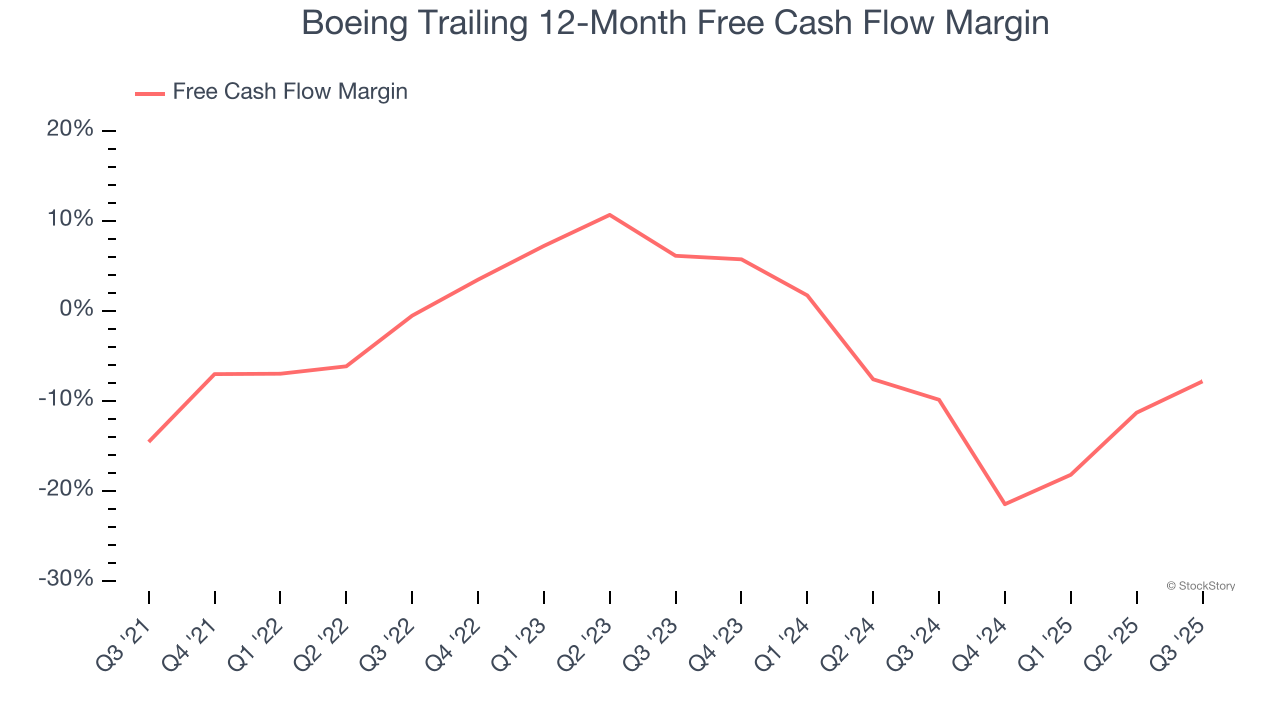
While Boeing posted positive free cash flow this quarter, the broader story hasn’t been so clean. Boeing’s demanding reinvestments have drained its resources over the last five years, putting it in a pinch and limiting its ability to return capital to investors. Its free cash flow margin averaged negative 5.2%, meaning it lit $5.23 of cash on fire for every $100 in revenue.
3. Restricted Access to Capital Increases Risk
As long-term investors, the risk we care about most is the permanent loss of capital, which can happen when a company goes bankrupt or raises money from a disadvantaged position. This is separate from short-term stock price volatility, something we are much less bothered by.
Boeing posted negative $7.40 billion of EBITDA over the last 12 months, and its $53.88 billion of debt exceeds the $22.98 billion of cash on its balance sheet. This is a deal breaker for us because indebted loss-making companies spell trouble.
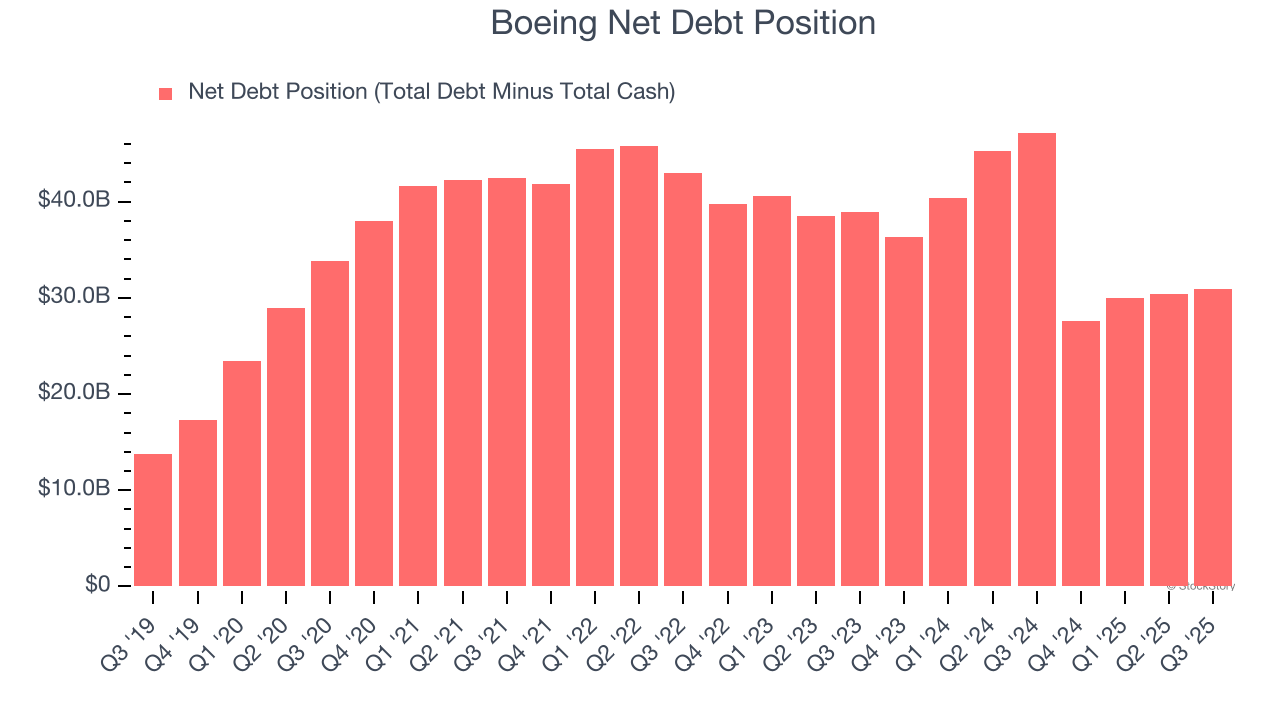
We implore our readers to tread carefully because credit agencies could downgrade Boeing if its unprofitable ways continue, making incremental borrowing more expensive and restricting growth prospects. The company could also be backed into a corner if the market turns unexpectedly. We hope Boeing can improve its profitability and remain cautious until then.
Final Judgment
Boeing falls short of our quality standards. With its shares trailing the market in recent months, the stock trades at 278.1× forward P/E (or $218.84 per share). This valuation tells us it’s a bit of a market darling with a lot of good news priced in - we think other companies feature superior fundamentals at the moment. We’d suggest looking at the most dominant software business in the world.
High-Quality Stocks for All Market Conditions
The market’s up big this year - but there’s a catch. Just 4 stocks account for half the S&P 500’s entire gain. That kind of concentration makes investors nervous, and for good reason. While everyone piles into the same crowded names, smart investors are hunting quality where no one’s looking - and paying a fraction of the price. Check out the high-quality names we’ve flagged in our Top 6 Stocks for this week. This is a curated list of our High Quality stocks that have generated a market-beating return of 244% over the last five years (as of June 30, 2025).
Stocks that have made our list include now familiar names such as Nvidia (+1,326% between June 2020 and June 2025) as well as under-the-radar businesses like the once-micro-cap company Tecnoglass (+1,754% five-year return). Find your next big winner with StockStory today.