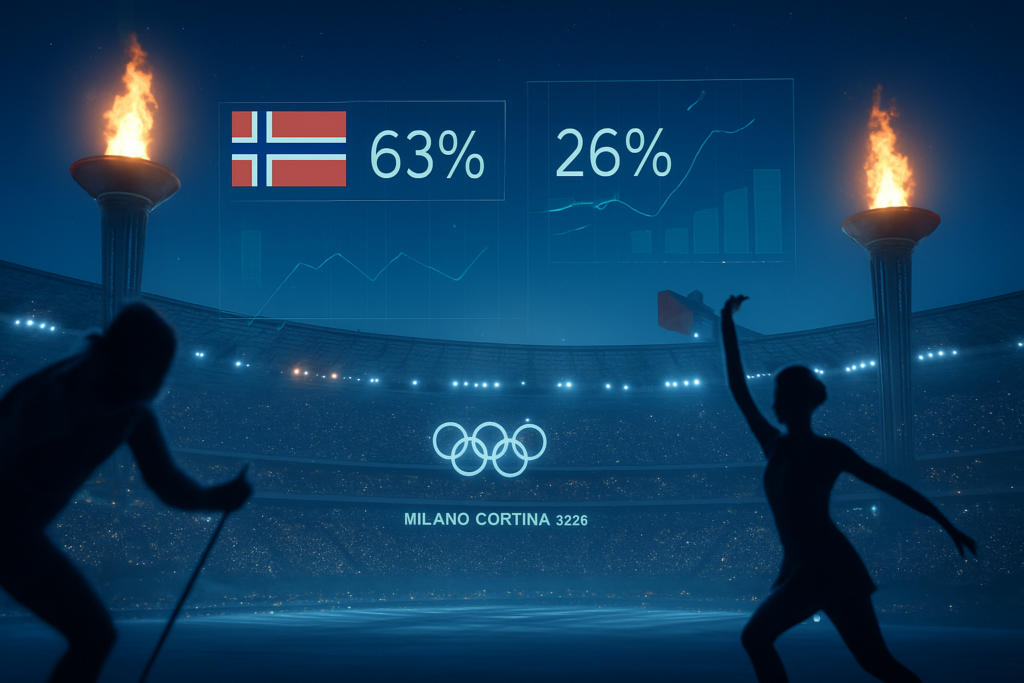
As the ceremonial fires of the XXV Olympic Winter Games flicker in the dual host cities of Milan and Cortina d'Ampezzo, the world’s attention has shifted from the spectacle of the opening ceremony to the high-stakes reality of the podium. On the world’s leading prediction platform, Polymarket, a clear consensus has emerged: Norway is the overwhelming favorite to lead the 2026 Winter Olympics in total gold medals, commanding a 63% probability of victory.
Team USA, currently sitting at 26% odds, trails significantly despite a roster packed with high-profile stars. The market reflects a deep-seated belief in Norwegian dominance in the "snow sports" that define the first half of the Games. With the first medals being awarded this weekend, the "Most Gold Medals" market is seeing its highest trading volume of the year, as speculators bet on whether American technical specialists can overcome the sheer depth of the Norwegian cross-country and biathlon machines.
The Market: What's Being Predicted
The primary market in focus is the "Most Gold Medals – 2026 Winter Olympics" contract on Polymarket. This "winner-take-all" market asks participants to predict which country will secure the highest number of gold medals by the closing ceremony on February 22, 2026. While the International Olympic Committee (IOC) does not officially recognize a "winning country," the gold medal count is the de facto scoreboard for international prestige.
At the current 63% mark, shares for Norway are trading at roughly $0.63, while the United States sits at $0.26. Trailing behind are Germany at 9% and Canada at a distant 2%. The liquidity in this market has surged since the torch was lit at San Siro Stadium yesterday, with millions of dollars in volume already recorded. The market resolution is tied to the official final medal standings published by the IOC, meaning any late-stage disqualifications or administrative shifts could potentially affect the outcome, though the market typically settles shortly after the final event—usually the Men’s Ice Hockey final.
Why Traders Are Betting
The 63% confidence in Norway isn't just a hunch; it’s backed by a historical track record that bordering on the invincible. Norway set an all-time record at the 2022 Beijing Games with 16 gold medals, and traders believe they are poised to repeat or exceed that performance in Italy. Norway's strength is concentrated in disciplines with multiple medal opportunities: Biathlon and Cross-Country Skiing. With legends like Johannes Thingnes Bø and Johannes Høsflot Klæbo still at the peak of their powers, Norway has a high floor for gold medals that few other nations can match.
Conversely, the 26% odds for the United States represent a "quality over quantity" gamble. American hopes are pinned on individual dominance in specialized events. Figure skater Ilia Malinin, known as the "God of the Quad," is a heavy favorite for gold, as is speed skater Jordan Stolz, who is eyeing a historic multi-medal haul. However, prediction market traders are skeptical that these individual brilliances can match the sheer volume of gold that Norway typically harvests from the biathlon trails.
Recent activity on Polymarket suggests that "whales"—large-scale traders—are hedging their bets on the USA following the return of NHL players to the Men's Ice Hockey competition. The inclusion of professional stars has made the USA a co-favorite in hockey, a high-prestige gold that could be the tiebreaker in a close race.
Broader Context and Implications
This market highlights the evolving role of prediction markets in sports. Unlike traditional sportsbooks that offer odds on individual games, platforms like Polymarket provide a macro-view of national performance, effectively acting as a real-time sentiment gauge for the "soft power" race of the Olympics. This has significant implications for sponsors and broadcasters. Comcast Corporation (NASDAQ: CMCSA), the parent company of NBCUniversal, is airing over 3,000 hours of coverage, and their advertising rates are often influenced by the perceived success of the home team.
Furthermore, the "Olympic Large Model" AI infrastructure provided by Alibaba Group Holding Limited (NYSE: BABA) is being used to track athlete performance more granularly than ever before. Traders are increasingly using these data points to find "value" in the market. Major sponsors like Nike, Inc. (NYSE: NKE), Visa Inc. (NYSE: V), and The Coca-Cola Company (NYSE: KO) also have a vested interest in these probabilities, as a "gold rush" for Team USA significantly boosts the marketing value of their sponsored athletes.
From a regulatory standpoint, the 2026 Games represent a turning point. Prediction markets have faced scrutiny in the past, but their accuracy—often outperforming traditional sports analysts—is making them an indispensable tool for understanding the likely trajectory of global events.
What to Watch Next
The next 48 hours are critical for the market’s stability. If Norway sweeps the early Biathlon and Cross-Country events as expected, their odds could climb toward the 75-80% range, effectively pricing out most competitors. However, the Men’s Downhill in Alpine Skiing and the early rounds of the Snowboard Big Air events offer the USA an opportunity to "steal" golds that could narrow the gap.
Key dates to watch include the Figure Skating finals in the second week and the Speed Skating events at the Fiera di Milano. If Jordan Stolz manages to capture three or more individual golds, the USA’s 26% odds will look like a massive bargain in hindsight. Conversely, if Norway’s "sliding" athletes perform well in the Bobsled and Luge events in Cortina—sports traditionally dominated by Germany—the race for the top spot could be over before the final weekend.
Bottom Line
The 2026 Winter Olympics gold medal race is currently Norway’s to lose. The 63% to 26% split on Polymarket reflects a market that respects Norway’s systemic advantages in high-medal-count winter disciplines. While Team USA possesses individual "superstars" capable of securing individual golds, they lack the broad-spectrum dominance across the snow disciplines that Norway has cultivated for decades.
For prediction market enthusiasts, this market serves as a fascinating case study in "volume vs. volatility." Norway represents the steady, high-volume producer, while the USA represents the volatile, high-upside challenger. As the Games progress through the mountains of Northern Italy, every pole plant and skate stride will be reflected in the fluctuating cents of the Polymarket contract. For now, the "Frozen Gold" belongs to the Norsemen.
This article is for informational purposes only and does not constitute financial or betting advice. Prediction market participation may be subject to legal restrictions in your jurisdiction.
PredictStreet focuses on covering the latest developments in prediction markets.
Visit the PredictStreet website at https://www.predictstreet.ai/.