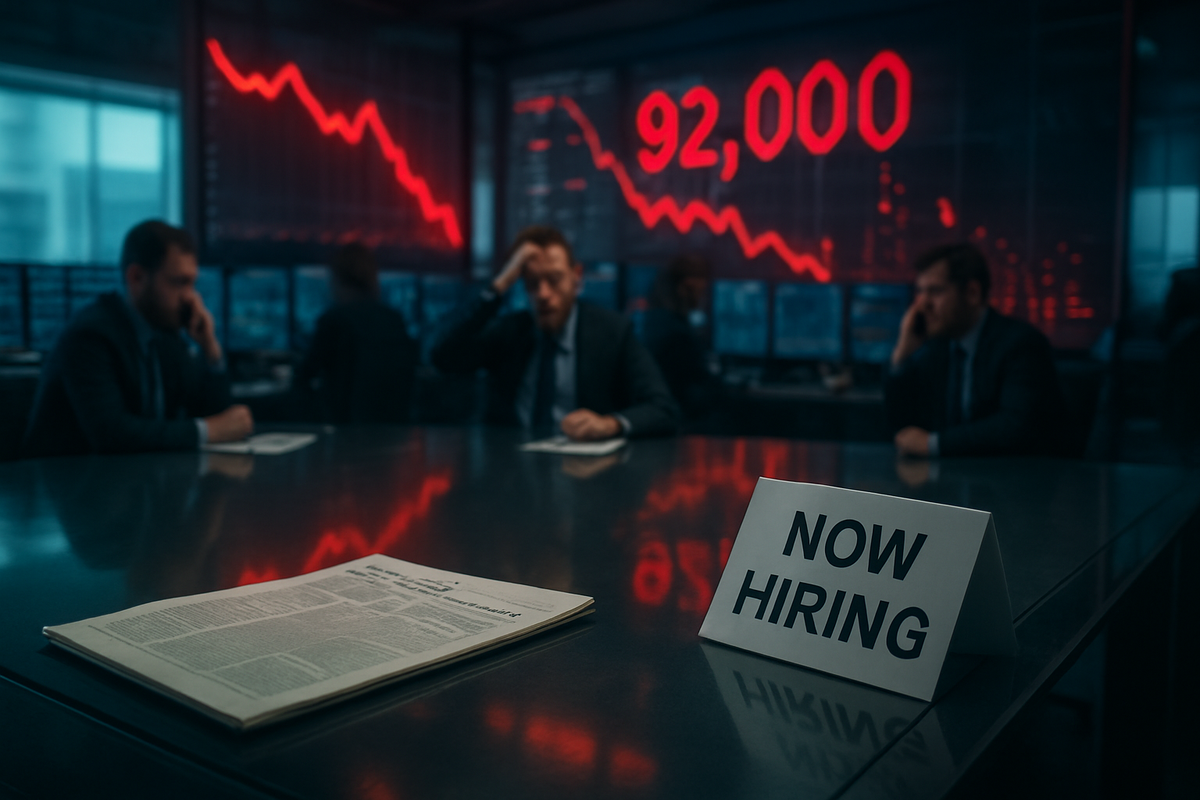
The United States labor market sent a seismic shock through global financial centers this morning as the Bureau of Labor Statistics (BLS) reported a staggering loss of 92,000 jobs for February 2026. Compounding the anxiety, the national unemployment rate climbed to 4.4%, a level not seen since the height of the post-pandemic recovery efforts. This unexpected contraction marks the most significant downturn in employment data since 2020, effectively shattering the "soft landing" narrative that many analysts had clung to despite a sluggish 2025.
The immediate implications are profound, as the data forces a radical repricing of risk across the S&P 500 (NYSEARCA:SPY) and the bond market. Yields on the 10-year Treasury note plummeted following the release, as investors aggressively bet that the Federal Reserve will be forced to abandon its "cautious easing" stance in favor of emergency liquidity measures. With the economy already reeling from a lackluster 2025 GDP growth rate of just 2.2%, the specter of a formal recession has transitioned from a distant tail risk to a front-and-center reality for Wall Street.
A Brutal Cold Snap for the American Worker
The February payroll report, released on Friday and fully digested by the markets this Monday, March 9, 2026, caught nearly every major brokerage by surprise. Consensus estimates had penciled in a modest gain of 110,000 jobs; the swing to a 92,000-job loss represents a massive statistical miss. The decline was broad-based, with significant hemorrhaging in the manufacturing and construction sectors—industries that were already struggling under the weight of the 2025 "Tariff Shocks" and the lingering effects of the 43-day government shutdown late last year.
The timeline leading to this moment is one of mounting pressure. Throughout 2025, the economy buckled under a restrictive Federal Funds Rate and a slowdown in consumer spending. Despite the "One Big Beautiful Bill Act" signed in mid-2025, which aimed to spur infrastructure, the lag in fiscal policy has proven unable to counteract a cooling private sector. Key stakeholders, including Federal Reserve Chair Jerome Powell, now face a pivotal moment. Only weeks ago, during the January FOMC meeting, the Fed signaled a "hawkish hold," maintaining rates in the 3.50%–3.75% range. Today, that stance appears dangerously out of sync with the rapidly deteriorating labor reality.
Initial market reactions were swift and unforgiving. The Dow Jones Industrial Average (INDEXDJX:.DJI) saw an immediate opening drop of over 600 points this morning as traders scrambled to adjust their models. Goldman Sachs Group Inc. (NYSE: GS) and other major investment banks quickly revised their 2026 GDP forecasts downward, with some now predicting a period of "jobless growth" or a "technical recession" in the first half of the year.
Corporate America in the Crosshairs: Winners and Losers
The fallout from the February jobs report has created a stark divide in corporate performance. Traditional banking giants like JPMorgan Chase & Co. (NYSE: JPM) and Bank of America Corp. (NYSE: BAC) are facing dual pressures: the prospect of lower interest rates squeezing net interest margins and a rising unemployment rate increasing the risk of credit defaults. If 4.4% unemployment persists, the provision for credit losses is expected to spike, weighing heavily on their Q1 2026 earnings reports.
Conversely, the technology sector is seeing a polarized response. Heavyweights like NVIDIA Corp. (NASDAQ: NVDA) and Microsoft Corp. (NASDAQ: MSFT) initially dipped on growth concerns but found some support as Treasury yields fell. The logic for some investors is that a weaker economy will force the Fed to cut rates aggressively, which historically benefits high-valuation tech stocks by lowering the discount rate on future earnings. However, consumer-facing tech like Apple Inc. (NASDAQ: AAPL) and Amazon.com Inc. (NASDAQ: AMZN) remains under pressure as a 4.4% unemployment rate threatens the discretionary spending that fuels their ecosystems.
Retailers are perhaps the most vulnerable to this data. Walmart Inc. (NYSE: WMT) and Target Corp. (NYSE: TGT) are already reporting signs of "shopper fatigue," and a shrinking workforce suggests that the robust consumer spending of the early 2020s may finally be exhausting itself. If the labor market does not stabilize by the spring, these companies could face significant inventory gluts and forced discounting, further eroding margins in an already difficult 2.2% growth environment.
The End of the Post-Pandemic Era
This labor shock marks a significant turning point in the broader economic cycle. Since 2020, the U.S. labor market has been characterized by its resilience, often defying high interest rates and global supply chain disruptions. The loss of 92,000 jobs suggests that the "buffer" of the post-pandemic labor shortage has finally evaporated. This event mirrors the historical precedent of the "late-cycle" shifts seen in the early 2000s and late 2007, where labor data served as the final, lagging indicator that a recession had already begun.
The policy implications are immense. The Federal Reserve's dual mandate—stable prices and maximum employment—is now lopsided. With inflation showing signs of stabilization near 2.5%, the "employment" side of the mandate is flashing a bright red warning light. Critics of the Fed are already arguing that the central bank waited too long to pivot, repeating the mistakes of previous cycles where they stayed "too high for too long."
Furthermore, the ripple effects are likely to extend to America’s trading partners. A cooling U.S. economy typically leads to a stronger dollar in a "flight to safety" initially, followed by a decline in global demand. Major exporters in Europe and Asia will be watching the March FOMC meeting with bated breath, as the health of the American consumer remains the primary engine for the global economy.
The Road to the March FOMC: What Comes Next?
In the short term, all eyes are on the Federal Reserve’s next move on March 18. Market participants are no longer asking if the Fed will cut rates, but by how much. Before this report, a 25-basis-point cut was the consensus; now, the CME FedWatch Tool is pricing in a 70% probability of a "jumbo" 50-basis-point cut. This would represent a strategic pivot, signaling that the Fed is moving into "emergency mode" to prevent a deeper contraction.
Long-term, corporations will likely shift their strategies from expansion to preservation. We may see a wave of "efficiency-focused" restructuring, as companies that over-hired during the AI hype of 2024 and 2025 look to trim payrolls further to protect their bottom lines. This could create a feedback loop where job losses lead to lower spending, which in turn leads to more job losses—the classic recessionary spiral.
However, a potential silver lining exists for investors. If the Fed successfully "front-loads" rate cuts and the 2.2% GDP growth from 2025 proves to be a durable floor rather than a ceiling, the market could see a significant "relief rally" by mid-2026. Opportunities may emerge in defensive sectors such as healthcare and utilities, which historically outperform during periods of economic cooling.
Summary and Investor Outlook
The February payroll report is a sobering reminder that the transition from a high-inflation environment to a stable one is rarely a smooth journey. The loss of 92,000 jobs and the jump to 4.4% unemployment are clear signals that the U.S. economy is at its most fragile state in over five years. When combined with the tepid 2.2% GDP growth seen throughout 2025, the narrative of "American exceptionalism" is being put to its ultimate test.
For investors, the coming months will require a defensive posture. Volatility is likely to remain elevated as the market grapples with every new piece of economic data, searching for signs of a bottom. The key takeaway is that the "Goldilocks" era of high growth and low unemployment has ended.
What to watch for:
- The March FOMC Statement: Look for a shift in language from "inflation concerns" to "labor market risks."
- Initial Jobless Claims: Weekly data will now be the most critical "heartbeat" monitor for the economy.
- Corporate Guidance: During the upcoming Q1 earnings season, listen for how CEOs are adjusting their hiring and capital expenditure plans in light of the February shock.
This content is intended for informational purposes only and is not financial advice.