NEW YORK — The era of unchecked artificial intelligence optimism met a jarring reality check this week as President Donald Trump signaled that "Operation Epic Fury"—initially framed as a surgical strike against Iranian interests—is evolving into a protracted military engagement. The shift in rhetoric has sent shockwaves through global markets, triggering a massive "risk-off" rotation that saw the Dow Jones Industrial Average (DJI) endure one of its most volatile sessions in recent memory.
As of March 4, 2026, the market narrative has pivoted sharply from the "boundless growth" of silicon and software to the "tangible reliability" of heavy industry and energy. The sudden return of macro volatility has effectively ended the "AI honeymoon" period that dominated the first two months of the year, leaving high-growth tech names vulnerable to a fundamental reassessment of value in a wartime economy.
A 1,200-Point Intraday Slide: The Reality of 'Operation Epic Fury'
The market's descent began in earnest on Monday, March 2, when President Trump shifted his messaging during a televised address. Moving away from earlier promises of a swift resolution, the President warned that military operations, conducted alongside Israeli forces, could last "much longer" than the originally projected four-to-five-week window. By the morning of March 3, a viral social media post from the President claiming that U.S. munitions stockpiles were "virtually unlimited" and that wars can be fought "forever" if necessary served as the catalyst for a broad-based sell-off.
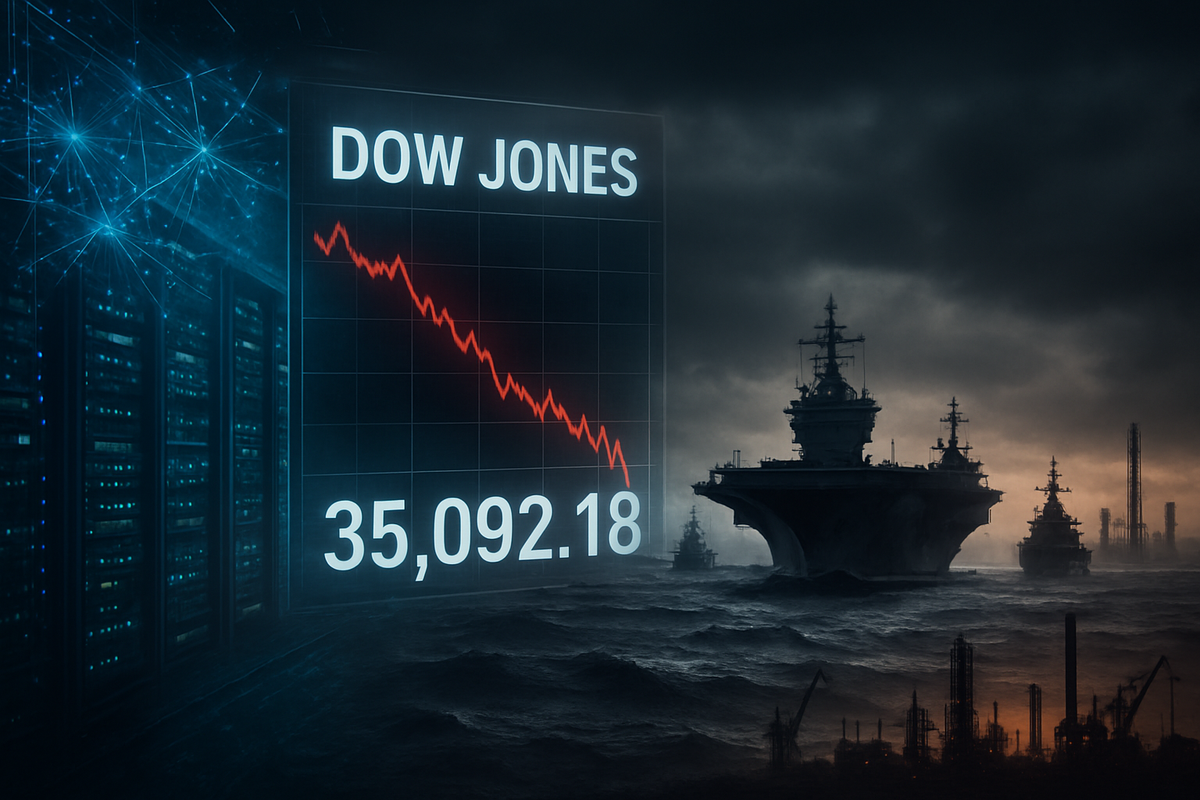
The Dow Jones Industrial Average experienced a "flash" tumble during Tuesday’s session, plummeting more than 1,200 points intraday. This marked the index's largest point drop since the trade-related "Liberation Day" volatility of April 2025. While the index pared some losses to close down 404 points (0.8%) at 48,501, the underlying damage to investor sentiment was clear. The CBOE Volatility Index (VIX), often called the market's "fear gauge," surged 23% to hit 27.30, its highest level in nearly a year.
The timeline of escalation has been rapid. Following a series of naval provocations in the Persian Gulf in late February, the U.S. launched "Operation Epic Fury" on February 28, initially targeting Iranian drone facilities. However, by March 3, the administration’s focus shifted toward an open-ended goal of neutralizing Iran’s nuclear and long-range missile capabilities, a move that analysts say could keep the U.S. military engaged in the region for the foreseeable future.
Winners and Losers: The Birth of the 'HALO' Trade
The geopolitical shift has forced a massive de-risking of portfolios, giving rise to what Wall Street is now calling the HALO trade—an acronym for Heavy Assets, Low Obsolescence. Investors are fleeing speculative tech and rotating aggressively into companies with physical infrastructure and essential services.
The Winners: Defense and Energy Majors Defense contractors have been the primary beneficiaries of the "extended conflict" outlook. Lockheed Martin (NYSE: LMT) and RTX Corporation (NYSE: RTX) both saw their shares climb as the prospect of multi-year contract backlogs for munitions and missile defense systems became a reality. BAE Systems (OTC:BAESY) similarly trended higher as European allies braced for regional instability. In the energy sector, ExxonMobil (NYSE: XOM) and Chevron (NYSE: CVX) surged as Brent crude oil prices breached the $82-a-barrel mark. The administration’s announcement that the U.S. Navy would begin escorting tankers through the Strait of Hormuz has added a layer of "political risk insurance" that has temporarily stabilized oil majors despite the broader market chaos.
The Losers: High-Growth Tech and AI Leaders Conversely, the "SaaSpocalypse" has arrived for the software sector. Nvidia (Nasdaq:NVDA), the poster child for the 2025 AI boom, saw a sharp pullback as concerns over energy security and supply chain stability in Asia eclipsed previous demand forecasts. Microsoft (Nasdaq:MSFT), Amazon (Nasdaq:AMZN), and Meta (Nasdaq:META)—collectively known as the "hyperscalers"—faced questions regarding their $600 billion in planned AI capital expenditures. Investors are now questioning if these massive investments can be sustained if war-driven inflation forces the Federal Reserve to keep interest rates higher for longer. Samsung (KRX:005930) also suffered, dropping over 11% in a single session as regional tensions threatened its semiconductor manufacturing hubs.
From AI Enthusiasm to Geopolitical Realism
The pivot in market sentiment is not merely a reaction to missiles and drones; it represents a fundamental shift in how the market values innovation versus stability. For the past 18 months, AI enthusiasm acted as a shield against macro concerns. However, the release of Anthropic’s "Claude Cowork" agentic AI platform in late February inadvertently exacerbated the tech sell-off. While the technology was a milestone, it sparked "seat compression" fears—the idea that AI agents could replace entire tiers of white-collar workers—leading to a $1.2 trillion vaporization in total software market value as investors feared a collapse in per-seat licensing revenue.
Historically, geopolitical shocks have often served as the "pin" that pops valuation bubbles. Similar to the "Nifty Fifty" era of the 1970s, where high-growth stocks were brought down by the 1973 oil crisis, the current "Magnificent" tech leaders are finding that even revolutionary technology cannot outrun the inflationary pressures of a global energy shock.
Furthermore, the prospect of oil staying above $80 a barrel has fundamentally altered the Federal Reserve's path. Earlier expectations for multiple rate cuts in 2026 are being scrapped in favor of a "higher for longer" stance to combat sticky inflation. This shift in the discount rate has forced a rapid compression of the lofty multiples previously enjoyed by AI-adjacent companies.
What Comes Next: Escorts, Embargoes, and Earnings
In the short term, the market will be hyper-focused on the Strait of Hormuz. The success of the U.S. Navy’s tanker escort program will determine whether oil prices stay at $80 or spike toward $120. Any disruption to maritime trade could trigger a secondary wave of selling in consumer discretionary stocks, as transportation costs feed directly into shelf prices.
Strategic pivots are already underway. High-growth tech companies are likely to shift their messaging from "growth at any cost" back to "operational efficiency" to appease a market that has suddenly lost its appetite for risk. We may see a slowdown in AI infrastructure spending as boards of directors prioritize cash preservation in an uncertain geopolitical environment.
Market opportunities may emerge in "unconventional safe havens." Gold has already surged past $5,296 an ounce, and "Hard Tech"—companies building the power grids, nuclear reactors, and physical infrastructure needed for both war and AI—may find a middle ground in the HALO trade.
Summary and Investor Outlook
The events of early March 2026 have marked a definitive end to the one-dimensional AI bull market. The return of macro volatility, spurred by the prospect of an extended U.S.-Iran conflict, has re-introduced the reality of geopolitical risk to a generation of investors who had grown accustomed to the "AI-will-fix-it" narrative.
Key Takeaways for Investors:
- The Rotation is Real: The shift from "bits" to "atoms" (the HALO trade) is likely to persist as long as the conflict remains "extended."
- Inflation is the Enemy: Watch the price of Brent crude. If energy stays elevated, the Fed's pivot to lower rates will remain on ice, keeping pressure on tech valuations.
- Defense is the New Growth: Contractors with established production lines for precision munitions are the current market leaders.
As we move forward, the "Prove It" phase of the market has begun. Investors are no longer buying the promise of a distant AI future; they are buying the reality of a complex and volatile present. Watching the resilience of the Dow and the stability of the energy supply chain will be the primary tasks for any market participant in the coming months.
This content is intended for informational purposes only and is not financial advice.