In a dramatic overnight escalation that has sent shockwaves through global financial capitals, U.S. naval forces launched a precision kinetic strike against Iranian maritime assets in the Persian Gulf. The operation, which resulted in the sinking of an Iranian Jamaran-class corvette and a Kilo-class diesel-electric submarine, marks a decisive shift from years of "shadow boxing" to a direct, high-stakes military confrontation. As the sun rose on March 4, 2026, the geopolitical landscape of the Middle East—and the stability of the world's most critical energy artery—entered its most volatile chapter in decades.
The immediate market reaction has been swift and unforgiving. Oil prices have surged to multi-year highs as the specter of a total blockade of the Strait of Hormuz looms, while global equities have retreated into a "risk-off" defensive crouch. With marine insurance premiums for the region reportedly skyrocketing forty-fold overnight, the economic implications of this military strike are rippling far beyond the Gulf, threatening to reignite inflationary pressures that central banks had only recently begun to tame.
Operation Epic Fury: The Night the Gulf Ignited
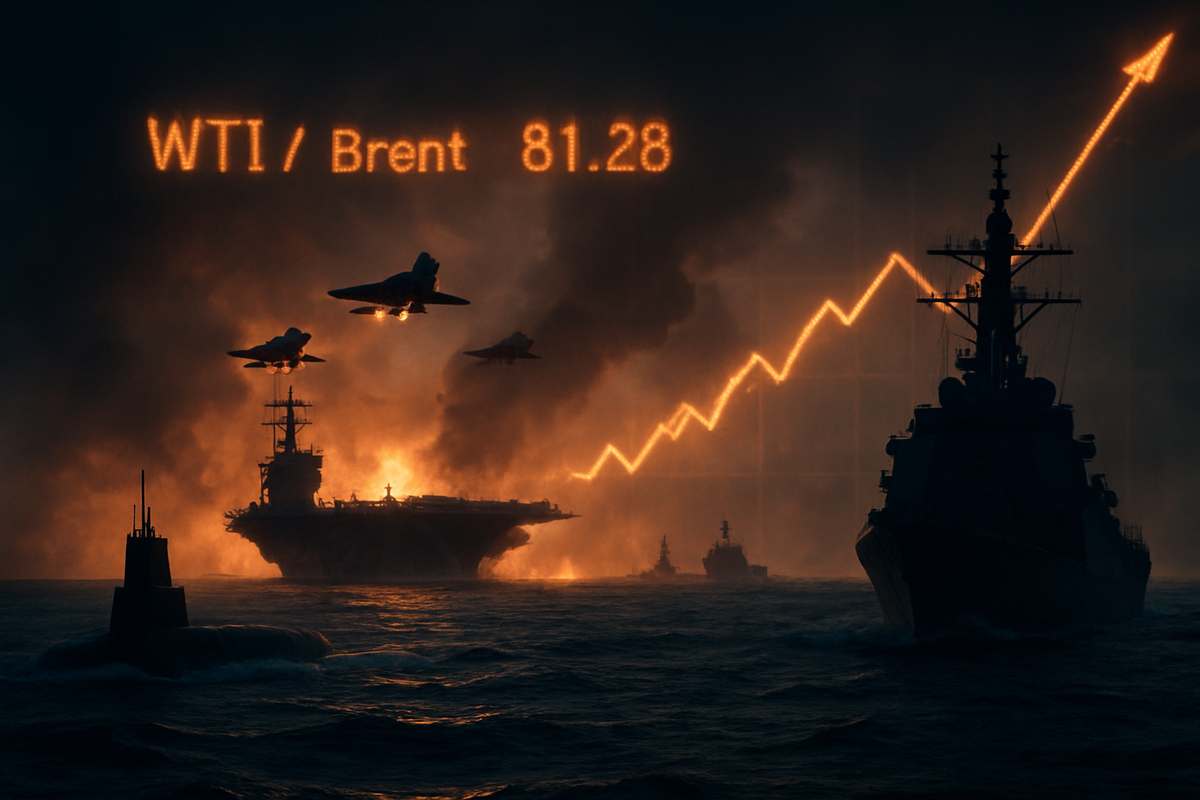
The strikes occurred shortly after 2:00 AM local time, executed by a combination of carrier-based F-35C Lightning II jets and Tomahawk cruise missiles launched from the USS Gerald R. Ford carrier strike group. According to Pentagon briefings, the primary targets were the Iranian corvette and a submarine docked at the strategic port of Chah Bahar. This military action follows the total collapse of the Geneva nuclear negotiations in late February 2026, which many analysts now view as the final diplomatic failure before the onset of what is being termed "Operation Epic Fury."
The timeline leading to this moment has been one of accelerating friction. Following a limited exchange of strikes in mid-2025 known as "Operation Midnight Hammer," which targeted Iranian enrichment facilities, a fragile ceasefire held for nearly eight months. However, reports of Iranian-backed drone swarms targeting commercial tankers in the Gulf of Oman earlier this week provided the "red line" provocation the U.S. and its regional allies needed to justify a direct naval intervention. The sinking of the submarine is particularly significant, as it removes one of Tehran’s most potent tools for "stealth mining" the Strait of Hormuz.
Key stakeholders, including U.S. Central Command and the newly formed Interim Leadership Council in Tehran—following the reported death of the Supreme Leader in recent weeks—are now locked in a stare-down. Market volatility has surged to levels not seen since the early days of the 2022 Ukraine conflict. The CBOE Volatility Index (VIX) jumped nearly 30% in early trading, reflecting deep uncertainty about whether this strike is a contained operation or the opening salvo of a regional conflagration.
Winners and Losers: Defense Rallies as Consumer Sectors Retreat
The financial impact of the escalation has created a sharp divergence in the equity markets. The primary beneficiaries of the "war footing" have been major defense contractors. Lockheed Martin (NYSE: LMT) saw its shares climb 6.5% in pre-market trading, driven by the heavy reliance on its stealth aircraft and missile defense systems during the operation. Similarly, RTX Corporation (NYSE: RTX), formerly Raytheon, hit all-time highs as investors anticipated a massive restocking of the Tomahawk and Patriot missile systems that have become central to the U.S. regional strategy. Northrop Grumman (NYSE: NOC) also notched gains of over 5%, fueled by the critical role of its B-21 Raider and surveillance platforms in the ongoing "Operation Epic Fury."
On the energy front, the prospect of 20 million barrels per day (bpd) being stranded by a Strait of Hormuz closure has pushed energy titans to record levels. ExxonMobil (NYSE: XOM) and Chevron (NYSE: CVX) are being viewed as safe havens within the energy sector, as their significant non-Middle Eastern assets—particularly in the Permian Basin and Guyana—insulate them from local transit risks while they benefit from the global price surge. Brent Crude has already cleared $84 per barrel, with analysts suggesting $150 is "within the realm of possibility" if the conflict expands.
Conversely, the "losers" of this escalation are quickly becoming apparent. Airlines, which are highly sensitive to jet fuel prices, are facing a brutal sell-off. Delta Air Lines (NYSE: DAL) and United Airlines (NASDAQ: UAL) both saw shares drop by more than 7% as the cost of operations is expected to balloon. Furthermore, global shipping firms like ZIM Integrated Shipping Services (NYSE: ZIM) are navigating a nightmare of rerouted vessels and astronomical war-risk insurance costs. Broader tech and growth stocks are also under pressure, as the prospect of sustained $100+ oil threatens to keep interest rates "higher for longer" to combat energy-driven inflation.
A New Paradigm in Global Energy Security
The wider significance of this strike cannot be overstated. It represents the transition from a decade of "gray zone" warfare—where the U.S. and Iran used proxies and cyberattacks—to a direct kinetic engagement between sovereign militaries. This event fits into a broader trend of "energy fragmentation," where global powers are increasingly willing to use military force to secure or disrupt energy flows. Historically, this mirrors the 1988 "Operation Praying Mantis," where the U.S. Navy destroyed much of the Iranian navy in a single day, but the stakes in 2026 are infinitely higher given the advanced drone and missile technologies now in play.
The policy implications are equally profound. The U.S. administration is now under immense pressure to release more from the Strategic Petroleum Reserve (SPR), which is already at historically low levels following the interventions of 2022 and 2024. Furthermore, the escalation is likely to force a regulatory pivot toward domestic energy production, potentially easing restrictions on offshore drilling and pipeline infrastructure as "national security" overrides environmental concerns in the short term.
The Road Ahead: Retaliation or De-escalation?
In the short term, the market is braced for the "other shoe to drop." Iranian retaliation is expected, likely in the form of asymmetric "swarm" drone attacks against regional refineries or cyber-offensives targeting Western financial infrastructure. A strategic pivot toward "dark fleet" oil smuggling may also intensify as Iran seeks to maintain some revenue despite the naval blockade. If the U.S. continues its policy of "naval annihilation," the goal will be to clear the Gulf entirely of Iranian surface and sub-surface threats to allow commercial traffic to resume, but this could take weeks or months.
Longer-term, this conflict may catalyze a permanent shift in how markets price geopolitical risk. The "peace dividend" that followed the Cold War has been fully erased, replaced by a "war premium" that affects everything from commodity futures to logistics planning. Investors should prepare for a period of extreme volatility, where traditional market correlations may break down as the world adjusts to a "hot war" in the heart of the global oil supply chain.
Summary and Investor Outlook
The overnight strikes on the Iranian warship and submarine have fundamentally altered the 2026 market narrative. Key takeaways include the robust performance of the "Defense-Energy Complex" (LMT, RTX, XOM) and the significant headwinds facing consumer-facing sectors like travel and logistics. While the broader market is currently in a state of shock, the true test will be the nature of Iran's response over the coming 48 to 72 hours.
Moving forward, investors should watch for the status of the Strait of Hormuz and any signs of the conflict spreading to the Red Sea or East Mediterranean. Gold, which has already cleared $5,400 per ounce, remains the ultimate hedge against this level of systemic instability. The lasting impact of "Operation Epic Fury" may well be the final end of the era of cheap, globalized energy, ushering in a more expensive and dangerous reality for the remainder of the decade.
This content is intended for informational purposes only and is not financial advice.