MOUNTAIN VIEW, CA — In a stunning reversal of the 2024 narrative that painted Google as an AI laggard, Alphabet Inc. (NASDAQ: GOOGL) has emerged as the undisputed titan of the "Magnificent 7" over the past twelve months. As of March 4, 2026, Alphabet shares have surged a staggering 80% year-over-year, leaving former market darlings like Nvidia Corp. (NASDAQ: NVDA) and Microsoft Corp. (NASDAQ: MSFT) in the rearview mirror. This meteoric rise has been fueled by a dual-engine strategy: the dominant rollout of the Gemini 3 model series and a high-stakes partnership with Broadcom Inc. (NASDAQ: AVGO) that has finally broken the industry’s dependence on third-party GPU hardware.
The market shift represents more than just a stock rally; it is a fundamental "vibe shift" in the technology sector. For the first time since the generative AI boom began, the narrative has moved from "who has the most chips" to "who can deliver the most intelligence at the lowest cost." By vertically integrating its own custom silicon with a world-leading model architecture, Alphabet has achieved a level of "AI Sovereignty" that has sent rivals into a defensive "Code Red" posture.
The Gemini 3 Earthquake and the Ironwood Breakthrough
The seeds of Alphabet’s current dominance were sown in late 2025 with the release of Gemini 3 Pro. Launched on November 18, 2025, the model introduced "Deep Think" mode—a reasoning-heavy architecture specifically designed to outmaneuver OpenAI’s O-series. Gemini 3 didn't just compete; it dominated, shattering records on the ARC-AGI-2 benchmark and achieving a record-breaking 1501 score on the LMSYS Arena leaderboard. This was followed by the February 19, 2026, debut of Gemini 3.1 Pro, which featured "Native Multimodal Fusion," allowing the AI to process video, audio, and 3D geospatial data simultaneously from its first layer of training.
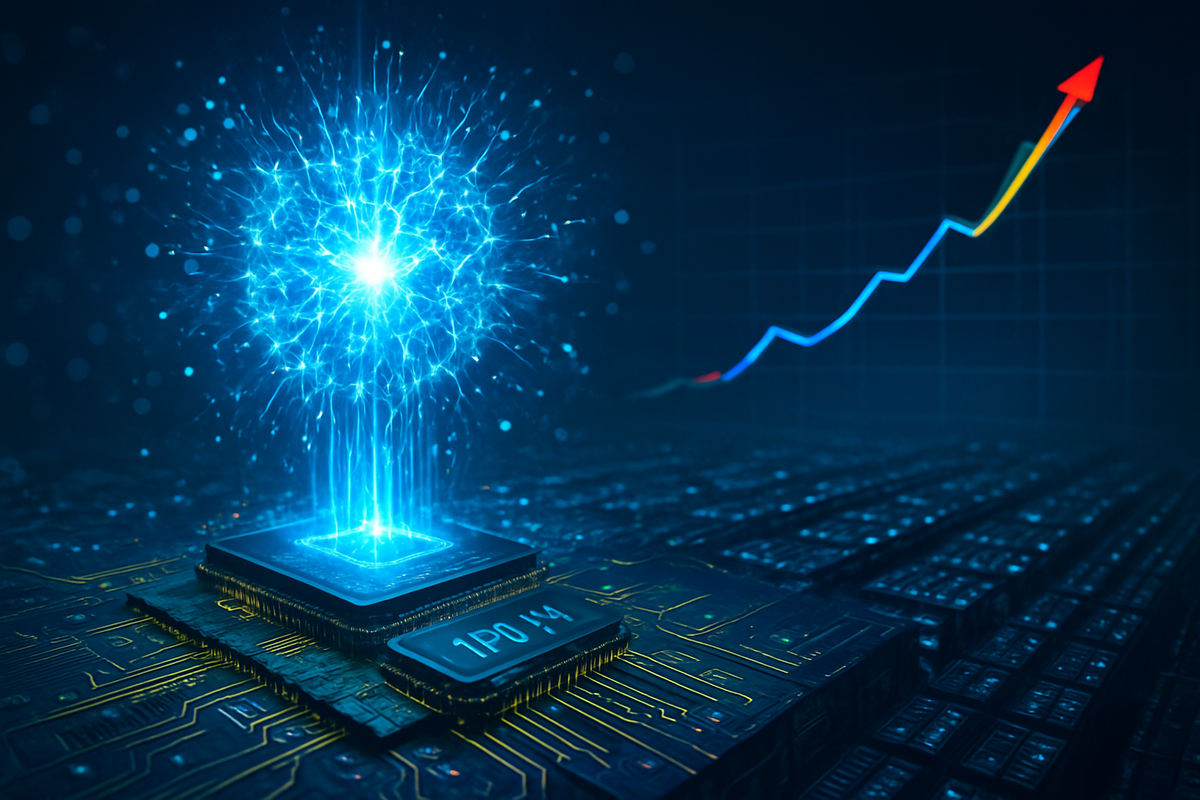
Parallel to these software milestones was the silent success of "Project Ironwood"—the seventh-generation Tensor Processing Unit (TPU v7) developed in deep collaboration with Broadcom. While competitors scrambled for Nvidia’s Blackwell systems, Google quietly deployed TPU v7 pods capable of 42.5 exaflops of compute. According to internal data leaked in January, these chips reduced Alphabet’s inference costs by nearly 70% compared to 2024 levels. This efficiency allowed Google to offer "frontier-level" intelligence at a price point that made legacy models look prohibitively expensive, effectively forcing a price war that its competitors were ill-equipped to fight.
Winners and Losers: A New Hierarchy in Big Tech
Alphabet’s resurgence has reshuffled the deck for the world's largest public companies. Broadcom has emerged as a primary beneficiary, with its stock tracking closely behind Alphabet's as it cements its role as the premier designer of custom AI ASICs (Application-Specific Integrated Circuits). Meanwhile, Apple Inc. (NASDAQ: AAPL) secured a kingmaker role in January 2026, when it announced that Gemini would become the default intelligence layer for Siri and Apple Intelligence. This deal effectively demoted previous partners to secondary, opt-in roles and provided Google with an unparalleled distribution network of over two billion active devices.
Conversely, the "losers" in this cycle are those most exposed to the high costs of general-purpose hardware. Microsoft has seen its margins compressed as it continues to pay "the Nvidia tax" while subsidizing its Copilot services. Its stock is down 18.6% year-to-date as of late February. Similarly, Nvidia, while still a powerhouse, has seen its growth decelerate to 39% over the past year—a respectable figure that nevertheless pales in comparison to Alphabet's 80%. Investors are increasingly wary of "capex exhaustion" among Nvidia's largest customers, who are now following Alphabet’s lead by developing their own internal silicon.
Breaking the "Code Red" and the Shift to Custom Silicon
The industry-wide impact of Alphabet's gains became undeniable in December 2025, when reports surfaced that OpenAI CEO Sam Altman had declared an internal "Code Red." The move was triggered by Gemini 3 Flash’s ability to provide GPT-5-level reasoning at one-eighth the cost. This strategic panic led OpenAI to halt several peripheral projects to focus on an "emergency" release of its next-generation models. This mirrors the panic Google felt in early 2023, but the roles have now been completely reversed.
Alphabet's success also signals a broader industry trend toward custom infrastructure. By proving that a vertically integrated stack—silicon, cloud, and model—can outperform a modular one, Alphabet has set a new standard for the industry. This is evidenced by Anthropic’s recent $21 billion commitment to use Google’s TPU infrastructure for its future model training. This "Infrastructure-as-a-Service" model has turned Google Cloud from a distant third-place contender into a high-margin powerhouse, leveraging Broadcom’s networking expertise to create a moat that is increasingly difficult for pure-play software companies to cross.
The Road to a $4 Trillion Market Cap
Looking ahead, the question is no longer whether Alphabet can compete, but how high its ceiling truly is. In January 2026, Alphabet briefly touched a $4 trillion market cap, a milestone that once seemed reserved for Apple or Microsoft. In the short term, the company is expected to leverage its Apple partnership to dominate the "agentic" AI market—AI that doesn't just answer questions but performs tasks across apps.
However, challenges remain. Regulatory scrutiny in both the US and EU is expected to intensify as Google’s "AI Sovereignty" begins to look like a new form of a monopoly. Furthermore, as more companies like Meta Platforms Inc. (NASDAQ: META) and Amazon.com Inc. (NASDAQ: AMZN) ramp up their own custom chip efforts, the "Ironwood" advantage may eventually face the same commoditization pressures that have begun to affect Nvidia.
Summary: A Lasting Impact on the AI Economy
Alphabet’s 80% rally over the past year marks a definitive turning point in the AI era. By pairing the sophisticated reasoning of Gemini 3 with the cost-efficiency of Broadcom-designed TPUs, Alphabet has solved the two biggest problems facing the AI industry: performance and profitability. The "Code Red" at rival firms and the pivot by major players like Salesforce and Apple suggest that the market has reached a consensus—integrated stacks win.
For investors, the coming months will be defined by how well Alphabet can monetize its massive distribution advantage through Gemini 3.1. Watch for quarterly margin expansions in Google Cloud and any further defections of enterprise clients from rival ecosystems. The "Magnificent 7" may still be a group, but as of March 2026, Alphabet is clearly the one leading the pack.
This content is intended for informational purposes only and is not financial advice.