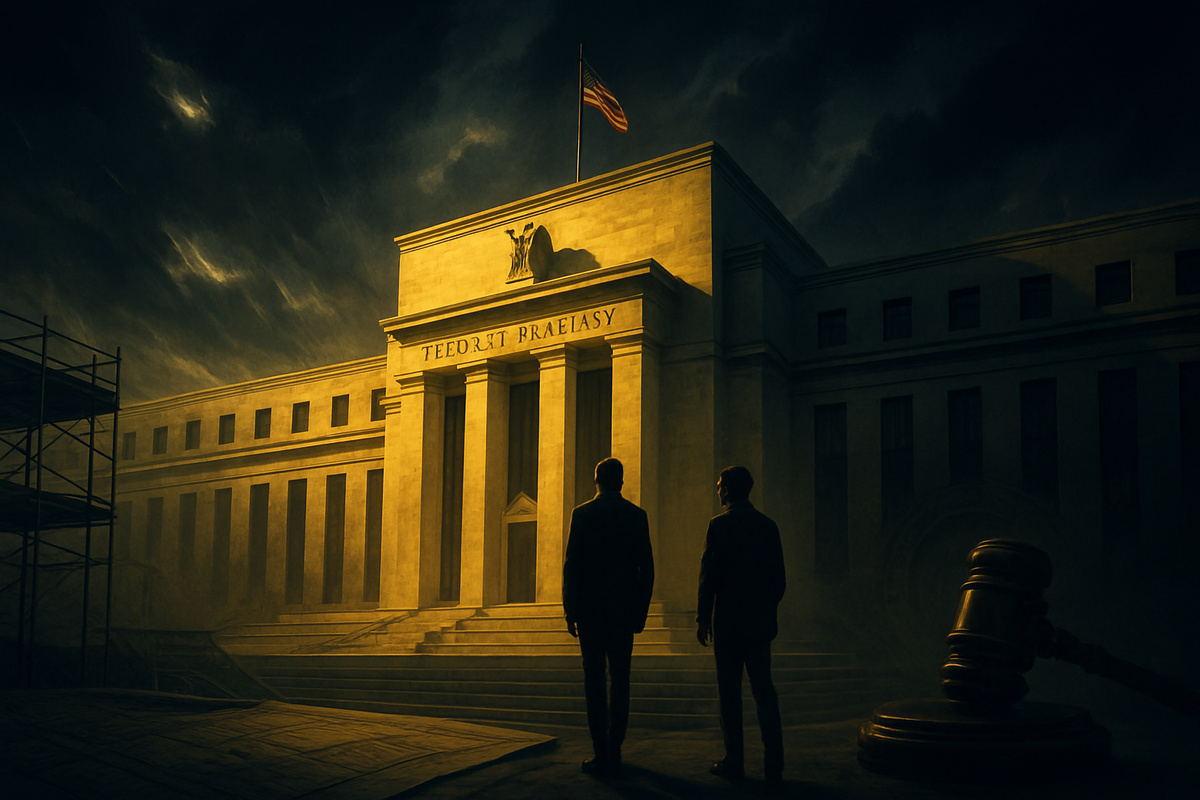
As of March 2, 2026, the halls of the Federal Reserve are echoing with more than just debates over interest rate targets; they are the center of a high-stakes political and legal drama that has sent shockwaves through global markets. The formal nomination of Kevin Warsh to succeed Jerome Powell as Chair of the Federal Reserve Board of Governors marks a decisive shift toward a "Sound Money" era, yet this transition is being heavily overshadowed by a burgeoning Department of Justice (DOJ) investigation into the very building where Warsh is expected to lead.
The investigation, which involves grand jury subpoenas served to Jerome Powell in January, centers on allegations of false testimony regarding the multi-billion-dollar renovation of the Marriner S. Eccles Building. While the "Two Kevins"—Warsh and National Economic Council Director Kevin Hassett—were the primary names in the succession race, the sudden legal pressure on Powell has transformed a standard leadership transition into a referendum on the independence of the American central bank.
The timeline of this unprecedented crisis began on January 9, 2026, when the DOJ, led by U.S. Attorney Jeanine Pirro, served subpoenas to Powell following a months-long inquiry into his June 2025 congressional testimony. At the heart of the probe is the renovation of the Federal Reserve's headquarters, a project that saw its budget balloon from an initial $1.9 billion to a staggering $2.5 billion. Prosecutors allege that Powell downplayed the inclusion of "luxury" amenities—such as specialized high-speed elevators and rare marble finishes—to the Senate Banking Committee as the project faced mounting public scrutiny over government spending.
By mid-January, the succession race had narrowed significantly. While Kevin Hassett was initially viewed as the administrative loyalist favorite, President Donald Trump signaled on January 16 that Hassett would remain at the National Economic Council, paving the way for the nomination of Kevin Warsh on January 30, 2026. Warsh, a veteran of Morgan Stanley (NYSE: MS) and a former Fed Governor during the 2008 financial crisis, is viewed by many on Wall Street as a "markets first" chairman. However, the nomination has been met with resistance from some Republican senators, including Thom Tillis and Lisa Murkowski, who have expressed concern that the DOJ investigation into Powell is a "political pretext" designed to undermine the Fed's autonomy.
The initial reaction from the markets in early January was one of sharp volatility. On January 12, following news of the criminal probe, major indices dipped as the VIX volatility index surged. Safe-haven assets like gold skyrocketed toward the $5,000 per ounce mark as investors feared a "crisis of confidence" in the U.S. dollar. However, since the Warsh nomination, the narrative has shifted toward a "regulatory relief rally," as investors begin to price in a more hawkish but pro-market leadership.
The financial sector has emerged as the primary beneficiary of the "Warsh Pivot," even as the legal clouds linger. JPMorgan Chase (NYSE: JPM) saw its shares rebound by 3.8% in February after the nomination was formalized. Analysts believe that a Warsh-led Fed would likely pursue a "QT-for-cuts" strategy—accelerating the reduction of the Fed's $8 trillion balance sheet while simultaneously lowering short-term rates. This would lead to a "bear steepening" of the yield curve, which historically expands Net Interest Margins (NIM), the primary engine of profitability for JPM and its peers.
Goldman Sachs (NYSE: GS) has also seen significant upside, with its stock rising 3.5% post-nomination. Warsh's background in Mergers and Acquisitions (M&A) is seen as a signal for a more lenient environment for deal-making. With global deal volumes projected to rise by 11% in 2026, Goldman is positioned to capture a significant share of that growth under a Fed that is less likely to impose draconian capital constraints.
Bank of America (NYSE: BAC) and Citigroup (NYSE: C) are also expected to win from a potential scaling back of Basel III "Endgame" capital requirements. Warsh has historically been skeptical of overly restrictive capital rules that he believes stifle lending and liquidity. If the new Fed leadership eases these requirements, BAC and other large institutions could free up billions of dollars for stock buybacks and dividend increases, providing a direct tailwind for shareholders throughout the remainder of 2026.
This event is more than a simple change in leadership; it represents a fundamental clash between the executive branch and the nation's central bank. The DOJ’s move against a sitting Fed Chair is a historical first, and it raises profound questions about the future of the Federal Reserve's independence. Traditionally, the Fed has operated as a "non-political" entity, but the investigation into the Eccles Building renovation suggests that administrative tools are now being used to influence monetary policy directions.
The significance of the "Two Kevins" choice also highlights a broader industry trend toward "Sound Money" doctrines. Kevin Warsh has long advocated for a smaller Fed footprint in the private markets, a move that contrasts with the expansive interventionist policies seen during the COVID-19 era. This shift mirrors the historical precedent of Paul Volcker, who was brought in to break the back of inflation through aggressive and often unpopular measures.
Furthermore, the ripple effects of this succession will be felt globally. As the Fed shifts its balance sheet strategy, other central banks, such as the European Central Bank and the Bank of Japan, will be forced to recalibrate their own monetary stances to avoid currency debasement. The regulatory implications are equally vast, as a move away from the "Basel III Endgame" could signal a broader global trend of financial deregulation, reversing the tightening cycle that has dominated the last decade.
Looking ahead, the immediate hurdle is the Senate confirmation process for Kevin Warsh, which is expected to be one of the most contentious in recent history. Lawmakers will likely use the hearings to grill Warsh not only on interest rates but on his views regarding the DOJ’s investigation into his predecessor. If the investigation into Powell results in formal charges, it could paralyze the Board of Governors at a time when the economy is at a critical "soft landing" juncture.
In the short term, investors should prepare for continued volatility in the bond market as the yield curve adjusts to the "Warshian" outlook. A strategic pivot toward financial stocks and commodities like gold may be required as the market weighs the benefits of deregulation against the risks of a politicized central bank. If Warsh successfully takes the helm by May 2026, the primary market opportunity will lie in the "steepener" trade, benefiting banks with large deposit bases and lending portfolios.
There is also the potential scenario where the DOJ probe expands into other areas of Fed operations, potentially dragging in other high-ranking officials. This would create a leadership vacuum that could force the administration to reconsider its stance on Kevin Hassett or even look toward a third-party "unity" candidate to stabilize the markets if Warsh’s confirmation stalls.
The succession of Jerome Powell is no longer a routine transition; it is a battle for the soul of the Federal Reserve. The nomination of Kevin Warsh signals a return to market-driven monetary policy and potential regulatory relief for giants like JPMorgan Chase and Goldman Sachs. However, the DOJ’s investigation into the Eccles Building renovation serves as a stark reminder of the political pressures now facing the Fed.
Moving forward, the market will likely remain in a "wait-and-see" mode as the confirmation hearings approach. The key takeaway for investors is that while the "Two Kevins" saga has ended in a nomination, the real drama is only beginning. The intersection of criminal law and monetary policy has created a new risk premium that will need to be accounted for in every portfolio.
In the coming months, watch for any shifts in the Senate Banking Committee’s rhetoric and further leaks from the DOJ probe. The stability of the U.S. financial system depends not just on who sits in the Chair’s seat, but on whether that seat remains independent of the political winds blowing from the White House.
This content is intended for informational purposes only and is not financial advice