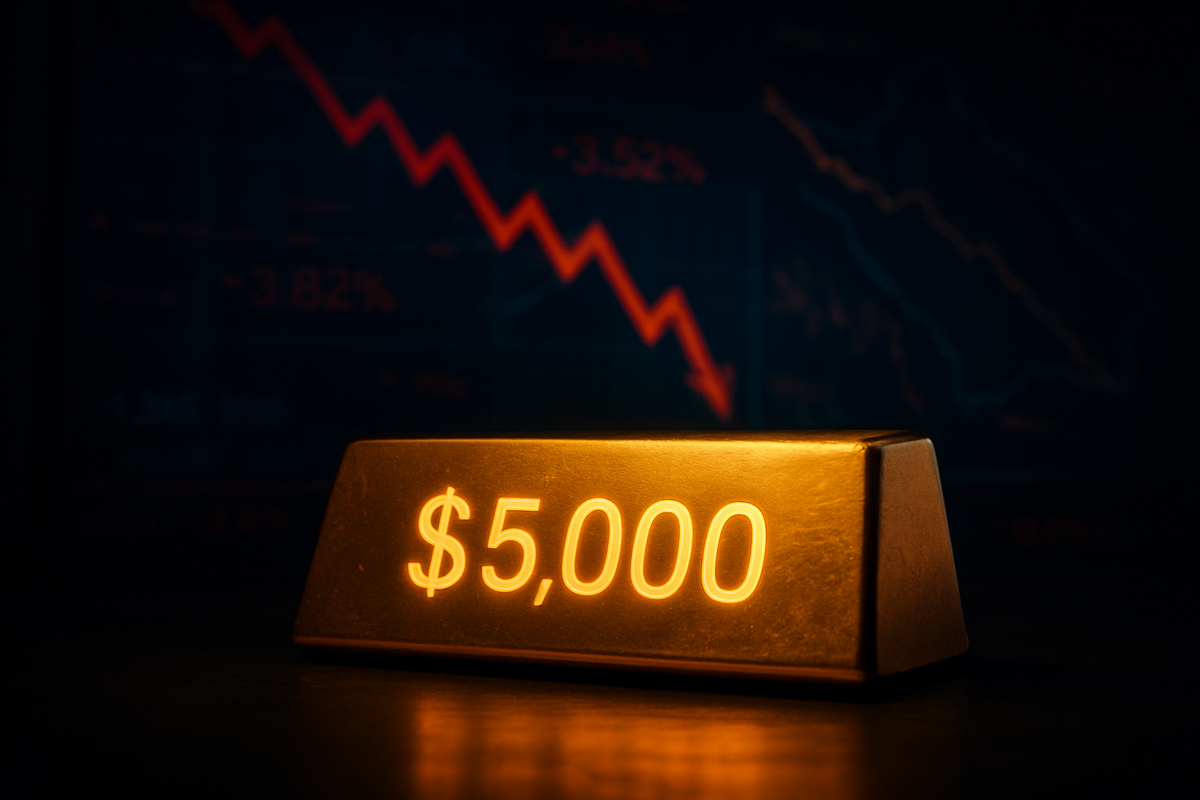
LONDON — In a move that has rewritten the history books of global finance, gold prices officially breached the psychological and historic $5,000 per ounce threshold during early trading on March 19, 2026. This unprecedented milestone comes as a direct consequence of a rapidly escalating conflict in the Middle East, which has paralyzed energy markets and sent shockwaves through global equity exchanges. As investors abandon risk-sensitive assets in a frantic "flight to quality," the yellow metal has solidified its status as the ultimate hedge against both geopolitical catastrophe and the looming specter of energy-driven stagflation.
The breach of $5,000 occurred at 9:14 AM GMT, following reports of significant maritime disruptions in the Strait of Hormuz. The immediate market reaction was one of systemic retreat; major indices across Asia and Europe saw aggressive selling, with the Nikkei 225 index plunging 3.4% in a single session. As oil prices surge past $130 per barrel, the global economy is facing a "perfect storm" where traditional safe havens like government bonds are being eschewed in favor of physical commodities that carry no counterparty risk.
The Morning the World Turned to Gold
The surge to $5,000 was not an isolated event but the culmination of a tense three-week standoff that turned into an active regional conflict in late February 2026. The breaking point arrived early this morning when intelligence reports confirmed that the Strait of Hormuz—the world’s most vital oil transit chokepoint—had become effectively impassable for commercial shipping due to localized hostilities. This sent Brent Crude prices skyrocketing, adding fuel to an already simmering inflationary fire that has plagued the global recovery for over a year.
The timeline leading to this morning's record-high reflects a market that was already on edge. In late 2025, gold had find a new floor above $3,800 as central banks, led by those in Asia and the Middle East, aggressively diversified their reserves away from the U.S. dollar. By the time the first kinetic engagements were reported three weeks ago, gold was already testing $4,400. The final $600 leg up occurred in a parabolic fashion over the last 48 hours as algorithmic trading and institutional hedging strategies converged, creating a massive liquidity vacuum in the futures markets.
Key institutional players, including the SPDR Gold Shares (NYSE: GLD), have seen record inflows this morning, with trading volumes three times the 30-day average. European markets followed Asia’s lead into the red, as the Euro Stoxx 50 fell 2.8% within the first hour of trading. The sentiment on trading floors from London to Tokyo is one of profound uncertainty, as the "War Premium" is now being priced into every asset class simultaneously.
Winners and Losers in a High-Value Gold Economy
In this era of $5,000 gold, the primary beneficiaries are the major mining conglomerates and royalty companies that possess the operational leverage to capitalize on record-high margins. Newmont Corporation (NYSE: NEM) and Barrick Gold Corporation (NYSE: GOLD) have seen their stock prices surge by double digits in pre-market and early trading, as their all-in sustaining costs (AISC) remain significantly below the current spot price. Similarly, Agnico Eagle Mines (NYSE: AEM) has emerged as a favorite for investors seeking exposure to "low-risk" jurisdictions, given its heavy concentration of assets in Canada and Australia.
Streaming and royalty firms like Franco-Nevada Corporation (NYSE: FNV) are also seeing a valuation rerating. Because these companies do not bear the direct burden of rising energy and labor costs associated with mine operations, their high-margin business models are viewed as the most efficient way to capture the gold price movement without the operational risks of traditional mining.
On the losing side of the ledger, the pain is being felt most acutely by energy-intensive sectors and companies sensitive to consumer discretionary spending.
- Airlines: Major carriers such as Delta Air Lines (NYSE: DAL) and United Airlines Holdings (NASDAQ: UAL) have seen their shares crater as the spike in jet fuel costs threatens to wipe out annual profitability.
- Technology: High-growth tech stocks, often represented by the Invesco QQQ Trust (NASDAQ: QQQ), are facing a dual threat: rising discount rates due to inflation and a general contraction in risk appetite.
- Japanese Exporters: The 3.4% drop in the Nikkei was led by giants like Toyota Motor Corporation (NYSE: TM), which are vulnerable to both higher shipping costs and a potential slowdown in global demand.
Geopolitical Risk and the Return of Stagflation
The significance of $5,000 gold extends far beyond a simple ticker price; it marks a fundamental shift in the global perception of value. For the first time since the 1970s, the market is facing a legitimate "Stagflationary" threat—a scenario where high inflation is coupled with stagnant economic growth. In such an environment, gold behaves differently than it does during a standard recession. While gold typically struggles when interest rates rise, it thrives when "real" rates (interest rates minus inflation) remain deep in negative territory, as they are today.
Historically, this event draws comparisons to the 1973 oil shock and the 1979 Iranian Revolution, both of which saw gold prices double in a short window as energy markets collapsed. However, the 2026 crisis is compounded by the sheer scale of global sovereign debt. With debt-to-GDP ratios at record highs in the U.S. and Europe, central banks have limited room to raise rates further without risking a systemic debt crisis, leaving gold as the only credible "exit ramp" for capital preservation.
Furthermore, the policy implications are vast. We are already seeing signs of "resource nationalism," where gold-producing nations may move to restrict exports to bolster their own domestic reserves. This mirrors the behavior seen in the lithium and cobalt markets earlier in the decade, but with the added weight of gold’s role as a global monetary anchor.
Navigating the Post-$5,000 Landscape
In the short term, the primary question is whether $5,000 represents a sustainable floor or a blow-off top. Many analysts suggest that as long as the Strait of Hormuz remains contested, the upward pressure on energy-driven inflation will keep gold demand high. Strategic pivots are already underway at major institutional funds, with several pension funds announcing a permanent increase in their "alternative asset" allocations from 5% to 15% to include physical bullion and mining equities.
However, challenges remain. A sustained gold price at these levels could lead to a massive increase in recycling and "scrap" gold entering the market, potentially dampening the price surge. There is also the risk of regulatory intervention; if gold begins to undermine the stability of major fiat currencies, we could see governments implement "windfall taxes" on mining profits or stricter reporting requirements for private gold holdings to curb capital flight.
Looking ahead, the next milestone for the market will be the release of the March Consumer Price Index (CPI) data. If inflation continues to accelerate alongside the rising gold price, the narrative of "gold as the new global currency" will gain further traction, potentially pushing the metal toward the $6,000 mark by the end of the year.
Assessing the New Market Reality
The breach of $5,000 per ounce is a watershed moment for the financial world. It signals that the traditional "60/40" portfolio of stocks and bonds may no longer be sufficient to protect wealth in an era of heightened geopolitical volatility and energy insecurity. The key takeaway for the market is that gold is no longer just a defensive play; it has become a central component of a modern macro strategy in a fragmented global economy.
Moving forward, the market will be defined by its ability to adapt to these higher costs of capital and energy. While the immediate focus remains on the Middle East, the lasting impact will be the permanent shift in how institutional investors view "safe" assets. The flight from the Nikkei and other global equities today is a stark reminder that in times of existential crisis, the market invariably returns to its most ancient and trusted store of value.
Investors should closely monitor two things in the coming months: the resolution (or lack thereof) of the shipping blockade in the Middle East, and the movement of central bank gold reserves. If the world’s leading economies continue to stockpile gold at $5,000, it will serve as the strongest possible signal that the era of "cheap" gold—and stable inflation—is firmly behind us.
This content is intended for informational purposes only and is not financial advice.