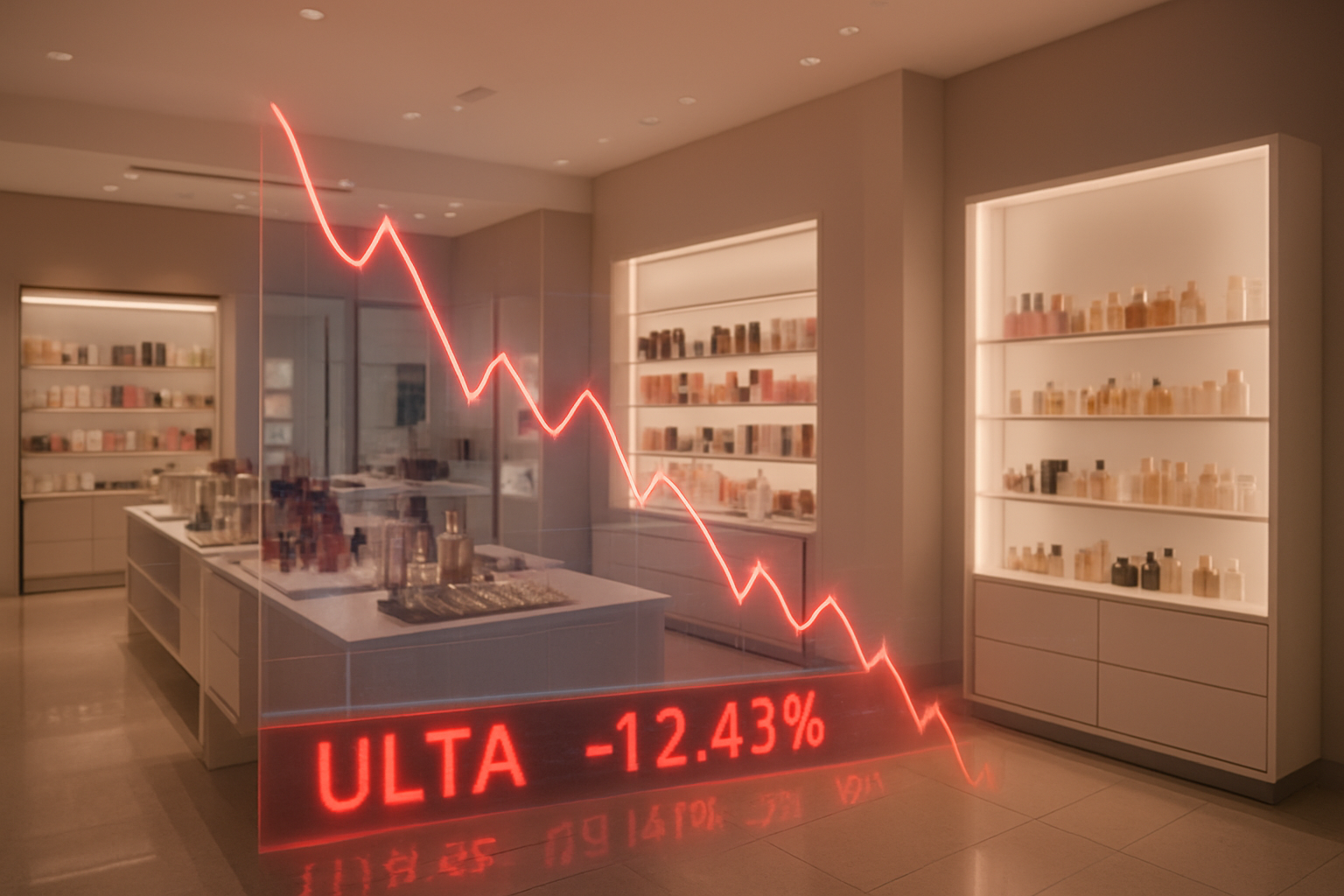
BOLINGBROOK, IL — In a startling reminder that top-line growth no longer guarantees investor confidence in the post-AI retail landscape, Ulta Beauty (NASDAQ: ULTA) saw its market capitalization take a significant hit on March 13, 2026. Despite reporting robust holiday sales that exceeded Wall Street estimates, the beauty giant’s fourth-quarter earnings were overshadowed by a massive 23% surge in Selling, General, and Administrative (SG&A) expenses. The spike, which management attributed to aggressive technological pivots and human capital investments, sent shares tumbling nearly 12% in early Friday trading, marking one of the stock's most volatile sessions in recent years.
The sell-off underscores a growing tension in the retail sector: the "precision era" of shopping requires massive upfront capital for artificial intelligence and supply chain modernization, even as consumer spending remains bifurcated. While Ulta’s revenue grew a healthy 11.8% to $3.9 billion during the fourth quarter of fiscal 2025, its operating margin contracted sharply from 14.8% to 12.2%. For investors, the message was clear—Ulta is winning the battle for the consumer's wallet, but the cost of victory is becoming increasingly steep.
A Perfect Storm of Strategic Spending
The earnings report, released after the bell on March 12, 2026, revealed a complex financial picture for the Bolingbrook-based retailer. Total SG&A expenses soared to $1.0 billion, a significant jump from $815.6 million in the prior-year period. This expenditure deleveraged SG&A as a percentage of net sales by 230 basis points, a metric that analysts point to as the primary driver of the stock's decline. The timeline leading to this moment has been defined by Ulta’s "Unleashed" strategic plan—a multi-year initiative designed to fortify the company’s digital moat against rivals like Amazon (NASDAQ: AMZN) and Sephora, owned by LVMH (OTC: LVMUY).
Key stakeholders, including CEO Dave Kimbell, emphasized that the expense spike was a deliberate choice rather than a lack of operational discipline. A large portion of the $1 billion was directed toward AI-driven personalization engines intended to service Ulta’s 44 million loyalty members. Additionally, the company integrated the recent acquisition of UK-based Space NK and funded a substantial increase in incentive-based compensation for frontline associates. In a tight labor market, Ulta chose to prioritize talent retention over short-term margin protection, a move that drew praise from labor advocates but a cold shoulder from institutional investors focused on quarterly EPS.
The Bifurcated Beauty Battle: Winners and Losers
The fallout from Ulta's margin compression has sent ripples across the beauty landscape, highlighting a clear divergence in performance. One of the primary beneficiaries of Ulta’s current growing pains appears to be E.L.F. Beauty (NYSE: ELF). As Ulta’s middle-income core customer "trades down" to navigate inflationary pressures, E.L.F. has reported a staggering 38% revenue growth in early 2026, capturing market share from traditional specialty retailers. E.L.F.’s lean operating model and "masstige" pricing have made it a favorite among Gen Z consumers who are increasingly price-sensitive but brand-loyal.
Conversely, the luxury end of the market continues to be dominated by Sephora. With its highly efficient shop-in-shop partnership with Kohl’s (NYSE: KSS) and exclusive brand launches—most notably the record-breaking expansion of Rhode by Hailey Bieber—Sephora has managed to sustain prestige growth without the same level of standalone margin erosion seen at Ulta. Meanwhile, Estée Lauder (NYSE: EL) has faced its own struggles, with shares dipping 11% recently as it navigates a similar "Beauty Reimagined" turnaround that mirrors Ulta's heavy investment cycle. The broader implication is that retailers "stuck in the middle" of the price spectrum are facing the most intense pressure to innovate or perish.
The "Year of the A": Affordability, AI, and Advertising
Ulta’s current predicament is a microcosm of what industry analysts are calling the "Year of the A" in retail. Across the board, public companies are grappling with the necessity of AI and advanced advertising tech to remain relevant. Target (NYSE: TGT), which also reported beauty as a bright spot in its recent earnings, is currently navigating the final months of its partnership with Ulta, set to expire in August 2026. Target is already pivoting toward its own "beauty makeover," investing heavily in supply chain automation to compete with the very partner it is preparing to leave behind.
Historically, retail transformations of this scale—such as the digital shifts of 2012-2015—often result in a temporary "valuation reset" for the sector. Ulta’s 23% SG&A increase is a modern-day equivalent of the heavy CAPEX spending that once defined the move to e-commerce. However, the current regulatory environment regarding data privacy and the soaring costs of specialized AI talent mean that these efficiency gains may take years, rather than quarters, to materialize. Investors are now questioning whether the "Lipstick Effect"—the theory that consumers buy small luxuries during downturns—is enough to offset the structural rise in the cost of doing business.
The Road Ahead: 2026 and Beyond
Looking forward, the immediate concern for Ulta is its conservative guidance for the remainder of fiscal 2026. Management has projected comparable sales growth of just 2.5% to 3.5%, a sharp deceleration from the high-single-digit growth investors have grown accustomed to. The short-term goal will be to prove that the "Unleashed" investments can drive meaningful conversion. If the AI-driven personalization can increase the "average ticket" and transaction frequency as promised, the margin compression of Q4 2025 may eventually be viewed as a necessary growing pain.
However, a major strategic pivot may be required if the partnership with Target is not renewed or successfully replaced. The looming August 2026 deadline creates a significant revenue hole that Ulta must fill through its international expansion into Mexico and the Middle East. For the retail sector at large, the next twelve months will be a test of whether technological scale can truly deliver operational leverage, or if the cost of maintaining a modern digital storefront has permanently lowered the ceiling for retail profitability.
Closing the Books on a Volatile Quarter
The key takeaway from Ulta Beauty’s Q4 2025 earnings is that market dominance does not offer immunity from the rising costs of the digital age. While the company continues to attract millions of loyal shoppers and maintains a healthy top-line trajectory, the 23% increase in SG&A has fundamentally changed the narrative around the stock. Investors are no longer just looking for sales; they are looking for "quality growth" that protects the bottom line.
Moving forward, the market will be watching for signs of margin recovery in the second half of 2026. The success of the Space NK integration and the performance of the new AI personalization tools will be the primary barometers for Ulta’s health. For the broader retail sector, the event serves as a cautionary tale: in 2026, innovation is a non-negotiable expense, but it is one that the market is currently unwilling to pay a premium for until the results are visible in the profit column.
This content is intended for informational purposes only and is not financial advice.