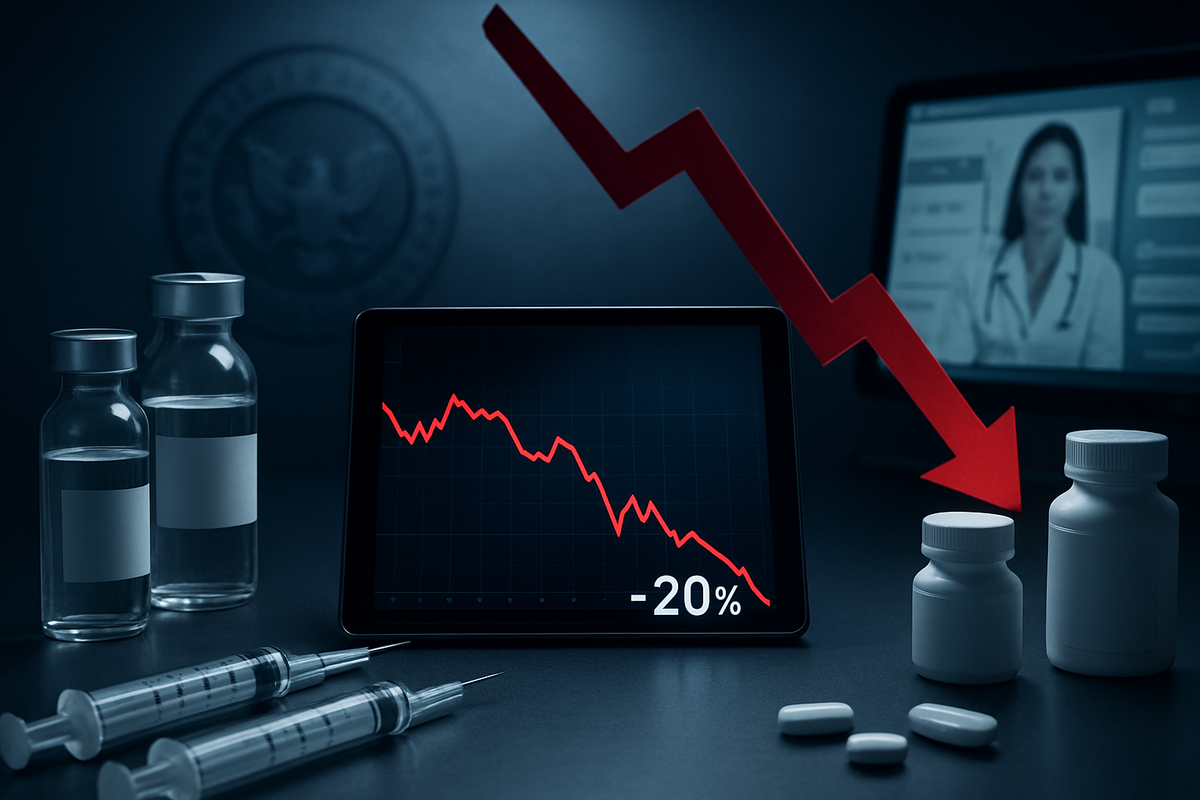
The multi-billion dollar weight-loss drug market experienced a seismic shift this morning as the era of easy-access compounded alternatives faced its most significant legal and regulatory challenge to date. On February 9, 2026, pharmaceutical giant Novo Nordisk (NYSE: NVO) filed a landmark patent infringement lawsuit against Hims & Hers Health, Inc. (NYSE: HIMS), just 48 hours after the telehealth company was forced to pull its newly launched compounded semaglutide pill from the market. The double blow of litigation and a sudden regulatory pivot by the FDA sent HIMS shares into a tailspin, cratering as much as 20% in early trading.
The sudden escalation marks a decisive turning point in the battle over GLP-1 treatments. For nearly two years, compounding pharmacies and telehealth platforms had leveraged drug shortages to sell cheaper, non-branded versions of blockbuster drugs like Wegovy and Ozempic. However, with the FDA officially signaling the end of these shortages and Novo Nordisk moving to aggressively defend its intellectual property, the "Wild West" period of the weight-loss industry appears to be coming to an abrupt and costly conclusion.
The 96-Hour Collapse: From Launch to Litigation
The crisis for Hims & Hers began with an ambitious move on February 5, 2026, when the company launched a compounded oral semaglutide pill priced at just $49 per month—a fraction of the $1,300+ list price for branded injectables. The "needle-free" offering was intended to be a cornerstone of the company’s 2026 growth strategy. However, the celebration was short-lived. By February 6, the FDA issued a scathing statement through Commissioner Martin A. Makary, announcing "decisive steps" to restrict the active pharmaceutical ingredients (APIs) used for mass-marketing GLP-1 alternatives. Simultaneously, the Department of Health and Human Services (HHS) referred Hims & Hers to the Department of Justice for potential violations of the Federal Food, Drug, and Cosmetic Act.
Facing immense regulatory pressure, Hims & Hers announced on February 7 that it would immediately suspend access to its compounded semaglutide pill. The retreat did little to appease Novo Nordisk, which filed its federal lawsuit this morning. The complaint, centered on U.S. Patent 8,129,343, accuses Hims & Hers of "illegal mass compounding" and marketing unapproved "knockoffs" that infringe on Novo’s patents through 2032. Novo Nordisk’s legal team alleged that independent testing of compounded samples revealed impurity levels as high as 86%, framing the lawsuit as a necessary measure for public safety.
The market reaction was swift and unforgiving. HIMS shares plummeted 20% in pre-market trading on February 9, wiping out over a billion dollars in market capitalization. Investors who had wagered on the company’s ability to disrupt the weight-loss market now face a reality where its primary growth engine has been sidelined by the combined might of federal regulators and Big Pharma.
Winners and Losers: A Power Shift Back to Big Pharma
The clear winners in this confrontation are the legacy pharmaceutical companies, specifically Novo Nordisk (NYSE: NVO) and Eli Lilly and Company (NYSE: LLY). By successfully lobbying the FDA to declare the GLP-1 shortage resolved in late 2025, these companies effectively removed the legal "shortage" loophole that allowed compounding pharmacies to manufacture generic versions of patented drugs. Novo Nordisk’s aggressive litigation serves as a warning shot to the entire compounding industry, asserting that patent protection will be enforced with the full weight of the law.
Conversely, Hims & Hers stands as the primary loser in this engagement. Having pivoted its entire business model toward weight loss over the past 18 months, the company now finds itself without its most competitive product and facing potentially hundreds of millions of dollars in trebled damages. Other telehealth and compounding firms, such as Ro and various independent pharmacies, are likely to see their valuations under pressure as the FDA’s "decisive steps" begin to take the form of actual seizures and cease-and-desist orders.
For patients, the outcome is more nuanced. While the crackdown ensures that the drugs being sold meet rigorous FDA safety standards, the loss of affordable compounded options—which often cost 80-90% less than branded versions—will likely push many out of the market. This creates a supply-demand tension that may eventually force Novo Nordisk and Eli Lilly to introduce more tiered pricing or official generic versions earlier than planned to capture the lower-income demographic.
Analyzing the Regulatory Tide: The End of the Shortage Loophole
This event is not merely a corporate dispute but a significant realignment of FDA policy. For years, the compounding industry operated under Section 503A and 503B of the Food, Drug, and Cosmetic Act, which allows pharmacies to create custom medications when a drug is in short supply. However, the FDA's February 6 statement signals that the agency will no longer tolerate "mass-marketing" under the guise of compounding. Commissioner Makary’s explicit naming of Hims & Hers marks a rare departure from the agency’s usually neutral tone, indicating that the federal government views the scale of the current compounding boom as a systemic risk to the drug approval process.
Historically, the FDA has been slow to move against compounders, often waiting for evidence of actual patient harm. The proactive nature of this intervention suggests a new "zero tolerance" approach for high-profile, patented biologics. This sets a precedent that will likely deter other startups from attempting to commoditize patented medications during temporary supply interruptions. It also reaffirms the power of the "Orange Book" patents, ensuring that the incentive for multi-billion dollar R&D investments remains protected by federal enforcement.
What Comes Next: Strategic Pivots and Legal Marathons
In the short term, Hims & Hers must find a way to stabilize its subscriber base. The company will likely pivot back to its core offerings in hair loss and sexual health, while perhaps attempting to partner with Novo Nordisk or Eli Lilly as an official distributor—a move that would drastically lower its margins but save its weight-loss division. However, given the vitriol of the current lawsuit, such a partnership seems unlikely in the near future.
The legal battle between Novo Nordisk and Hims & Hers is expected to be a long-term marathon. If Novo succeeds in obtaining a permanent injunction, it will effectively shut the door on any non-branded semaglutide in the U.S. market until 2032. Investors should also watch for similar moves from Eli Lilly, which has its own suite of patents protecting tirzepatide (Zepbound). We may see a flurry of "settlement" agreements where smaller compounders agree to exit the market to avoid the crushing cost of litigation against a trillion-dollar industry.
Market Outlook and Final Thoughts
The events of early February 2026 have effectively burst the "compounding bubble" that had inflated the valuations of several telehealth disruptors. The key takeaway for the market is that the FDA and Big Pharma have successfully closed the gap that allowed for the proliferation of cheap GLP-1 alternatives. As the dust settles, the weight-loss market will likely return to a more traditional duopoly controlled by Novo Nordisk and Eli Lilly, characterized by high prices, strict patent enforcement, and clinical-grade quality control.
Moving forward, investors should monitor the Department of Justice's response to the HHS referral, as any criminal charges could be a death knell for Hims & Hers. Furthermore, watch for Novo Nordisk’s upcoming quarterly earnings to see how much market share they reclaim now that the $49 "gray market" alternative has been eliminated. The weight-loss gold rush isn't over, but the rules of engagement have been permanently rewritten in favor of the incumbents.
This content is intended for informational purposes only and is not financial advice.