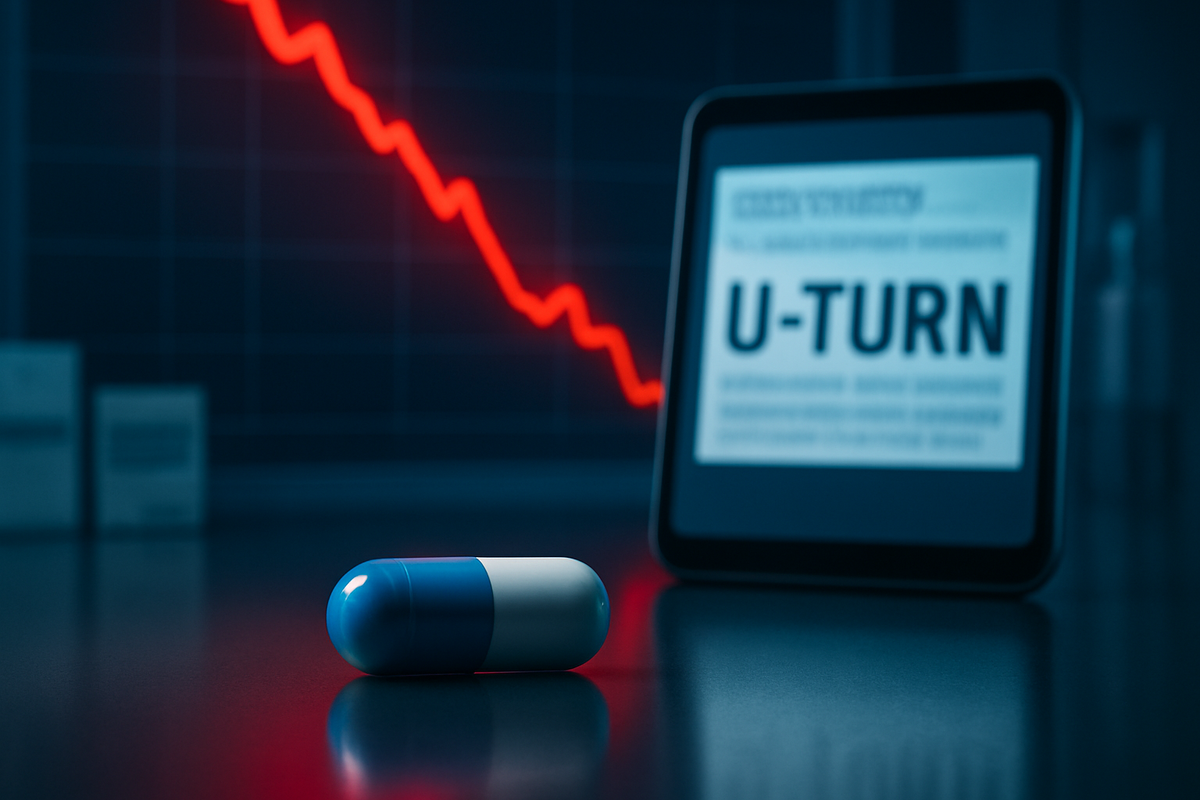
The meteoric rise of telehealth giant Hims & Hers Health (NYSE: HIMS) faced its most severe reckoning this week, as the company’s stock plummeted to a one-year low following a dramatic withdrawal of its highly anticipated oral weight-loss treatment. What was intended to be a disruptive move against the pharmaceutical establishment has instead triggered a regulatory firestorm, leaving investors reeling from a nearly 30% wipeout in market value within a single trading week.
The sudden reversal marks a pivotal moment for the weight-loss industry, signaling the end of an era where telehealth providers could exploit drug shortages to offer low-cost compounded alternatives. By abandoning its plan to market a $49-per-month oral semaglutide pill just 48 hours after its launch, Hims & Hers has not only lost a massive potential revenue stream but has also invited unprecedented scrutiny from federal investigators and the Department of Justice.
The 48-Hour Collapse: A Timeline of the HIMS U-Turn
The volatility began on Thursday, February 5, 2026, when Hims & Hers announced the launch of a compounded oral version of Novo Nordisk's (NYSE: NVO) blockbuster drug Wegovy. Priced at just $49 per month, the product was positioned to undercut Novo’s own branded oral semaglutide, which carries a list price closer to $149. Initially, the market cheered the move, sending HIMS shares up as much as 13% in pre-market trading. However, the optimism was short-lived as Novo Nordisk immediately signaled its intent to pursue aggressive legal action, and the Food and Drug Administration (FDA) issued a rare, pointed statement questioning the legality of mass-marketing compounded versions of drugs no longer in official shortage.
By Friday, February 6, the situation escalated from a corporate dispute to a federal matter. The Department of Health and Human Services (HHS) and the FDA transitioned from warnings to active enforcement, referring Hims & Hers to the Department of Justice (DOJ) for potential violations of the Federal Food, Drug, and Cosmetic Act. Federal regulators argued that because the GLP-1 shortage had been officially declared resolved in April 2025, the legal safe harbor for compounding "copycat" drugs had expired. Hims’ attempt to market the pill under Section 503A of the Act was characterized by regulators as "illegal mass manufacturing" rather than individualized pharmacy compounding.
Over a tense weekend, the company’s leadership, led by CEO Andrew Dudum, engaged in what were described as "constructive conversations" with federal stakeholders. The result was an abrupt surrender. In a statement issued via social media on Sunday, the company announced it would cease offering the oral semaglutide treatment effective immediately. By the time markets opened on Monday, February 9, 2026, the damage was done. HIMS shares collapsed, bottoming out around $19.37, as the prospect of a permanent ban on its most lucrative growth vertical became a reality for shareholders.
Market Winners and Losers: Big Pharma Tightens Its Grip
The clear losers in this debacle are Hims & Hers and its telehealth peers, who have seen their business models—largely built on providing affordable access to high-demand medications—called into question. For Hims & Hers, the fallout is both financial and reputational. The company had spent much of late 2025 touting its "liposomal technology" as a breakthrough for oral delivery, but the FDA’s skepticism regarding the efficacy and safety of these unvetted versions has cast a shadow over the firm’s future research and development claims. Investors are now left wondering if the company's "moat" was merely a temporary regulatory loophole.
Conversely, the pharmaceutical titans Novo Nordisk and Eli Lilly and Company (NYSE: LLY) emerged as the definitive victors. Novo Nordisk, which had seen its own stock struggle earlier in the month due to conservative 2026 guidance, saw a sharp 8% rebound following the news of the HIMS withdrawal. The removal of a cut-price competitor essentially restores Novo’s pricing power and protects the intellectual property of its SNAC technology, which allows semaglutide to survive the harsh environment of the human stomach—a technological hurdle the FDA suggested Hims had not adequately cleared.
Eli Lilly also benefited from the stabilization of the weight-loss market. While Lilly’s stock initially dipped in sympathy with the telehealth sector, it quickly recovered as the FDA’s crackdown effectively cleared the path for Lilly’s own oral GLP-1 candidate, orforglipron. With compounded "knockoffs" now facing a federal blockade, the oral weight-loss market is poised to remain a high-margin duopoly between the two established giants, ensuring that any patient seeking an oral alternative to injections must go through traditional, brand-name channels.
A Regulatory Sea Change for the Telehealth Industry
The Hims & Hers U-turn is a landmark event that signifies the closing of the "Wild West" era of GLP-1 compounding. For the past several years, the surge in demand for Ozempic and Wegovy outpaced supply, creating a legal grey area that allowed compounding pharmacies to thrive. However, this event proves that the FDA’s patience has reached its limit. The agency’s move to refer a major public company to the DOJ signals a transition from "warning letters" to "law enforcement," a shift that will likely force other telehealth platforms to immediately purge their catalogs of semaglutide and tirzepatide clones.
Furthermore, this event highlights the increasing protection of pharmaceutical intellectual property in the face of public pressure for lower drug prices. While many advocates argued that Hims & Hers was providing a necessary service for those who could not afford brand-name prices, federal regulators prioritized the integrity of the FDA approval process. The precedent set here suggests that as long as a manufacturer can prove they have met the supply demand of the public, the legal window for compounding will remain tightly shut, regardless of the price differential.
The Path Ahead: Strategic Pivots and Survival
In the short term, Hims & Hers must find a way to stabilize its core business, which includes its traditional men’s and women’s health products like hair loss and erectile dysfunction treatments. However, the company’s valuation was heavily predicated on its entry into the massive GLP-1 market. To regain investor trust, the company may need to pivot away from compounded medications entirely and instead seek partnerships with authorized manufacturers, or perhaps double down on its software and logistics platform to become an authorized distributor of brand-name GLP-1s, albeit at much lower margins.
For the wider market, the coming months will be defined by consolidation. Smaller telehealth providers who lack the cash reserves of Hims & Hers may find themselves unable to survive the legal and regulatory costs of the new environment. We may see a wave of acquisitions as larger healthcare entities look to pick up the digital infrastructure of these struggling platforms while leaving the risky compounding business behind. The "gold rush" has effectively ended, and the industry must now adapt to a landscape defined by strict adherence to federal drug manufacturing standards.
Investor Outlook: What to Watch Moving Forward
The primary takeaway for investors is that regulatory risk in the telehealth space is no longer theoretical—it is existential. The Hims & Hers collapse demonstrates how quickly a business model can evaporate when it relies on a specific interpretation of FDA shortage lists. Moving forward, the market will likely place a premium on companies that have moved beyond compounding and toward proprietary, FDA-approved formulations.
Investors should keep a close eye on Eli Lilly’s upcoming clinical data for orforglipron and Novo Nordisk's capacity expansion for its oral Wegovy pill. These will be the primary drivers of the weight-loss sector in late 2026. As for Hims & Hers, the focus will be on their next earnings call, where management will be forced to provide a roadmap for a future that no longer includes the "cheap Wegovy" narrative that once drove its stock to record highs.
This content is intended for informational purposes only and is not financial advice.