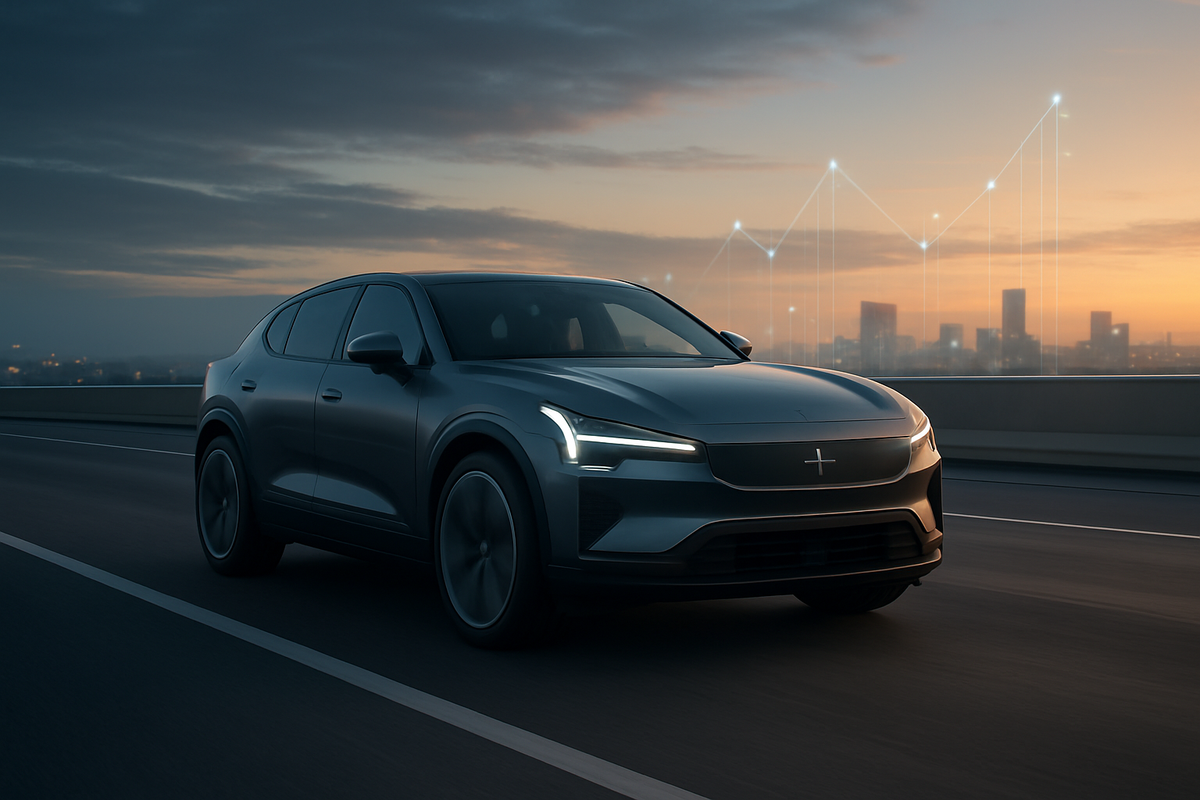
In a dramatic reversal of fortune for the beleaguered electric vehicle sector, Polestar Automotive Holding UK PLC (NASDAQ: PSNY) saw its shares skyrocket by nearly 32% on Friday, February 6, 2026. The surge, which propelled the stock to a closing price of $19.42, marks the company’s most significant single-day gain since its public debut. As the broader market grapples with cooling consumer demand and shifting trade policies, Polestar has emerged as a standout performer, fueled by a massive capital injection and a strategic pivot that appears to have quelled long-standing bankruptcy fears.
The rally is a culminating moment in a transformative three-month period for the premium Swedish brand. Following a year of intense restructuring and a structural 1-for-30 reverse stock split in late 2025, the recent influx of institutional capital and a record-breaking sales report for the 2025 fiscal year have repositioned Polestar as a leading "survivor" in the high-stakes global EV race. For investors, the message is clear: the backing of industrial giants and a diversified manufacturing footprint have turned a speculative play into a serious contender for long-term profitability.
Institutional Lifeline and the 'Geely Backstop'
The primary driver behind the 31.93% surge was the announcement of a $400 million equity financing deal finalized in early February 2026. The funding was secured from a consortium of global financial heavyweights, including Sumitomo Mitsui Banking Corporation (NYSE: SMFG) and Standard Chartered (LSE: STAN). Critically, the shares were priced at $19.34 per American Depositary Share (ADS), providing a high-conviction valuation anchor that far exceeded the stock’s prior trading range.
Investors were particularly encouraged by a unique "put option" agreement provided by Geely Sweden Holdings AB, a subsidiary of Geely Automobile Holdings Ltd (OTC: GELYF). This arrangement effectively grants the participating banks a guaranteed exit path in three years, with Geely pledging to backstop the investment. This level of commitment from Polestar’s parent company has effectively neutralized the "liquidity risk" narrative that plagued the company throughout 2024 and 2025. This deal follows closely on the heels of a $600 million term loan from Geely, bringing the company’s recent capital intake to over $1 billion.
This financial stabilization coincided with the release of Polestar’s full-year 2025 performance data. The company reported delivering 60,119 vehicles in 2025, representing a robust 34% year-over-year increase. Much of this momentum was attributed to a strong fourth quarter, where the global ramp-up of the Polestar 3 and Polestar 4 SUVs led to a 27% jump in retail sales. Under the leadership of CEO Michael Lohscheller, who took the helm in late 2025, Polestar has also successfully narrowed its adjusted EBITDA losses by more than 30%, signaling a move toward operational discipline.
Winners and Losers in the Premium EV Shift
The immediate winner of this market move is undoubtedly Polestar and its strategic partners. Volvo Car AB (STO: VOLV-B), which retains a significant stake in Polestar despite reducing its direct financial exposure in 2024, saw its own shares buoyed by the news. The successful funding round validates Volvo’s decision to maintain a collaborative relationship with the brand while offloading capital intensive responsibilities to Geely. Furthermore, the participation of Sumitomo Mitsui Banking Corporation suggests that major Japanese and European institutions are once again willing to bet on pure-play EV companies, provided they have a clear path to break-even.
Conversely, the success of Polestar’s capital raise puts additional pressure on struggling competitors like Lucid Group, Inc. (NASDAQ: LCID). While Lucid reported a sales jump in January 2026 due to its Gravity SUV, the company remains heavily reliant on the Saudi Arabian Public Investment Fund (PIF) for survival. Polestar’s ability to attract diverse, market-rate financing from commercial banks—rather than just sovereign wealth funds—sets a new benchmark for financial health in the sector.
Legacy automakers also face a challenging comparison. Ford Motor Company (NYSE: F) and General Motors (NYSE: GM) both began 2026 by taking significant multi-billion-dollar restructuring charges as they scaled back their EV ambitions in favor of hybrids. Polestar’s aggressive growth and high-premium sales volume suggest that while the "mass market" EV adoption may be slowing, the high-end luxury segment where Polestar competes remains fertile ground for companies that can deliver technological prestige without the baggage of legacy ICE (internal combustion engine) operations.
Navigating Geopolitical Headwinds and Industry Trends
Polestar’s resurgence is happening against a backdrop of intense global trade tension. By early 2026, the United States has effectively quadrupled tariffs on Chinese-made EVs, a move that would have been catastrophic for Polestar just two years ago. However, the company’s recent stock surge is a testament to its successful "manufacturing diversification" strategy. By moving Polestar 4 production to South Korea and Polestar 3 production to South Carolina, USA, the company has insulated itself from the most punitive trade barriers.
In Europe, the landscape has shifted toward a "Minimum Price Agreement" (MIP) between the EU and China. This policy prevents Chinese manufacturers from undercutting European rivals on price, forcing a competition based on product quality and technology. Polestar, with its Scandinavian design heritage and high-tech interface, is uniquely positioned to thrive under these "price floor" conditions where luxury and performance, rather than low cost, are the primary differentiators.
This event also signals a broader shift in the EV industry from a period of unbridled speculation to one of institutional consolidation. As Tesla, Inc. (NASDAQ: TSLA) pivots its narrative toward AI, robotics, and its "Cybercab" robotaxi fleet, a vacuum has opened for a pure-play automotive brand that focuses on the traditional premium driving experience. Polestar is stepping into that void, leveraging Geely’s supply chain scale while maintaining a distinct identity that appeals to traditional luxury car buyers who are transitioning to electric.
The Road to 2027: What’s Next for PSNY?
Looking ahead, the road for Polestar remains ambitious but narrow. The company has publicly stated its goal to reach free cash flow break-even by late 2027. To achieve this, Polestar must successfully scale its manufacturing in the United States and South Korea without the quality-control hiccups that have hindered peers like Rivian Automotive, Inc. (NASDAQ: RIVN) during their own production ramps.
Short-term volatility may persist as the company navigates the integration of its new funding and continues its global rollout. However, the strategic pivot toward SUVs—the Polestar 3 and 4—places the brand in the most profitable segment of the global auto market. Analysts will be closely watching for the launch of the Polestar 5, a high-performance GT, later in 2026, which is expected to further elevate the brand's status as a technological leader.
The primary challenge moving forward will be maintaining this momentum in an environment where interest rates remain stubbornly high, and consumer sentiment toward pure EVs is cautious. Polestar’s success will depend on its ability to convert its current "top mover" status into consistent quarterly earnings that prove its business model is sustainable without further Geely-backed lifelines.
A New Chapter for the Electric Performance Brand
The 31% surge in Polestar’s stock is more than just a momentary spike; it is a signal of a maturing market that is beginning to reward structural stability and strategic foresight over hype. By securing institutional backing and diversifying its production to bypass geopolitical hurdles, Polestar has provided a blueprint for how a dedicated EV player can survive the transition from a growth story to a sustainable business.
For investors, the key takeaways are the diminishing bankruptcy risk and the clear institutional confidence shown by the $19.34 pricing floor. Moving forward, the market will be looking for continued delivery growth, particularly in the North American market, and signs that the South Carolina production facility is hitting its efficiency targets. As the "EV Winter" continues to freeze out less-prepared competitors, Polestar’s recent performance suggests it has the thermal mass to not only survive but thrive in the next era of mobility.
This content is intended for informational purposes only and is not financial advice.