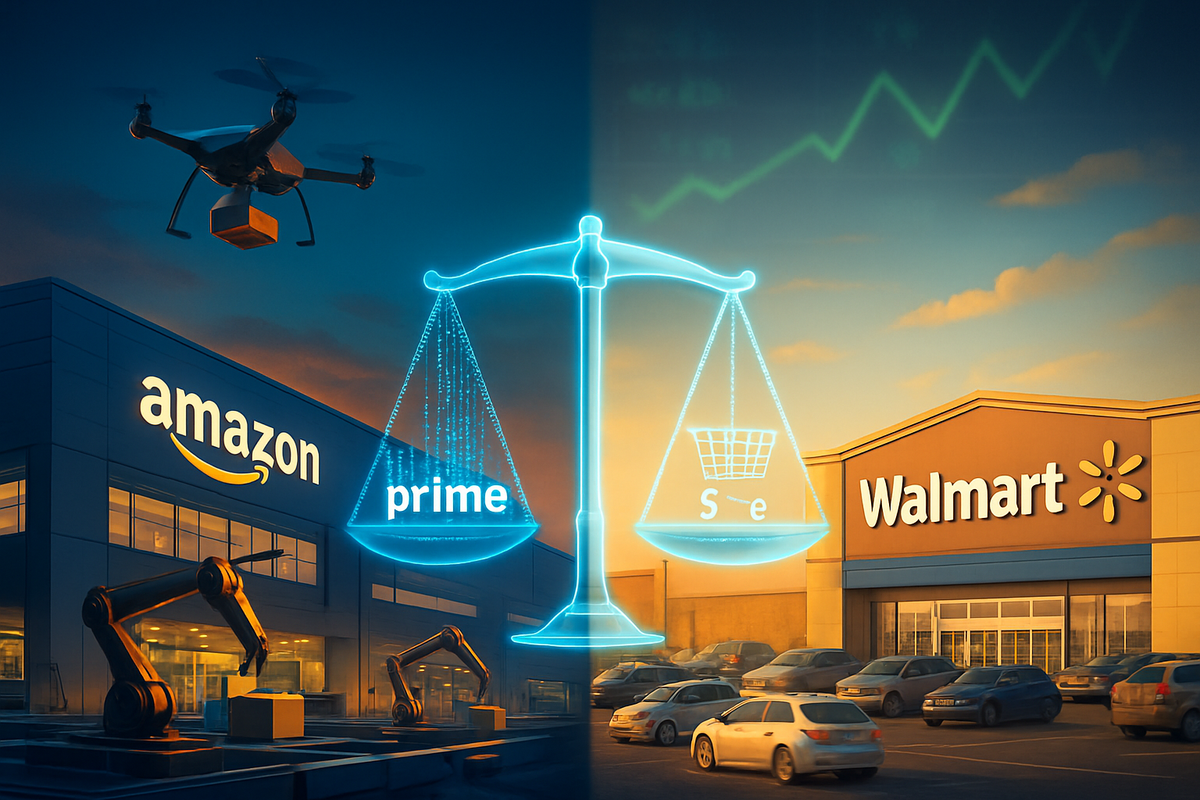
In a watershed moment for the global economy, Amazon.com Inc. (NASDAQ: AMZN) has officially surpassed Walmart Inc. (NYSE: WMT) to become the world’s largest company by annual revenue. As of February 27, 2026, newly released fiscal data confirms that the e-commerce and cloud giant generated $716.9 billion in its most recent fiscal year, narrowly eclipsing Walmart’s $713.2 billion. This shift marks the end of Walmart’s 13-year tenure at the top of the Fortune 500 and signals a definitive transition in the global hierarchy of commerce, where data and infrastructure have finally overtaken the traditional brick-and-mortar powerhouse.
The immediate implications of this milestone are profound, reshaping investor sentiment across both the retail and technology sectors. While the two titans have been locked in a "cold war" for market dominance for over a decade, Amazon’s ability to scale its high-margin Amazon Web Services (AWS) and its burgeoning advertising division allowed it to outpace Walmart’s more capital-intensive physical expansion. For the market, this confirms that the "Amazonification" of retail is no longer a trend but a completed transformation, forcing every major player to rethink their reliance on physical footprint versus digital ecosystems.
The $716.9 Billion Milestone: A Changing of the Guard
The official "changing of the guard" was cemented in mid-February 2026, following a high-stakes earnings season that saw Amazon report a 12% year-over-year revenue increase. The gap between the two companies was a mere $3.7 billion—a razor-thin margin in the context of nearly three-quarters of a trillion dollars—but the symbolic weight is massive. For over half a century, Walmart used its massive logistics network and physical presence to dominate the American consumer landscape. However, Amazon’s relentless push into logistics, coupled with the exponential growth of its cloud computing arm, provided a dual-engine growth model that Walmart’s digital transformation, though impressive, could not quite catch.
The timeline leading to this moment was accelerated by the massive AI spending spree of 2025. While Walmart spent the last year automating its distribution centers, Amazon leveraged its proprietary AI chips—Trainium and Graviton—to lower the cost of its cloud services and enhance its retail recommendation engines. This strategic focus allowed Amazon to capture a larger share of the "agentic commerce" market, where AI assistants increasingly handle routine shopping tasks for consumers. Key stakeholders, including Amazon CEO Andy Jassy and outgoing Walmart CEO Doug McMillon, have spent years positioning their respective firms for this inevitable convergence of bits and atoms.
Initial industry reactions have been a mix of awe and scrutiny. Market analysts noted that while Amazon is now the revenue leader, the nature of its revenue is fundamentally different from Walmart’s. AWS alone contributed $128.7 billion to Amazon's total, operating at margins that a traditional retailer could only dream of. Conversely, Walmart’s debut under new CEO John Furner focused on "Sparky," the company's new AI shopping assistant, signaling that Walmart is no longer content being just a retailer; it is now desperately chasing the "tech-and-services" hybrid model that made Amazon the new king.
Ecosystem Warfare: Winners and Losers in the New Hierarchy
As Amazon takes the crown, the "winners" include the millions of third-party sellers who now account for over 60% of the units sold on Amazon’s platform. These small and medium-sized businesses have benefited from Amazon’s massive $200 billion capital expenditure plan, which has streamlined global logistics to the point where "same-day delivery" is now the standard for over 100 million items. Additionally, tech firms like Nvidia (NASDAQ: NVDA) continue to win as the primary suppliers of the hardware powering Amazon’s AI-driven logistics and cloud dominance.
On the losing end are mid-tier retailers who lack the capital to compete with the "big two." Companies like Target Corp. (NYSE: TGT) and Best Buy Co. Inc. (NYSE: BBY) are finding themselves squeezed in a pincer movement. They lack the cloud revenue of Amazon and the massive grocery footprint of Walmart, making it increasingly difficult to match the delivery speeds and price points of the market leaders. Furthermore, traditional advertising agencies are losing ground to "Amazon Ads," which reached $68.6 billion in revenue this past year, effectively cannibalizing budgets that used to go to television and search engines.
The shift also places immense pressure on traditional logistics providers. As Amazon expands its own delivery fleet and uses AI to predict consumer needs before they even place an order, legacy carriers are being relegated to "overflow" status. However, Walmart’s acquisition of VIZIO (NYSE: VZIO) and its growth in the "Walmart Connect" advertising space show that the Arkansas-based giant is not going down without a fight. The real losers may be the local communities where "zombie malls" continue to proliferate as the battle for the American wallet moves entirely to the phone and the automated fulfillment center.
The Death of Pure-Play Retail and the Rise of the Hybrid Model
This event fits into a broader industry trend toward "conglomerate-lite" structures, where a company’s primary service (selling socks or groceries) is subsidized by its secondary high-margin service (cloud data or advertising). In the 20th century, Sears and Kmart failed because they could not transition away from their physical limitations. Amazon’s ascent is the first time a company has successfully leveraged a secondary, unrelated business—cloud computing—to fund the conquest of a primary market. This creates a historical precedent that will likely be studied by regulators for decades.
The regulatory implications are already mounting. With Amazon now the largest revenue generator in the world, antitrust hawks in both the U.S. and the EU are expected to increase their scrutiny of the "flywheel" effect. Critics argue that using AWS profits to subsidize predatory pricing in the retail sector creates an unlevel playing field that no traditional retailer can survive. This milestone could serve as the catalyst for new legislation aimed at separating platform owners from platform participants—a move that would fundamentally alter Amazon’s business model.
Historically, the transition of the "top spot" has always signaled a shift in the American psyche. When General Motors was surpassed, it signaled the end of the industrial age. When Walmart took the lead from ExxonMobil, it signaled the rise of the consumer economy. Now, Amazon’s move to the top signals the dawn of the "Intelligence Economy," where the value of a company is measured not by its inventory, but by its ability to process data and automate the movement of goods through AI.
The Road to $1 Trillion: AI and Automation
Looking ahead, the next phase of this rivalry will be fought in the realm of "Agentic AI." Amazon has already signaled its intentions with a $200 billion investment plan dedicated to AI infrastructure and the integration of "Alexa+"—a more sophisticated, agent-based version of its voice assistant. The goal is a world of "zero-click commerce," where Amazon’s AI anticipates a household’s needs and delivers products before the consumer even realizes they are out of stock. Short-term, this will require massive strategic pivots in how the company manages its workforce and its relationship with organized labor.
Walmart, meanwhile, is betting on its 4,700 U.S. stores as "micro-fulfillment centers." In the long term, Walmart's proximity to 90% of the American population remains its greatest defensive moat. The company is doubling down on "Walmart+," which has grown to over 28 million members, by bundling streaming services like Paramount+ and Peacock to mimic the Prime ecosystem. The challenge for Walmart will be whether it can pivot its corporate culture fast enough to act like a tech company while maintaining its reputation as a value-driven retailer.
Investors should watch for the "convergence of margins." As Walmart automates its supply chain to lower costs and Amazon scales its advertising and cloud businesses to raise profits, the two companies are actually becoming more like each other. The market opportunity lies in who can successfully integrate "Automated Agentic Commerce" first. If Amazon can successfully deploy its humanoid robotics fleet to lower fulfillment costs, it may not just be the largest company by revenue, but the most profitable entity in human history.
Summary and Final Assessment
The rise of Amazon to the top of the revenue charts is more than just a financial metric; it is a confirmation of a new economic reality. Key takeaways include the dominance of the hybrid business model, the critical role of AI in future retail, and the diminishing importance of the physical storefront as a primary driver of growth. While Walmart remains the larger "pure" retailer in terms of physical goods sold, Amazon’s diversified ecosystem has proven more resilient and scalable in a digital-first world.
Moving forward, the market will likely see increased volatility in the retail sector as competitors scramble to find their niche in an Amazon-Walmart duopoly. Investors should keep a close eye on AWS growth rates and Walmart’s "Sparky" AI adoption over the coming months. The lasting impact of this shift will be felt in everything from urban planning and logistics to data privacy and antitrust law. For now, the crown has moved from Bentonville to Seattle, marking the definitive start of the era of the Tech-Retail Titan.
This content is intended for informational purposes only and is not financial advice.