As the dust settles on Walmart's (NYSE: WMT) blockbuster fourth-quarter earnings report, the retail giant has not only exceeded market expectations but has also set the stage for what analysts are calling a "spring of stimulus." While the official earnings call took place on February 19, the market is still processing the implications of Walmart’s record $190.7 billion in quarterly revenue—a figure that underscores the company’s evolution from a big-box discounter into a dominant, tech-driven ecosystem. As of February 24, 2026, the focus has shifted toward the massive liquidity injection hitting consumer bank accounts via the "One Big Beautiful Bill" (OBBB) Act, which is expected to supercharge retail spending throughout the first half of the year.
The immediate implications of Walmart’s "beat and raise" performance are clear: the American consumer remains resilient, albeit increasingly surgical in their spending habits. By posting an adjusted earnings per share (EPS) of $0.74—edging out the $0.73 consensus—and a 27% surge in U.S. e-commerce sales, Walmart has signaled that it is the primary beneficiary of a polarized economy. Investors are now closely watching how this momentum will collide with the largest tax refund season in U.S. history, fueled by the retroactive tax cuts of 2025 that are finally being realized in 2026 filings.
The 'One Big Beautiful Bill' and the $91 Billion Windfall
The primary catalyst for the current retail optimism is the "One Big Beautiful Bill" Act (Public Law 119-21), signed into law on July 4, 2025. This landmark legislation, a cornerstone of the second Trump administration’s fiscal policy, permanently extended the 2017 tax cuts while introducing aggressive new provisions, including "No Tax on Tips" and "No Tax on Overtime," both capped at $25,000 in deductions. Critically for the current quarter, these cuts were made retroactive to January 1, 2025. However, because the IRS did not adjust payroll withholding tables during the 2025 calendar year, millions of Americans effectively overpaid their taxes for twelve months.
This accounting lag has resulted in a historic "catch-up" refund season. Analysts from Bank of America (NYSE: BAC) and Wells Fargo (NYSE: WFC) estimate that the average individual tax refund in 2026 has ballooned to roughly $4,000—a nearly 20% increase over 2025 levels. Total retroactive relief is projected to inject between $65 billion and $100 billion into the U.S. economy between February and May. Walmart’s management noted during their earnings call that they are already seeing early signs of this liquidity, with higher-ticket items in electronics and home goods beginning to move after a year of stagnation.
Winners and Losers in the Polarized Retail Landscape
Walmart’s dominance is creating a widening gap between the "haves" and "have-nots" of the retail sector. While Walmart (NYSE: WMT) and Amazon (NASDAQ: AMZN) continue to gain market share through superior logistics and AI integration, Target (NYSE: TGT) continues to struggle. Target has faced persistent softness in discretionary categories like apparel, forecasting a 1% revenue decline for its upcoming report. The "K-shaped" recovery is evident here; middle-income shoppers are trading down from Target’s "cheap chic" to Walmart’s "everyday low prices" to stretch their tax-refund dollars further.
In the discount space, Dollar General (NYSE: DG) and Dollar Tree (NASDAQ: DLTR) are positioning themselves as aggressive "refund hunters." Dollar General has launched "Project Elevate," a massive plan to remodel 4,200 stores to accommodate fresh produce and expanded grocery options, targeting the 3 million new households that have started shopping at dollar stores in the last year. Conversely, Dollar Tree is leaning into its multi-price strategy, offering items at $5, $7, and $9 price points to capture the larger refund checks of its new, higher-income customer base. Meanwhile, Costco (NASDAQ: COST) remains a fortress of stability, reporting a 7.1% jump in January sales as affluent consumers use their tax savings to bulk-buy high-end perishables.
The Rise of Agentic Commerce and AI 'Super Agents'
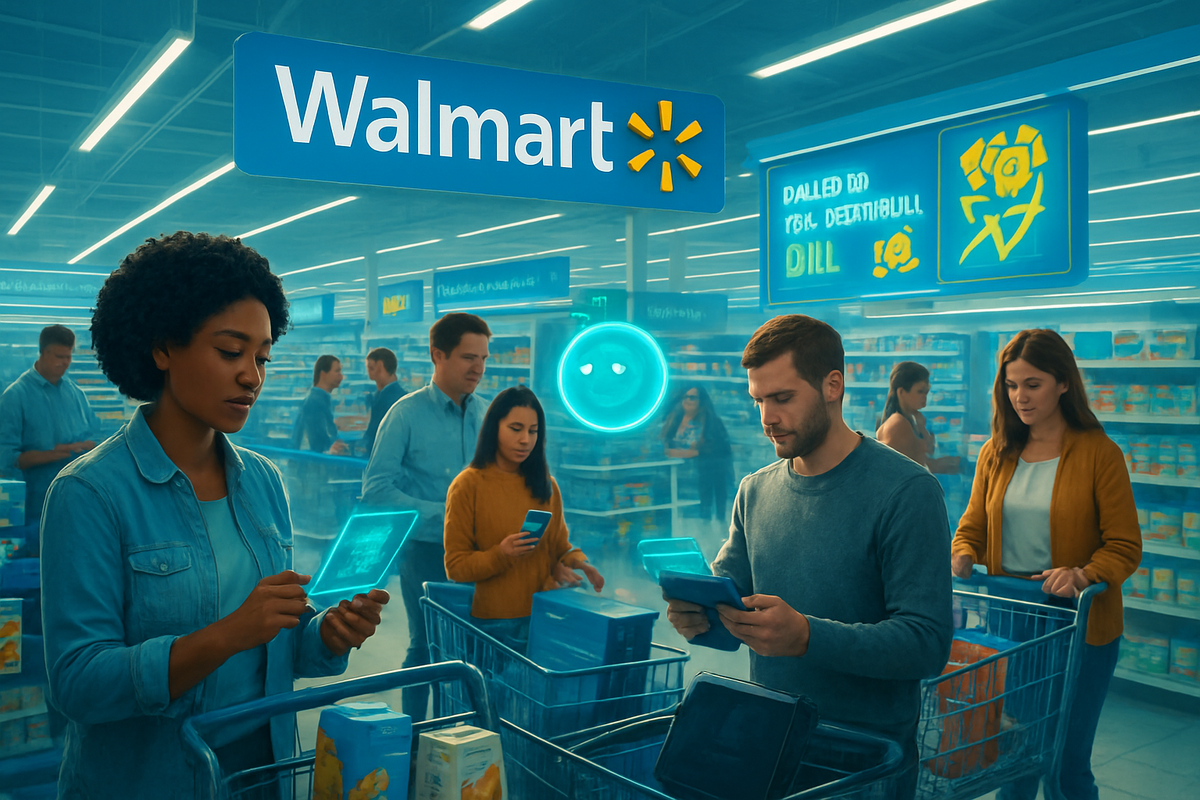
Beyond the fiscal stimulus, Walmart’s success is being driven by a fundamental shift in how people shop, a trend known as "Agentic Commerce." The 2026 earnings report highlighted the massive adoption of "Sparky," Walmart’s generative AI shopping assistant. Unlike the basic chatbots of 2024, Sparky is a true autonomous agent. It can reason through complex requests—such as "optimize my weekly grocery list for a high-protein diet on a $150 budget"—and execute the purchase across Walmart’s omnichannel network. Walmart reported that customers using Sparky have a 35% higher average order value than those who do not.
This shift fits into a broader industry trend where brand loyalty is being replaced by "utility loyalty." Through a landmark partnership with Google (NASDAQ: GOOGL), Walmart has integrated Sparky with the Gemini AI ecosystem, allowing shoppers to initiate purchases via voice or image search and have the agent handle the fulfillment. However, this high-tech pivot comes as retailers face significant "tariff headwinds" due to 2026 trade policies. To protect margins, Walmart and Amazon (NASDAQ: AMZN) are pivoting toward high-margin services, such as digital advertising and membership fees (Walmart+ and Prime), to offset the rising cost of imported goods.
Looking Ahead: The Zero-Click Replenishment Era
The next six months will likely be defined by the transition to "Zero-Click Replenishment." Walmart is already testing predictive reordering, where Sparky autonomously manages a household’s essentials based on consumption patterns monitored by smart home devices and past purchase data. Short-term, the focus remains on capturing the $91 billion OBBB Act windfall, but the long-term strategic pivot is toward becoming a service-and-technology platform rather than just a seller of goods.
Market opportunities are emerging in the "agent-to-agent" economy, where a consumer's personal AI agent negotiates prices with a retailer's AI agent. For investors, the challenge will be identifying which retailers can afford the massive capital expenditures required to maintain this infrastructure. Amazon (NASDAQ: AMZN) recently announced a $200 billion capex plan for 2026, a staggering sum that initially spooked the market but underscored the "arms race" currently underway in retail technology.
Wrap-Up and Investor Outlook
Walmart's Q4 performance and the subsequent market reaction as of late February 2026 confirm that the company is the "new utility" of the American household. The synergy between the "One Big Beautiful Bill" Act’s massive tax refunds and Walmart’s technological evolution via Sparky has created a powerful tailwind for the stock. With a newly authorized $30 billion share buyback program, Walmart is signaling to investors that it has ample cash to weather any potential tariff-induced margin compression in the latter half of the year.
Moving forward, investors should watch for the "velocity of the refund." If the $91 billion stimulus is spent quickly on high-margin discretionary items, we could see a massive upward revision for the entire retail sector by mid-year. However, if consumers use their retroactive tax cuts primarily to pay down debt or build savings in an uncertain geopolitical climate, the "retail renaissance" may be more of a "retail relief." For now, Walmart stands at the center of the storm, proving that in 2026, the winner in retail is the one who controls both the price point and the AI agent that finds it.
This content is intended for informational purposes only and is not financial advice.