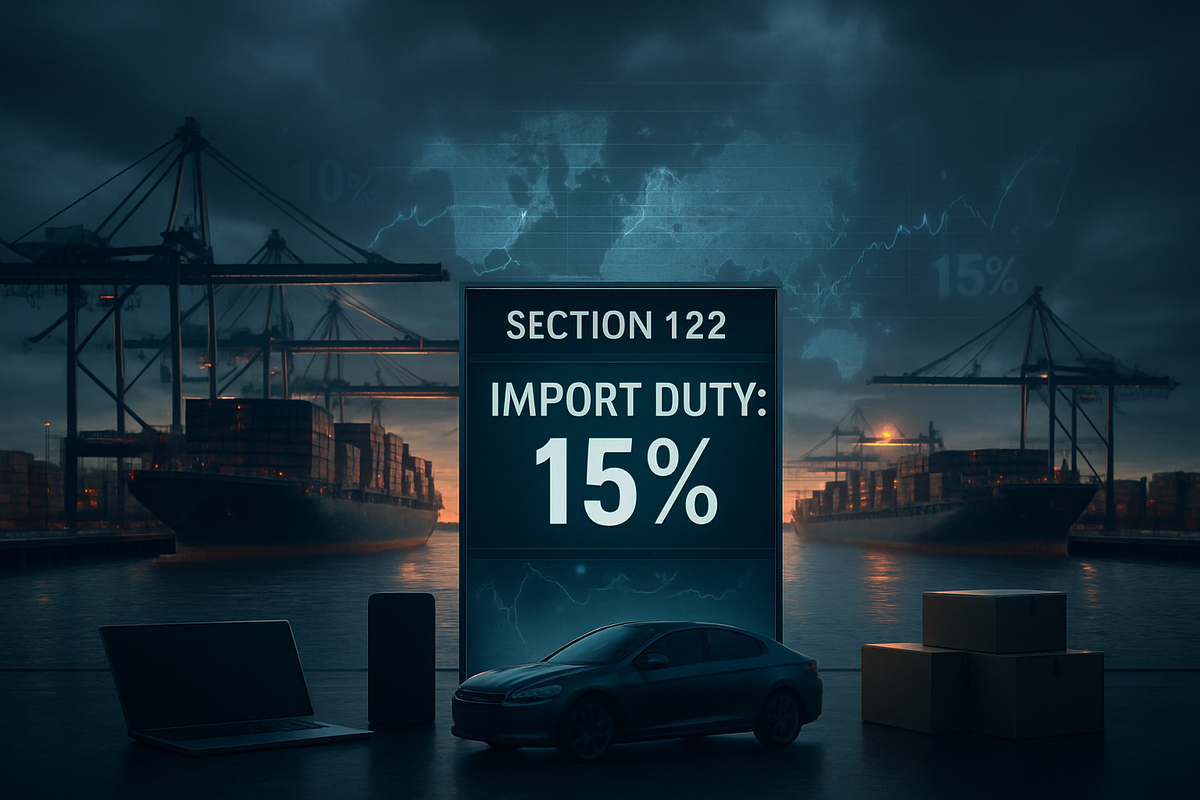
The global trade landscape underwent a seismic shift at 12:01 a.m. EST on February 24, 2026, as the United States officially implemented a 10% global import tariff under Section 122 of the Trade Act of 1974. This move, characterized as a "Plan B" by the administration, comes just days after the U.S. Supreme Court struck down a previous set of "reciprocal" tariffs. While the current rate stands at 10%, President Trump has already signaled via social media his intention to hike the surcharge to the statutory maximum of 15%, creating a climate of intense operational uncertainty for multinational corporations and domestic retailers alike.
The immediate implications for the U.S. market are stark: an instant increase in the cost of imported goods across nearly every sector, from consumer electronics to automotive components. Although the Section 122 duties are legally capped at a 150-day duration, the sudden implementation has triggered a "risk-off" environment on Wall Street. As the market digested the news on Tuesday morning, the S&P 500 hovered near the 6,837 level, while the Nasdaq Composite (INDEXNASDAQ: .IXIC) faced continued pressure following a volatile Monday session that saw defensive sectors outperforming growth-oriented tech stocks.
The Return of Section 122: A Strategic Pivot
The activation of Section 122 follows a chaotic week in trade policy. On February 20, 2026, the Supreme Court ruled that the administration’s previous use of the International Emergency Economic Powers Act (IEEPA) for broad "reciprocal" tariffs was unconstitutional. Facing the sudden loss of billions in monthly tariff revenue and a central pillar of its trade agenda, the White House pivoted to Section 122—a Cold War-era provision designed to address "fundamental international payments problems." This specific authority allows the President to impose temporary surcharges of up to 15% for a period of 150 days to correct a balance-of-payments deficit.
The timeline leading to this moment has been marked by rapid-fire executive action. Following the court's Friday ruling, President Trump spent the weekend consulting with trade advisors before announcing the new "Plan B" surcharge on February 21. While the 10% rate was operationalized by the customs deadline on February 24, the administration has been vocal about its desire to move to 15% almost immediately. The legal justification rests on a reported $1.2 trillion goods trade deficit, which the administration argues constitutes a threat to national economic security.
Initial industry reactions have been a mix of confusion and strategic recalibration. Domestic manufacturing groups have largely supported the move as a necessary protectionist measure, while the U.S. Chamber of Commerce and various retail trade associations have condemned the tariffs as a "tax on the American consumer." On the morning of February 24, international partners including the European Union and China issued stern warnings of retaliation, with the EU freezing the ratification of the "Turnberry" trade agreement in direct response to the new levies.
Sector Divergence: Winners, Losers, and the Resilient
The impact of the Section 122 duties has created a sharp divide between companies capable of absorbing costs and those with thin margins. Walmart (NYSE: WMT) emerged as an early "relative winner," with its stock rising approximately 2.3% on the day of implementation. Analysts suggest that Walmart’s immense scale and sophisticated supply chain allow it to negotiate better terms with suppliers to mitigate the 10% hit. Furthermore, Walmart is a primary candidate for massive refunds from the now-invalidated IEEPA tariffs, providing a significant fiscal cushion. Conversely, Target (NYSE: TGT) saw its shares retreat as investors fretted over its higher exposure to imported discretionary goods and a less flexible supply chain compared to its larger rival.
In the automotive sector, the outlook is considerably more somber. Ford Motor Company (NYSE: F) and General Motors (NYSE: GM) are both facing significant headwinds. GM has already signaled a potential $750 million to $1 billion tariff hit for the first quarter of 2026 alone. While some final vehicle assemblies remain exempt, the cost of specialized imported components has risen instantly, squeezing margins in a sector already grappling with the high costs of the electric vehicle transition. Shares of Ford were notably volatile in early trading on February 24 as the market weighed the impact of increased raw material costs against potential domestic market share gains.
The technology sector presents a more nuanced picture. Apple (NASDAQ: AAPL) saw its shares fluctuate but ultimately remain resilient. For Apple, a flat 10% or 15% global tariff is actually lower than the 35–40% "reciprocal" duties it had been facing on certain Asian components under the previous, now-voided regime. Similarly, NVIDIA (NASDAQ: NVDA) remained relatively stable. While the tariff affects hardware production costs, the insatiable demand for AI infrastructure and NVIDIA's high profit margins make it less sensitive to a 10% duty than consumer-facing hardware companies.
Broader Significance and Historical Precedents
The use of Section 122 represents a significant escalation in the use of executive trade powers. Historically, this provision was intended for use in fixed-exchange rate regimes—a system the global economy moved away from in the 1970s. By invoking "Balance of Payments" as a justification in a floating-rate era, the administration is testing the boundaries of trade law. This event fits into a broader trend of "de-globalization" and the weaponization of trade policy as a tool for industrial strategy.
The ripple effects are already being felt globally. The European Union has warned it may reactivate €93 billion in retaliatory levies on high-profile U.S. exports, including bourbon and steel derivatives. China’s Ministry of Commerce has called the measures "unilateral and illegal," threatening to restrict exports of critical minerals such as rare earths. These developments mirror the trade wars of 2018-2019 but carry higher stakes given the current fragility of global supply chains and the integrated nature of the modern high-tech economy.
From a regulatory standpoint, the 150-day limit on Section 122 creates a "ticking clock" scenario. This temporary window is likely intended to force trading partners back to the negotiating table or to provide enough time for the administration to find a more permanent legislative or executive solution that survives judicial scrutiny. The precedent set here could lead to more frequent use of obscure trade statutes to bypass congressional gridlock or unfavorable court rulings.
What Comes Next: The 150-Day Countdown
The immediate focus for investors will be the President's State of the Union address, scheduled for the evening of February 24, where he is expected to provide further clarity on the 15% rate hike. In the short term, companies will likely engage in "front-running," attempting to pull forward imports before the 15% rate is finalized. This could lead to a temporary spike in shipping volumes and logistics costs, followed by a significant cooling period as inventories are worked through.
Long-term, a strategic pivot toward "near-shoring" or domestic production is expected to accelerate, though such transitions take years, not months. Market opportunities may emerge for domestic logistics firms and software providers that specialize in supply chain optimization and tariff management. However, the potential for a full-scale trade war with the EU and China remains the primary "tail risk" that could dampen global growth projections for the remainder of 2026.
Market Outlook and Final Thoughts
The implementation of Section 122 tariffs on February 24, 2026, marks a pivotal moment for the U.S. economy. The key takeaway for investors is that trade policy has entered a phase of high volatility where "Plan B" strategies can be deployed with little warning. The market is currently in a "wait and see" mode, balancing the potential for corporate tax refunds from the previous tariff regime against the new costs imposed by the global surcharge.
Moving forward, the market will likely remain sensitive to any rhetoric regarding the 15% hike and the response from international trade blocs. Investors should closely monitor the earnings calls of major importers over the next quarter to assess how much of the tariff cost is being passed on to consumers versus absorbed by margins. While some large-cap companies like Walmart and Apple appear positioned to weather the storm, the broader consumer discretionary sector remains at risk. The next 150 days will be a critical test of the administration's trade strategy and the resilience of the American corporate sector in a rapidly changing global order.
This content is intended for informational purposes only and is not financial advice