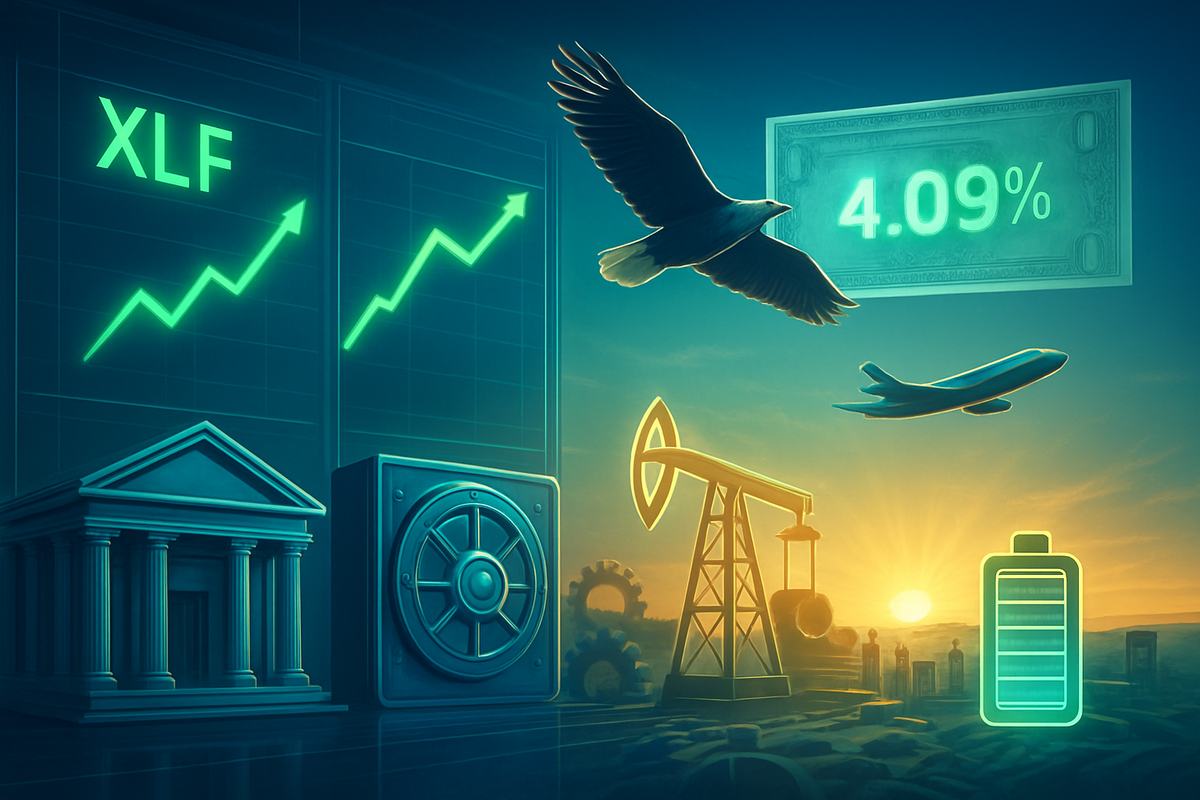
The U.S. financial markets witnessed a powerful midday rally on February 18, 2026, as investors aggressively rotated into cyclical sectors, fueled by a potent combination of surging Treasury yields and surprisingly robust industrial data. By the middle of the trading session, the Financial Select Sector SPDR Fund (NYSEARCA: XLF) emerged as a primary engine of market growth, mirroring a broader "reflation trade" that has increasingly defined the first quarter of the year. This surge pushed the S&P 500 up by 0.84%, as the market shook off earlier anxieties regarding the Federal Reserve’s long-term interest rate path.
The rally marks a significant pivot in investor sentiment, shifting away from the high-growth technology narratives that dominated 2025 and toward "Old Economy" stalwarts. With the 10-year Treasury yield climbing back above the 4% threshold, the banking sector is finding new life, as widened spreads promise a recovery in net interest margins. Alongside the financials, the Energy Select Sector SPDR Fund (NYSEARCA: XLE) continued its torrid 2026 run, benefiting from rising crude prices and a strengthening industrial backdrop, cementing a day where tangible assets and cash-flow-heavy lenders led the charge.
Economic Data Ignites the Reflation Trade
The catalyst for Wednesday's midday momentum was the release of the Federal Reserve’s G.17 report on industrial production, which painted a picture of a domestic economy that is far from cooling. Industrial production for January rose by a staggering 0.7%, crushing the consensus economist forecast of just 0.2%. More impressively, manufacturing output—a key barometer of economic health—climbed by 0.6%, marking its strongest monthly performance in nearly a year. This data effectively neutralized concerns stemming from a stagnant December retail sales report, suggesting that while consumers may be tightening their belts, the nation’s "physical economy" and industrial infrastructure are accelerating.
This macroeconomic strength sent immediate ripples through the bond market. The yield on the 10-year Treasury note climbed to 4.09%, recovering from a two-month low of 4.04% hit earlier in the week. Simultaneously, the 2-year Treasury note rose to 3.46%. For the banking sector, this steepening of the yield curve is a critical fundamental tailwind. Higher long-term rates allow banks to charge more for loans while maintaining relatively lower costs on short-term deposits, directly padding the bottom line of the nation’s largest lenders.
The reaction on trading floors was swift. Traders who had spent the early morning hours braced for potential volatility ahead of the afternoon’s FOMC minutes release instead pivoted toward cyclicals. The narrative of a "no-landing" scenario—where the economy continues to grow despite high interest rates—has become the dominant theme of the day. This shift was characterized by a visible migration of capital out of "priced-for-perfection" software stocks and into large-cap banks and energy producers, which offer more attractive valuations in a higher-yield environment.
Large-Cap Banks Lead the Charge
JPMorgan Chase & Co. (NYSE: JPM) stood at the forefront of the banking rally, with its shares climbing 1.51% by midday. The banking giant capitalized on the optimistic mood by announcing an aggressive physical expansion plan, including the opening of 160 new branches. This move signals a deep confidence in the traditional banking model and the bank's ability to capture more market share even as digital competition remains fierce. With a Return on Equity (ROE) of over 17%, JPMorgan remains the gold standard for investors looking to play the reflationary trend.
Citigroup Inc. (NYSE: C) was the session's standout performer among the "Big Three," with shares jumping 2.4%. The rally was propelled by the strategic announcement that the bank had finalized its full exit from the Russian market by selling its subsidiary to Renaissance Capital. This long-awaited move is expected to unlock approximately $4 billion in regulatory capital, providing Citigroup with a significant war chest for share buybacks or reinvestment into its core wealth management and corporate banking divisions.
Meanwhile, Bank of America Corp. (NYSE: BAC) saw a more modest but steady gain of 0.2%, trading near the $52.74 level. Investors have remained bullish on the firm due to its disciplined cost management and a healthy 29% dividend payout ratio. Beyond the banks, the energy sector’s heavyweights, such as Exxon Mobil Corp. (NYSE: XOM) and Chevron Corp. (NYSE: CVX), tracked the 2.5% rise in WTI Crude prices, which hit $63.89 per barrel. These companies are increasingly viewed as "safe havens" for cash flow in an environment where geopolitical tensions in the Middle East continue to pressure global supply.
Wider Significance and Sector Rotation
The midday rally on February 18 is more than just a single-day fluctuation; it represents a deepening of the "Great Rotation" that began at the turn of the year. This trend suggests that the market is finally adjusting to a "higher-for-longer" interest rate environment, moving away from the dependency on cheap capital that fueled the tech boom of the early 2020s. The high correlation between Financials and Energy today underscores a market that is betting on the durability of the U.S. industrial base and the necessity of traditional banking infrastructure.
This shift mirrors historical precedents, such as the mid-2000s or the post-pandemic recovery of 2021, where a combination of rising yields and firming commodity prices favored cyclicals over growth. However, the 2026 iteration is unique due to the role of high-tech manufacturing. The surge in industrial production was led significantly by semiconductors and AI hardware, suggesting that the "New Economy" is now driving the "Old Economy's" factories. This synergy is creating a more resilient market structure than previous cycles.
From a regulatory standpoint, the capital unlock at Citigroup and the expansion at JPMorgan highlight a banking sector that feels emboldened by its current capital positions. While the Federal Reserve remains cautious about inflation, the strength in manufacturing suggests that the "supply side" of the economy is expanding, which could eventually help dampen inflationary pressures without requiring a recessionary "hard landing." This provides a favorable backdrop for bank regulators to maintain a steady, if not slightly more relaxed, posture toward the industry’s largest players.
Looking Forward: Scenarios and Strategy
Looking ahead, the primary focus for market participants will be the Federal Reserve’s reaction to this continued economic strength. While the "no-landing" scenario is currently fueling stock gains, it also raises the floor for how low interest rates can eventually go. If the industrial sector continues to overheat, the Fed may be forced to maintain its current stance longer than the market previously anticipated, which could eventually create a "tipping point" for consumer-facing sectors that are already showing signs of fatigue.
In the short term, the performance of the Financials sector will likely hinge on the upcoming quarterly earnings reports, where investors will look for concrete evidence that higher yields are translating into significantly improved net interest income. For Energy, the trajectory is more closely tied to geopolitical developments and the ongoing supply-demand balance in the global oil market. Strategic pivots may be required for investors who remain overweight in technology, as the valuation gap between "Growth" and "Value" continues to close.
The potential for a "Goldilocks" outcome remains on the table, but it is a narrow path. If the banking sector can maintain its momentum without triggering a broader credit crunch, and if energy prices stabilize enough to prevent a second wave of inflation, the current rally could serve as the foundation for a multi-quarter bull run in cyclicals. However, any sudden shift in the labor market or a sharper-than-expected decline in consumer spending could quickly reverse the midday optimism seen today.
Market Wrap-Up and Takeaways
The midday surge on February 18, 2026, serves as a vivid reminder of the market’s underlying resilience and its capacity for rapid sector rotation. With the Financials and Energy sectors leading the S&P 500, the "reflation trade" has clearly regained its footing. The combination of strong industrial output and rising Treasury yields has created a sweet spot for large-cap banks like JPMorgan Chase and Citigroup, which are now poised to benefit from improved margins and strategic capital deployments.
As the market moves forward, investors should keep a close watch on the relationship between yield movements and economic data. The current "no-landing" narrative is a double-edged sword: it justifies higher equity valuations for banks and energy firms but also keeps the threat of persistent inflation alive. The divergence between strong industrial performance and flat retail sales suggests a bifurcated economy that will require careful navigation in the months ahead.
In conclusion, the events of February 18 highlight a fundamental shift in the market's leadership. The dominance of the Financials sector today suggests that the era of "Value" may be far from over. Investors should remain vigilant, watching for the next round of Federal Reserve commentary and industrial indicators to see if this midday rally is the start of a lasting trend or a temporary reprieve in an otherwise volatile year.
This content is intended for informational purposes only and is not financial advice.