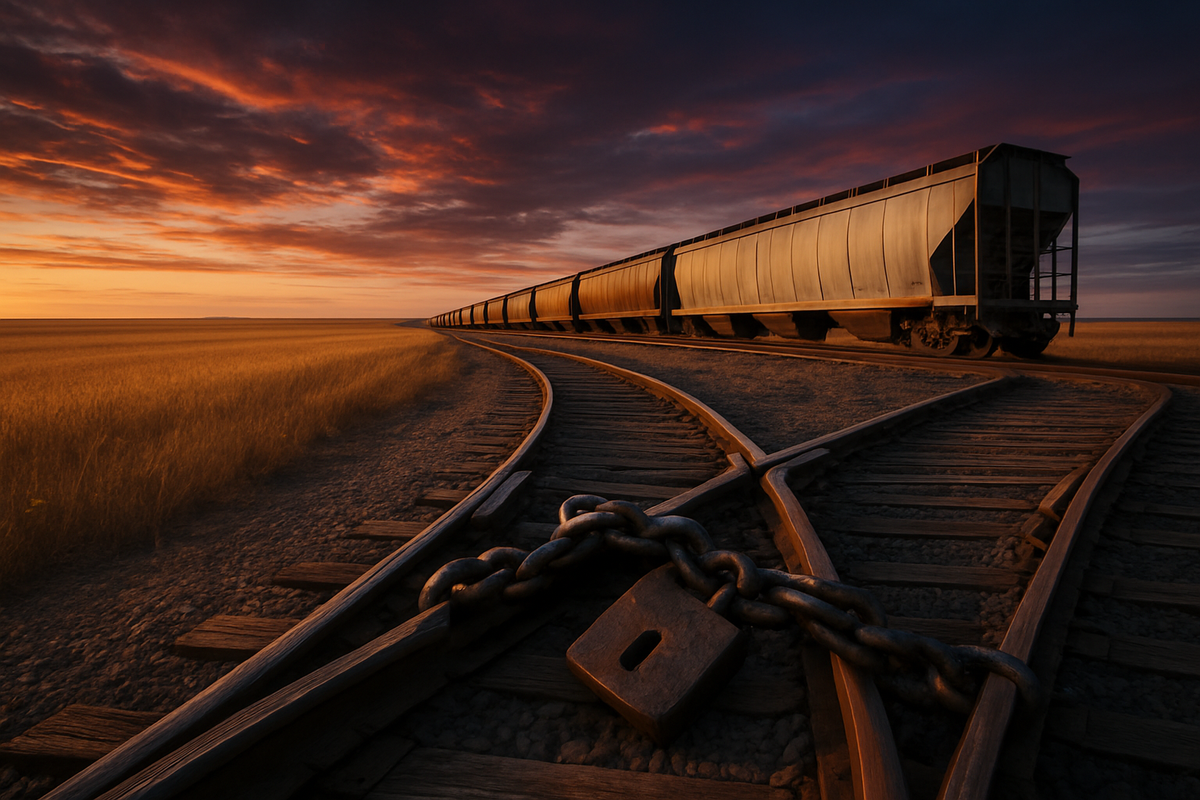
In a legal battle that could reshape the logistics of the American breadbasket, Weskan Grain LLC and a coalition of 13 local farmers have filed a major antitrust lawsuit against rail giant Union Pacific Railroad Company (NYSE: UNP) and the Kansas & Oklahoma Railroad (K&O). Filed in late January 2026 in the U.S. District Court for the District of Kansas, the lawsuit alleges a decades-old lease was "secretly and unlawfully" amended to create a "paper barrier" that stifles competition and artificially inflates shipping costs for grain exports.
The plaintiffs contend that a prohibitive $500-per-car interchange fee has effectively locked western Kansas and eastern Colorado farmers into a monopoly. By making the more efficient westward route over the Towner Line economically unviable, the railroads allegedly force grain to travel hundreds of unnecessary miles, a move that the lawsuit claims depresses the "basis" prices paid to local farmers and threatens the long-term viability of the regional agricultural economy.
The 'Secret' Agreement and the $500 Barrier
The crux of the litigation centers on a 2019 "Fourth Supplement" to a 1997 lease agreement between Union Pacific and K&O, a subsidiary of the privately held Watco. According to the complaint, this amendment was designed to protect Union Pacific’s dominance over westward grain shipments following the 2018 rehabilitation of the Towner Line by the Colorado Pacific Railroad (CXR). Before this line was reopened, Union Pacific faced little competition for grain moving from the High Plains to West Coast ports or Western mills.
The lawsuit alleges that the defendants instituted a "paper barrier"—a contractual clause that imposes an exorbitant interchange fee of more than $500 for every railcar that moves from K&O tracks onto the competing Towner Line. In a industry where margins are razor-thin, such a fee is described as "cost-prohibitive," effectively neutralizing the Towner Line as a competitive alternative. As a result, not a single westward-bound railcar has utilized the Towner Line from the disputed region in over six years.
The operational inefficiency caused by this agreement is staggering. Instead of moving directly west, grain originating near Scott City, Kansas, is allegedly forced to travel 140 miles east to Great Bend, Kansas, just to interchange with Union Pacific before it can finally turn back around and head west. This detour adds significant time and fuel costs, which the plaintiffs argue are passed directly down to the producers. To bypass this bottleneck, Weskan Grain reports it is forced to utilize approximately 25,000 truck moves annually, an expensive and carbon-intensive workaround.
Winners and Losers: A Stakeholder Analysis
Union Pacific Railroad Company (NYSE: UNP) stands as the primary defendant and the entity with the most to lose if the court strikes down the interchange fees. For years, UP has enjoyed a 100% market share of westward rail traffic from this specific region. A loss in court could not only result in "triple damages" under the Sherman Antitrust Act but also force the railroad to compete on pricing and service for the first time in decades. Furthermore, the timing is precarious as UP navigates a potential merger with Norfolk Southern Corporation (NYSE: NSC); allegations of anticompetitive behavior in the Midwest could invite stricter scrutiny from the Surface Transportation Board (STB) regarding the larger merger.
On the other side, Weskan Grain and its parent, the Soloviev Group, represent the potential winners. Successfully breaking the "paper barrier" would allow their subsidiary, Colorado Pacific Railroad, to capture a significant portion of the regional grain traffic. For the 13 local farmers named in the suit—including operations like D&L Farms and Hineman Land & Cattle—a victory would mean a direct increase in their bottom line. By reducing transportation overhead, the "basis" price for their grain would likely rise, providing much-needed relief to a sector currently battling high production costs and stagnant commodity prices.
Short-line operators like the Kansas & Oklahoma Railroad find themselves in a complex position. While K&O is a defendant, the lawsuit highlights the restrictive nature of the leases that many small railroads must sign with "Class I" giants like Union Pacific. While K&O currently benefits from the protected traffic flow, a ruling against these types of "paper barriers" could ultimately provide short-lines across the country with more autonomy to choose the most efficient routes for their customers.
Broader Industry Trends and Regulatory Fallout
This lawsuit is not happening in a vacuum. It reflects a growing frustration within the agricultural sector over rail consolidation and service quality. Over the last decade, the U.S. rail industry has seen massive consolidation, leaving many shippers with only one viable rail option. The concept of the "paper barrier" has long been a point of contention at the STB, with regulators frequently debating whether these legacy contracts serve the public interest or merely protect monopoly rents.
The case also draws comparisons to historical antitrust actions in the rail sector, where courts have had to step in when administrative bodies were seen as too slow to act. Throughout 2025, Weskan Grain pursued this matter through the STB, successfully winning motions to compel discovery that forced the railroads to turn over internal documents regarding the 2019 amendment. The transition from an administrative battle to a federal antitrust lawsuit suggests the plaintiffs believe the evidence of "price fixing" is strong enough to meet the high bar of the Sherman Act.
Furthermore, if the court rules in favor of the farmers, it could set a precedent that challenges thousands of similar "paper barrier" agreements across the United States. Such a shift would represent a fundamental change in the relationship between Class I railroads and the smaller short-line railroads that serve as the "first and last mile" of the American supply chain.
Future Outlook and Strategic Pivots
In the short term, market participants should expect significant volatility in the legal proceedings. Union Pacific has already indicated it will seek to have the case moved back to the STB or dismissed, arguing that the federal court lacks jurisdiction over specialized rail commerce agreements. However, if the case proceeds to discovery and trial, the revelation of internal communications regarding the "Fourth Supplement" could provide a rare look into how rail monopolies are maintained in the modern era.
Long-term, a ruling against Union Pacific could trigger a "Western Rail Renaissance" for the High Plains. With the $500 fee removed, the Towner Line would likely see an immediate surge in traffic, requiring infrastructure investment and potentially leading to the construction of new high-capacity grain elevators. For farmers, this would mean a more competitive landscape where they can choose between multiple outlets for their harvests, potentially shifting the balance of power back toward the producer.
Investors should also keep a close eye on the STB's reaction. Even if the court case drags on, the regulator may feel emboldened to issue new rules regarding interchange commitments and "paper barriers" to preempt further litigation. Such regulatory pivots would require Class I railroads like Union Pacific and Burlington Northern Santa Fe (owned by Berkshire Hathaway) to adapt their business models away from territorial protection and toward operational efficiency.
Market Assessment and Investor Takeaways
The Weskan Grain lawsuit is more than a local dispute; it is a stress test for the American rail system's competitive framework. As of February 2026, the agricultural logistics chain remains in a state of enforced inefficiency, with farmers footing the bill for a 140-mile detour that serves only to protect a dominant carrier's market share.
For investors, the key takeaways are twofold: First, the legal risks facing Union Pacific are mounting, particularly as antitrust sentiment grows in Washington and among state-level agricultural advocates. Second, the success of this lawsuit could unlock significant value for agricultural producers and independent rail operators who have been sidelined by legacy agreements.
Moving forward, the market should watch for:
- Court Rulings on Jurisdiction: Whether the case stays in federal court or is kicked back to the STB.
- The 'Triple Damages' Threat: Any indication that the court finds evidence of a "secret agreement" could lead to massive payouts.
- Merger Scrutiny: How this case impacts the potential UP-Norfolk Southern merger proceedings.
The "survivability of the farm economy," as stated by the plaintiffs, may well depend on whether the tracks through the High Plains are opened to the highest bidder or remain locked behind a $500-per-car "paper barrier."
This content is intended for informational purposes only and is not financial advice.