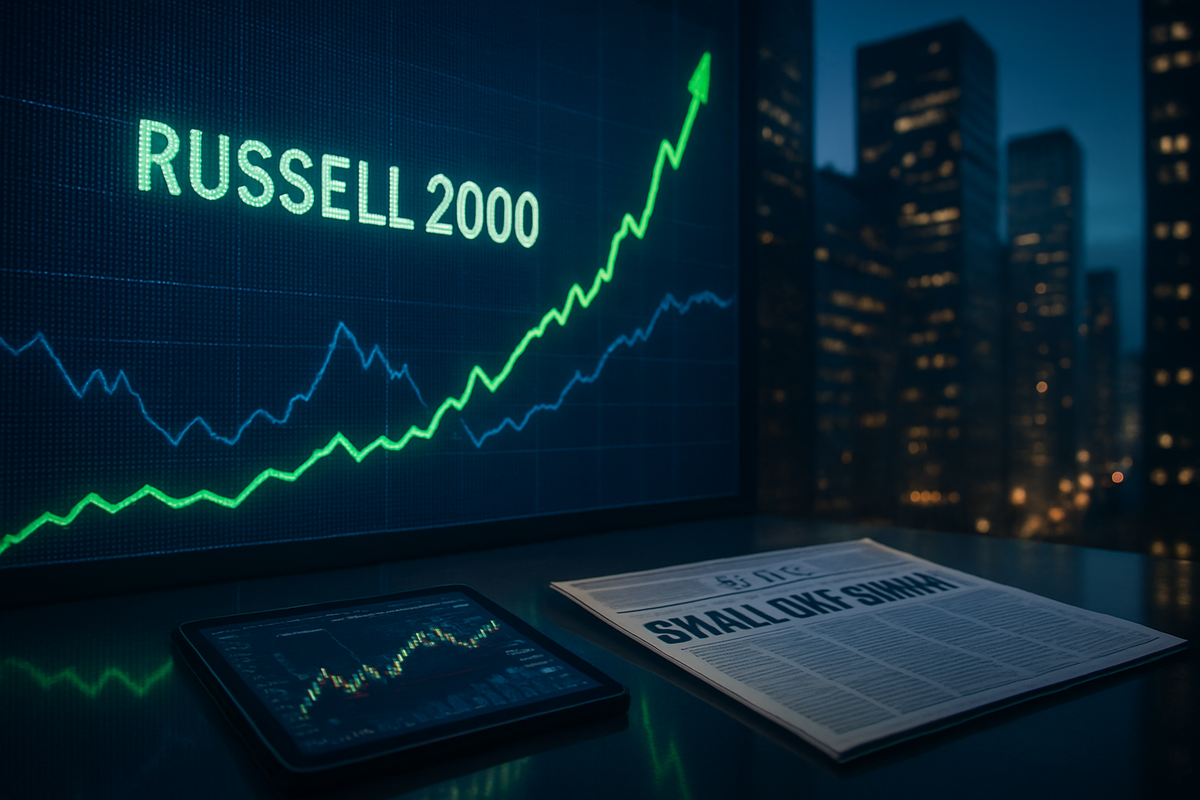
The financial landscape shifted violently this week as the long-dormant Russell 2000 index (INDEXRUSSELL:RUT) staged a breathtaking 18% rally, marking its best single-week performance in decades. Triggered by a surprisingly soft Consumer Price Index (CPI) report released on Wednesday, the surge has ignited what analysts are calling "The Great Rotation"—a massive migration of capital away from overextended mega-cap technology names and into the interest-rate-sensitive "other 2,000" companies that have lived in the shadow of the AI boom for years.
This mid-week explosion represents more than just a technical bounce; it is a fundamental repricing of risk as the market moves toward a "soft landing" scenario. With the iShares Russell 2000 ETF (NYSEARCA:IWM) leading the charge, the immediate implications are clear: the era of extreme market concentration may finally be fracturing. Investors who had crowded into a handful of trillion-dollar tech giants are now scrambling to capture the "catch-up trade" in a segment of the market that, until this week, was trading at a historic valuation discount.
A Week of Market Rebirth
The catalyst for this historic move arrived on the morning of February 11, 2026, when the Labor Department reported that January inflation had cooled to a 2.5% annualized rate, significantly lower than the 2.9% consensus estimate. The data effectively signaled to the market that the Federal Reserve’s restrictive policy era is nearing its end. Within minutes of the release, the Russell 2000—which had been flat for the first month of the year—began a vertical ascent. By Thursday's close, the index had eclipsed its previous all-time highs, leaving the S&P 500 (INDEXSP:.INX) and its tech-heavy components trailing in its wake.
This rally was not an isolated event but the culmination of months of building pressure. Throughout 2024 and 2025, small-cap companies struggled under the weight of "higher-for-longer" interest rates, which disproportionately affected their ability to service floating-rate debt and fund growth. However, as the yield curve began to normalize in early 2026, the valuation gap between the Russell 2000 (trading at roughly 16x forward earnings) and the S&P 500 (trading at 25x) became too wide for institutional investors to ignore.
Key stakeholders, including major hedge funds and pension funds, appear to have been the primary drivers of this week’s volume. Data from major exchanges indicates a massive "short squeeze" in small-cap futures, as bearish bets were liquidated in the face of the cooling inflation data. The reaction from the retail sector was equally fervent, with call option volume on small-cap ETFs hitting record levels as investors bet on a continued "mean reversion" for the asset class.
Winners and Losers of the Rotation
The most immediate beneficiaries of this surge have been the "duration-sensitive" sectors, particularly biotechnology and regional banking. The SPDR S&P Biotech ETF (NYSEARCA:XBI) saw individual components like Viking Therapeutics (NASDAQ: VKTX) and other mid-tier clinical-stage firms jump double digits as the cost of capital plummeted. For these companies, lower interest rates do not just mean cheaper debt; they mean a higher present value for future drug pipelines, making them significantly more attractive for acquisition by Big Pharma.
Regional lenders also found themselves back in favor. Banks such as KeyCorp (NYSE: KEY) and Western Alliance Bancorporation (NYSE: WAL) surged as the cooling inflation data suggested a more stable environment for deposit costs and a lower risk of loan defaults among small-business borrowers. Conversely, the "Magnificent Seven" experienced a rare period of stagnation. While companies like NVIDIA (NASDAQ: NVDA) and Microsoft (NASDAQ: MSFT) did not collapse, they largely sat out the rally, as investors used their gains in these winners to fund their new positions in the Russell 2000.
On the losing side are the "defensive" stocks and high-valuation software-as-a-service (SaaS) companies that had served as safe havens during the inflationary period. As capital flows toward growth-oriented small caps, these formerly stable assets have seen their premium vanish. Companies with high price-to-sales ratios but low earnings growth are now facing a "valuation reality check" as the market prioritizes domestic-focused companies with clear paths to profitability in a lower-rate environment.
The Significance of the Catch-Up Trade
The broader significance of this move lies in its historical precedent. The last time the market saw a rotation of this magnitude was during the post-dot-com bubble era of the early 2000s, when small caps outperformed large-cap tech for nearly five consecutive years. By early 2026, the "AI fatigue" that had begun to settle over the market provided the perfect vacuum for this rotation. Investors are increasingly questioning the immediate ROI of massive AI capital expenditures, looking instead for "tangible economy" gains in manufacturing, healthcare, and local services.
Furthermore, this surge fits into a broader trend of "reshoring" and domestic reinvestment. Small-cap companies in the Russell 2000 derive a much larger percentage of their revenue from within the United States compared to the multinational giants of the S&P 500. With new domestic policy initiatives like the One Big Beautiful Bill Act (OBBBA) providing tax incentives for American-made goods, the 18% jump this week can be seen as a vote of confidence in the U.S. domestic economy over globalized tech dominance.
Regulatory implications are also surfacing. The sudden influx of capital into smaller firms may alleviate some of the antitrust pressure currently focused on mega-cap tech. If the market naturally decentralizes, regulators may find less urgency in aggressive break-up campaigns. However, for the Russell 2000, the challenge will be maintaining this momentum without overheating, as a too-rapid rise could lead the Federal Reserve to pause its planned rate cuts later this year.
What Comes Next for the Small-Cap Rally
In the short term, market participants should expect a period of heightened volatility as the Russell 2000 consolidates its gains. An 18% move in a single week is statistically extreme, and some profit-taking is inevitable. However, the long-term outlook remains constructive. Many analysts believe this is the start of a multi-quarter "re-rating" of small caps. Strategic pivots will be required for portfolio managers who have been "underweight" small caps for the last three years; they must now decide whether to chase the rally or wait for a pullback.
The primary challenge moving forward will be the "quality" of the rally. Roughly 40% of the companies in the Russell 2000 are currently unprofitable. For the surge to be sustainable, these "zombie" companies must use the current window of lower rates to repair their balance sheets or reach profitability. If they fail to do so, the rally could narrow, favoring "Small-Cap Quality" stocks over the broader index. Potential scenarios include a secondary "junk rally" in highly leveraged names, followed by a more disciplined selection process as the initial excitement fades.
Closing Perspective on the February Surge
The "Small Cap Surge" of February 2026 will likely be remembered as a pivot point in market history. It marks the moment the post-pandemic inflation trade finally broke, replaced by a more balanced market architecture. The key takeaway for investors is that the "Magnificent Seven" era of concentration is no longer the only game in town. The domestic-focused, rate-sensitive companies that form the backbone of the American economy are once again attracting the capital they need to innovate and expand.
Moving forward, the market will be watching the next round of earnings reports from small-cap industrials and regional banks to see if the fundamental data matches the price action. Investors should also keep a close eye on the "yield curve" and the Fed’s March meeting. If the cooling inflation trend persists and the Fed follows through with a 25-basis-point cut, this 18% jump might just be the opening act of a new bull market for the Russell 2000.
This content is intended for informational purposes only and is not financial advice.