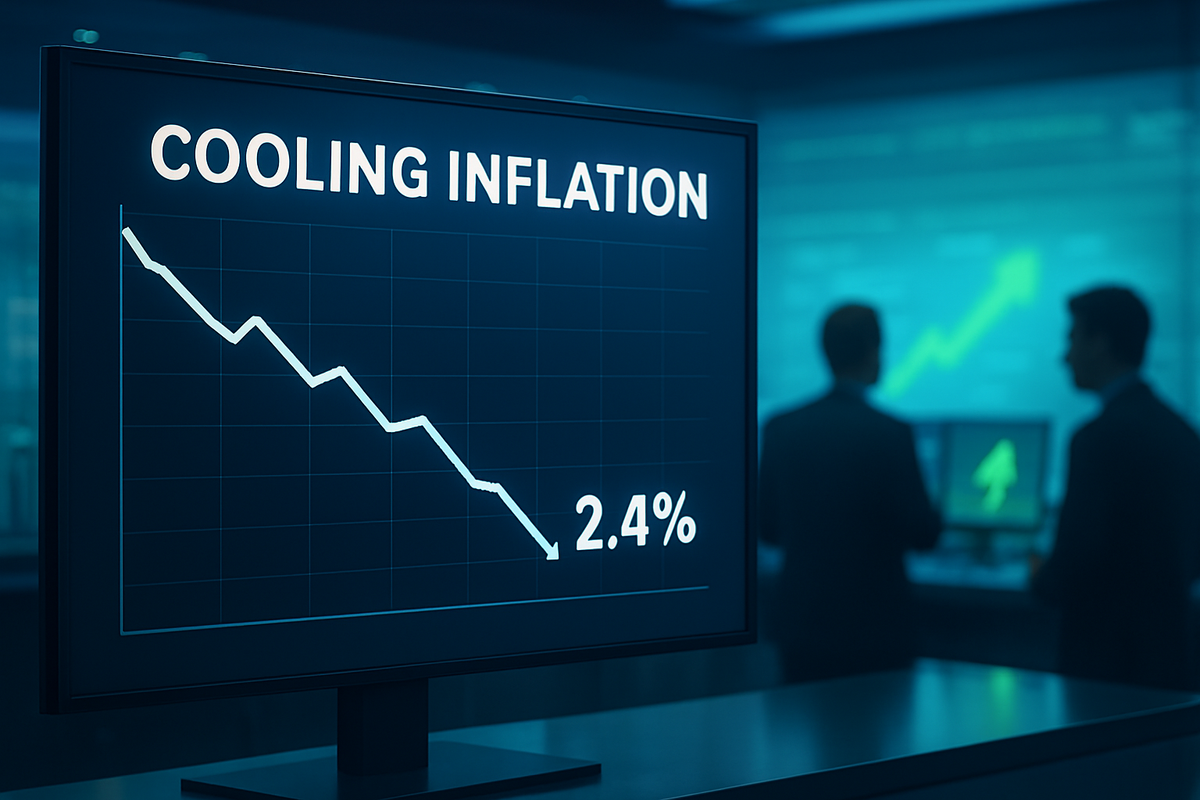
The U.S. Bureau of Labor Statistics released its highly anticipated January Consumer Price Index (CPI) report on the morning of February 13, 2026, revealing that headline inflation has slowed to 2.4% year-over-year. This figure came in below the consensus economist expectation of 2.5%, marking a significant milestone in the Federal Reserve's multi-year campaign to stabilize prices without triggering a deep recession. Core inflation, which excludes the more volatile categories of food and energy, landed exactly at 2.5%, matching market estimates and providing a consistent signal that underlying price pressures are continuing to moderate.
The immediate market response was one of palpable relief. Following a period of jittery trading in early February, the S&P 500 (NYSE: SPY) climbed 0.6%, while the Dow Jones Industrial Average (NYSE: DIA) surged over 200 points in early afternoon trading. This "soft landing" data has effectively quieted fears that the Federal Reserve would be forced to maintain its current restrictive interest rate policy well into the second half of the year. For a market that has become increasingly sensitive to "higher-for-longer" rhetoric, today’s data suggests that the path to a more accommodative monetary environment is becoming clearer.
Lower-Than-Expected Headline Data Sparks Market Optimism
The 2.4% headline reading for January represents a sharp cooling from the 2.7% recorded in December 2025, driven largely by a continued decline in energy costs and a stabilization in used vehicle prices. While the monthly increase of 0.2% showed that prices are still rising, the pace is now comfortably within the range that policy makers consider manageable. The timeline leading up to this morning’s release was fraught with tension; throughout 2025, the economy grappled with "sticky" service-sector inflation and brief supply chain hiccups that threatened to stall the disinflationary trend. However, the January data suggests that those obstacles were temporary rather than structural.
Key stakeholders, including Treasury Secretary Janet Yellen and various Federal Reserve regional presidents, had spent the preceding weeks urging caution, noting that the "last mile" of the inflation fight is often the most difficult. The core CPI reading of 2.5% justifies this caution, as it remains half a percentage point above the Fed’s long-term 2% target. Despite this gap, the markets reacted positively because the "upside surprise" that many traders feared—where inflation might have ticked back up toward 3%—failed to materialize.
Initial industry reactions were focused on the bond market, where the yield on the 10-year Treasury note dipped significantly following the 8:30 AM ET announcement. This move in fixed income provided the necessary oxygen for equity markets to breathe, particularly for growth-oriented sectors. Tech analysts noted that the consistency between the headline miss and the core meet suggests a balanced economy where consumer demand remains healthy but is no longer overheating the system.
Growth Stocks and Real Estate Lead the Gainers
The primary beneficiaries of today’s cooling inflation data were the mega-cap technology and artificial intelligence leaders. Companies like NVIDIA (NASDAQ: NVDA), Microsoft (NASDAQ: MSFT), and Apple (NASDAQ: AAPL) saw immediate gains as the prospect of lower discount rates boosted the present value of their future earnings. NVIDIA, in particular, led the tech-heavy Nasdaq higher, as investors bet that a stabilizing macro environment would encourage continued enterprise spending on AI infrastructure. The relief rally was especially potent for these firms, which had seen their valuations stretched by the uncertainty of the Fed's next moves.
Beyond tech, the real estate and utilities sectors—often the most sensitive to interest rate fluctuations—showed robust strength. Real estate investment trusts like Prologis (NYSE: PLD) and American Tower (NYSE: AMT) gained on the news, as lower inflation usually precedes lower borrowing costs, which are the lifeblood of property development and acquisition. Furthermore, high-dividend paying stocks in the utilities sector became more attractive relative to bonds as yields retreated, providing a broad-based lift to defensive portfolios.
On the other side of the ledger, the banking sector saw a more mixed reaction. While a healthier economy is generally good for credit quality, a flatter yield curve and the prospect of imminent rate cuts can compress net interest margins for major lenders like JPMorgan Chase (NYSE: JPM) and Bank of America (NYSE: BAC). These institutions may face a period of adjustment where the high-interest income of the 2024-2025 era begins to normalize. Additionally, some energy companies saw slight pressure as the decline in headline inflation was partly attributed to falling oil and gas prices, impacting the top-line revenue expectations for firms like ExxonMobil (NYSE: XOM).
A Major Milestone in the Post-Pandemic Economic Recovery
The January 2026 CPI report fits into a broader historical narrative of the "Great Normalization" following the inflationary shocks of the early 2020s. For the first time in five years, the U.S. economy appears to be operating in a regime where inflation is a secondary concern rather than a primary driver of daily volatility. This event signals a transition from the era of aggressive monetary tightening to an era of strategic maintenance. The ripple effects will likely be felt globally, as a more stable U.S. dollar and predictable Fed policy provide a blueprint for other central banks, such as the ECB and the Bank of England, to navigate their own inflation targets.
Regulatory and policy implications are also significant. With inflation trending toward the 2% goal, the political pressure on the Federal Reserve to "do something" about the cost of living may begin to pivot toward pressure to ensure that high rates do not unnecessarily cool the labor market. This shift in focus is crucial as the 2026 mid-term election cycle approaches, with economic stability being a central theme for both voters and policy makers.
Historically, periods where headline inflation drops while core remains steady—as seen today—have often preceded long periods of steady economic growth. Comparisons are already being made to the mid-1990s, when the Fed successfully engineered a soft landing that paved the way for the late-90s tech boom. While today’s geopolitical landscape is far more complex, the underlying data suggests that the structural components of the U.S. economy are remarkably resilient.
Looking Ahead: The Road to the March FOMC Meeting
The next critical juncture for investors will be the Federal Reserve's March policy meeting. While today’s data makes a rate hike virtually impossible, the debate has now shifted entirely to the timing and frequency of rate cuts. Short-term, the market will be looking for confirmation from the Producer Price Index (PPI) and upcoming labor market reports to see if the cooling trend is holistic. If wage growth remains moderate alongside these lower CPI figures, the "goldilocks" scenario—where growth stays positive while inflation fades—will become the dominant market thesis.
Strategic pivots may be required for fixed-income investors who have been hiding in high-yield cash equivalents. As the "higher-for-longer" narrative dissolves, the opportunity cost of not being invested in longer-duration assets increases. Market participants should expect increased volatility around the next few employment reports, as the Fed’s dual mandate shifts its weight toward the "full employment" side of the scale. The biggest challenge emerging will be the risk of premature celebration; if the Fed cuts too early and inflation rebounds, the hard-won credibility of the last two years could be at risk.
Potential scenarios for the remainder of 2026 include a steady series of 25-basis-point cuts starting in the summer, which would likely support a continued bull market in equities. However, any unexpected geopolitical shocks—particularly those affecting energy prices—could quickly upend the 2.4% headline figure. Investors should remain vigilant, watching for any divergence between the cooling headline numbers and the "sticky" service costs that kept core inflation at 2.5% this month.
Conclusion: A Turning Point for the 2026 Market
The January CPI report is a watershed moment for the 2026 financial landscape. By delivering a headline inflation rate of 2.4%, the economy has signaled that the extreme price volatility of the past several years is largely in the rearview mirror. The relief rally in the S&P 500 and the Dow reflects a market that is finally ready to move past its obsession with the Federal Reserve’s every word and return to a focus on corporate fundamentals and technological innovation.
Moving forward, the market’s trajectory seems biased toward the upside, provided that the labor market remains stable and core inflation continues its slow descent toward the 2% mark. The key takeaway for investors is that the "soft landing" is no longer just a theoretical possibility—it is the current reality. While risks such as geopolitical instability and persistent housing costs remain, the cooling of headline inflation provides the Federal Reserve with the flexibility it needs to support the economy through the next phase of the cycle.
In the coming months, watch for the Fed's commentary on the "terminal rate"—the level where they believe interest rates should sit in a stable economy. As this number becomes clearer, expect capital to move more decisively out of cash and into the growth engines of the American economy. Today was not just about a 0.1% beat on a government report; it was about the restoration of confidence in the long-term stability of the U.S. dollar and the markets that trade in it.
This content is intended for informational purposes only and is not financial advice