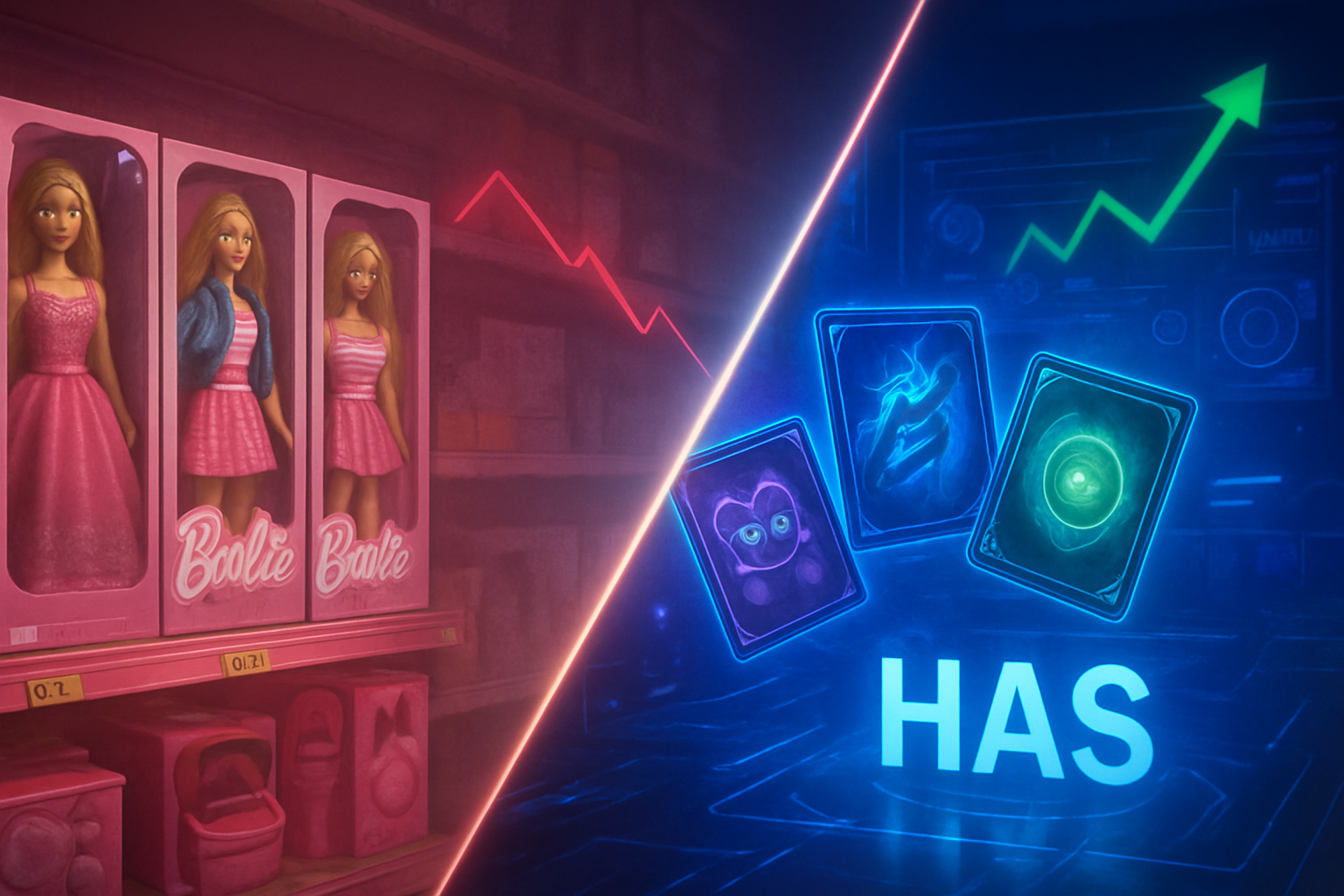
The global toy industry witnessed a dramatic divergence this week as the two titans of play, Mattel, Inc. (NASDAQ: MAT) and Hasbro, Inc. (NASDAQ: HAS), reported their latest financial results. On February 11, 2026, Mattel shares plummeted 24% following a disappointing holiday season and a cautious outlook for the year ahead, signaling that the viral momentum of the 2023 Barbie movie has officially cooled. In stark contrast, Hasbro reached a six-year high, buoyed by the explosive growth of its digital gaming portfolio and the continued dominance of "Magic: The Gathering."
The market's reaction highlights a fundamental shift in how value is being created in the play sector. While Mattel struggles to replicate the lightning-in-a-bottle success of its cinematic universe in a traditional retail environment, Hasbro has successfully pivoted toward a high-margin, digital-first strategy. This "Tale of Two Toymakers" serves as a stark reminder that in 2026, the battle for the hearts and wallets of consumers is no longer just on the toy aisle—it is happening on screens, through subscription services, and via complex digital ecosystems.
A Tale of Two Tickers: The Post-Holiday Fallout
The immediate market fallout on February 11 was swift. Mattel’s stock cratered to $15.73, wiping out billions in market capitalization in a single session. The primary culprit was a "Barbie hangover" characterized by a 17% decline in gross billings for the iconic doll line compared to the previous peak. Despite CEO Ynon Kreiz’s efforts to brand 2026 as an "inflection year" for the company’s entertainment strategy, investors were spooked by soft U.S. holiday sales and 2026 earnings-per-share guidance that fell well below analyst expectations. Mattel’s reliance on physical retail proved to be a liability during a promotional and volatile shopping season.
Meanwhile, at Hasbro’s headquarters, the mood was celebratory. The company’s "Playing to Win" strategy, initiated several years ago, has begun to pay massive dividends. Hasbro’s Wizards of the Coast (WotC) segment reported that "Magic: The Gathering" revenue surged 59% in 2025, driven by high-profile "Universes Beyond" collaborations. By the time the markets opened on February 12, 2026, Hasbro shares were trading at levels not seen since 2020. The company’s ability to leverage its intellectual property (IP) into digital realms, specifically through the mobile juggernaut Monopoly Go! and a robust pipeline of AAA video games, has shielded it from the headwinds affecting traditional toy manufacturing.
Winners and Losers in the Play Economy
Hasbro emerges as the clear winner in this cycle, having successfully navigated the transition from a toy manufacturer to an IP-driven gaming powerhouse. The Wizards of the Coast division is now the primary engine of the company, with digital gaming and licensed IPs providing a recurring revenue stream that physical dolls and action figures simply cannot match. Hasbro's upcoming 2026 slate for "Magic: The Gathering," which includes massive collaborations with Marvel and Star Trek, suggests that their growth trajectory is far from over.
Mattel, however, finds itself in a precarious position. The company is the primary "loser" in this earnings cycle, as it remains heavily dependent on the "Barbie Playbook"—the hope that theatrical releases will drive physical toy sales. While Mattel has a full slate for 2026, including Masters of the Universe and Matchbox, the market is increasingly skeptical that these films can generate the same cultural zeitgeist as Barbie. Retailers, facing shifting consumer patterns, have also moved toward more conservative ordering, further squeezing Mattel’s margins on physical goods.
The Digital vs. Physical Divide
This divergence is not merely a matter of different product lines; it represents a broader industry trend toward "phygital" and digital-first play. In 2026, children are moving to digital platforms at younger ages, a phenomenon often referred to as "KGO" (Kids Getting Older younger). Hasbro’s success is rooted in its early recognition of this shift. By focusing on "Kidults"—adult collectors and gamers who represent the fastest-growing demographic in the industry—Hasbro has tapped into a market that is less price-sensitive and more engaged with digital ecosystems.
The wider significance of this event lies in the structural decline of the one-off toy purchase. Mattel’s recent acquisition of its partner NetEase’s stake in the Mattel163 mobile games studio is a move to catch up, but it underscores how far behind they started. For the rest of the industry, the message is clear: a successful IP strategy must be platform-agnostic. Whether it is AI-powered dolls that engage in contextual conversations or board games with integrated digital tracking, the companies that successfully blur the lines between physical and digital are the ones that will thrive.
Looking Ahead: The 2026 Pivot
For Mattel, the rest of 2026 will be a period of intense pressure to perform. All eyes are on the June 5 release of Masters of the Universe. If the film fails to ignite a retail firestorm, Mattel may be forced to accelerate its digital transformation, perhaps through further acquisitions or a more radical restructuring of its manufacturing base. The company must prove that its "entertainment-led" model can work without a once-in-a-generation hit like Barbie.
Hasbro, conversely, faces the challenge of maintaining its momentum. With seven major "Magic" sets planned for 2026 and intensive marketing beginning for its sci-fi RPG Exodus, the company is operating at peak capacity. The risk for Hasbro lies in IP fatigue and the potential for over-saturation in the "Universes Beyond" line. However, with its digital gaming pipeline extending well into 2027 with titles like Warlock, Hasbro appears to have the more predictable and scalable business model for the current era.
Closing the Toy Box: Market Outlook
The "Tale of Two Toymakers" highlights a permanent shift in the landscape of play. The 24% drop in Mattel’s stock serves as a cautionary tale for companies that rely too heavily on the traditional "movie-to-toy" pipeline in an increasingly digital world. Meanwhile, Hasbro’s six-year highs provide a blueprint for how legacy brands can reinvent themselves for the 21st century.
Investors should watch Mattel’s theatrical performance in the summer of 2026 and Hasbro’s ability to sustain the growth of its digital gaming ecosystem. As the industry moves toward "phygital" integration and AI-driven play, the gap between the winners and losers will likely continue to widen. For now, the market has sent a loud message: the future of play is digital, and those who cannot adapt will be left on the shelf.
This content is intended for informational purposes only and is not financial advice.