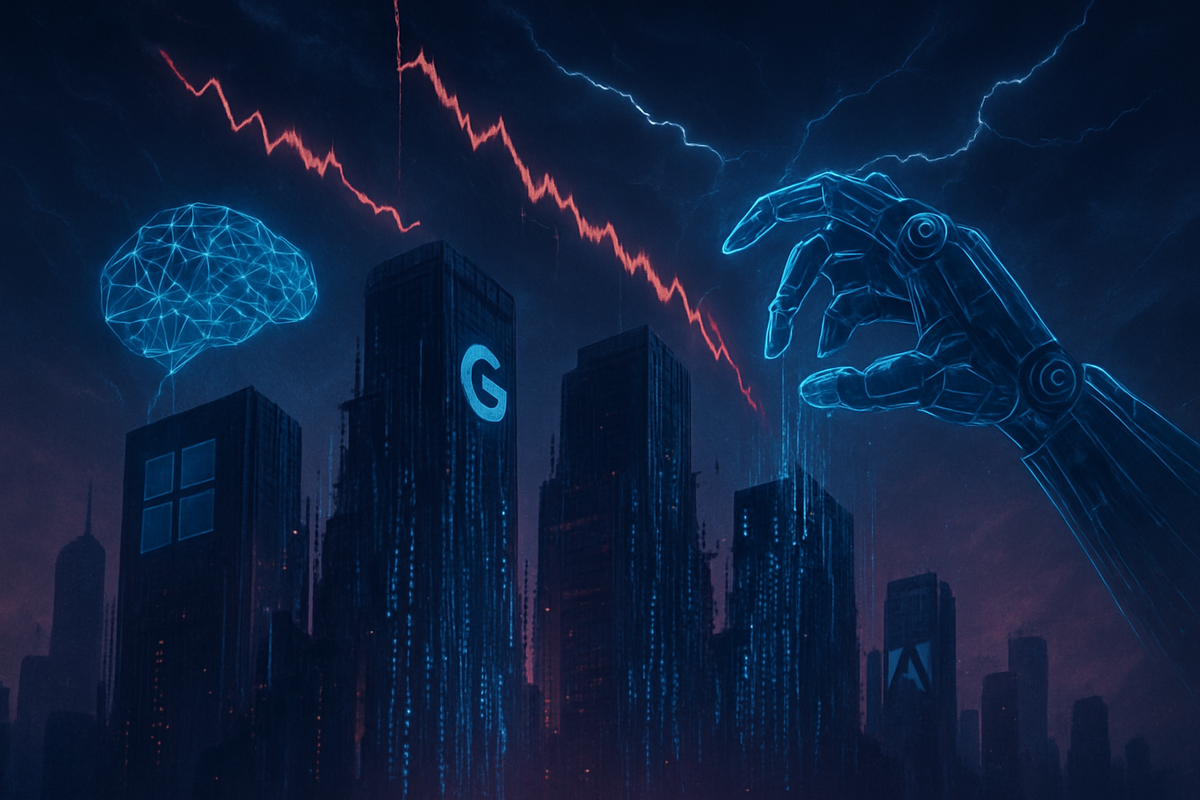
The enterprise software market is currently grappling with a seismic shift that many are calling the "Software Sector Apocalypse" or the "SaaSpocalypse." As of mid-February 2026, a massive rotation out of legacy software-as-a-service (SaaS) names has wiped hundreds of billions of dollars from the market. Investors, once enamored by the steady, recurring revenue of cloud-based subscriptions, are now fleeing toward AI infrastructure, fearing that the very technology they once championed is now poised to cannibalize the traditional software model.
The immediate implications are stark: double-digit monthly drops in valuation for some of the industry’s most stable giants and a fundamental questioning of the "per-seat" pricing model. The fear is no longer just about competition from other software firms; it is about the rise of agentic AI that can build custom internal tools or perform complex workflows autonomously, rendering expensive, monolithic software suites redundant for many enterprises.
A Timeline of the Software Collapse
The roots of this "apocalypse" stretch back to mid-2024, when Salesforce (NYSE: CRM) experienced its worst trading day in two decades, dropping 20% after a rare revenue miss. This event served as the first major warning that the decade-long SaaS gold rush was losing steam. By late 2025, the sentiment shifted from caution to genuine panic as major AI labs began releasing "agentic" tools capable of orchestrating business processes without the need for traditional user interfaces.
The situation reached a fever pitch in late January and early February 2026. The launch of specialized agentic platforms, such as Anthropic’s "Claude Cowork," acted as a catalyst for a historic sector-wide sell-off. Between January 30 and February 4, 2026, nearly $300 billion in market value evaporated from the application software layer. This period saw major names like Atlassian (NASDAQ: TEAM) plunge by 35% in a single week, while the iShares Tech-Software ETF (NYSEARCA: IGV) retreated roughly 30% from its late 2025 highs.
Key stakeholders, including institutional investors and venture capitalists, have rapidly pivoted their capital toward "picks and shovels" hardware and foundation models. The market's reaction has been swift and unforgiving: companies that failed to show a direct, accretive path to AI monetization were punished, while those perceived as "CRUD" (Create, Read, Update, Delete) databases—apps that simply store and display data—were treated as liabilities.
The Winners and Losers of the AI Disruption
The most prominent losers in this transition have been the "seat-based" giants. Atlassian (NASDAQ: TEAM) has seen its valuation crater to levels not seen in years, as tools like "Claude Code" enable developers to build their own internal coordination systems, bypassing Jira and Confluence. Similarly, Intuit (NASDAQ: INTU) has faced a punishing 34% quarterly drop leading into February 2026. Investors are increasingly skeptical that small businesses will continue to pay for expensive accounting suites when autonomous AI agents can scan receipts, manage ledgers, and file taxes with minimal human intervention.
Salesforce (NYSE: CRM) remains in a precarious position. While it has aggressively marketed its "Agentforce" platform to counteract the narrative of decline, the market remains focused on the risk of seat cannibalization. If a single AI agent can manage the workload of ten human sales representatives, the traditional model of charging for ten "seats" becomes unsustainable. This structural threat has forced Salesforce and its peers like Workday (NASDAQ: WDAY) and ServiceNow (NYSE: NOW) to consider a radical overhaul of their business models.
On the winning side, the beneficiaries remain concentrated in the infrastructure and hardware layers. NVIDIA (NASDAQ: NVDA) and Advanced Micro Devices (NASDAQ: AMD) continue to see unprecedented demand as the software layer rebuilds itself on AI-first foundations. Furthermore, hyperscalers like Microsoft (NASDAQ: MSFT) and Amazon (NASDAQ: AMZN) have managed to capture the "rotation" by providing the cloud compute necessary to run the very agents that are disrupting the SaaS companies they host.
Analyzing the Significance of the Shift
This event represents a fundamental evolution in how business value is captured. We are witnessing the transition from "Software-as-a-Service" to "AI-as-a-Service," where the primary unit of value is no longer the software interface but the completion of an outcome. Historically, software was a tool for humans to be more productive; now, AI is becoming the worker itself. This shifts the focus from human-centric licensing to consumption-based or performance-based models, a transition that is proving to be incredibly painful for Wall Street to value.
The rise of "custom internal software" is perhaps the most significant ripple effect. In the past, the cost and complexity of building a custom CRM or project management tool were prohibitive for most companies. Today, generative AI and low-code agents have lowered that barrier to near zero. Enterprises are increasingly realizing they can build "disposable software"—micro-apps tailored perfectly to their specific workflows—rather than paying for a bloated, generic subscription.
This trend mirrors previous historical precedents, such as the transition from on-premise hardware to the cloud. However, the speed of the AI-driven "SaaSpocalypse" is far greater. Regulators are also beginning to take notice, as the concentration of power moves from a diverse ecosystem of software vendors to a few massive AI model providers, raising concerns about market competition and the future of the digital economy.
What Comes Next for Enterprise Tech
In the short term, the software sector will likely remain under immense pressure as firms undergo a "Show-Me-The-Money" phase. Investors will demand proof that AI features are not just defensive measures to prevent churn, but offensive tools that can drive new revenue. We should expect a wave of consolidation as struggling SaaS firms are acquired by larger platforms or private equity firms looking to strip them down to their core data assets.
Strategic pivots are already underway. The industry is moving toward "headless" software—applications that have no traditional user interface and are meant to be accessed exclusively by AI agents via APIs. To survive, companies like Intuit and Atlassian must convince the market that their proprietary data "moats" are deep enough that even the most advanced generic AI cannot replicate their domain-specific insights.
Longer-term, the market may find a new equilibrium where "outcome-based" pricing becomes the standard. Instead of charging per user, software vendors might charge a percentage of the value created or a fee per task completed by an AI agent. While this could eventually lead to higher margins, the transition period will be characterized by extreme volatility and the potential for more high-profile collapses.
A Comprehensive Wrap-up of the SaaSpocalypse
The "Software Sector Apocalypse" of 2024-2026 marks the end of the easy-growth era for cloud subscriptions. The sudden retreat of giants like Salesforce, Intuit, and Atlassian serves as a stark reminder that in the age of AI, no business model is sacred. The shift from seat-based subscriptions to agentic, outcome-based productivity is not just a trend; it is a total re-architecting of the enterprise technology stack.
Moving forward, the market will be bifurcated into "AI-Native" companies that can leverage agents to create new value and "Legacy SaaS" companies that are slowly cannibalized by the very automation they helped usher in. For investors, the coming months will require a rigorous focus on "moats"—specifically, who owns the unique, non-scrapable data that AI needs to be effective.
In conclusion, while the current sell-off is painful, it is also a clearing of the brush that may eventually make way for a more efficient, AI-integrated economy. However, for the major tech names caught in the crosshairs, the road to recovery will be long, and the software landscape of 2027 will likely look nothing like the one we knew just a few years ago.
This content is intended for informational purposes only and is not financial advice.