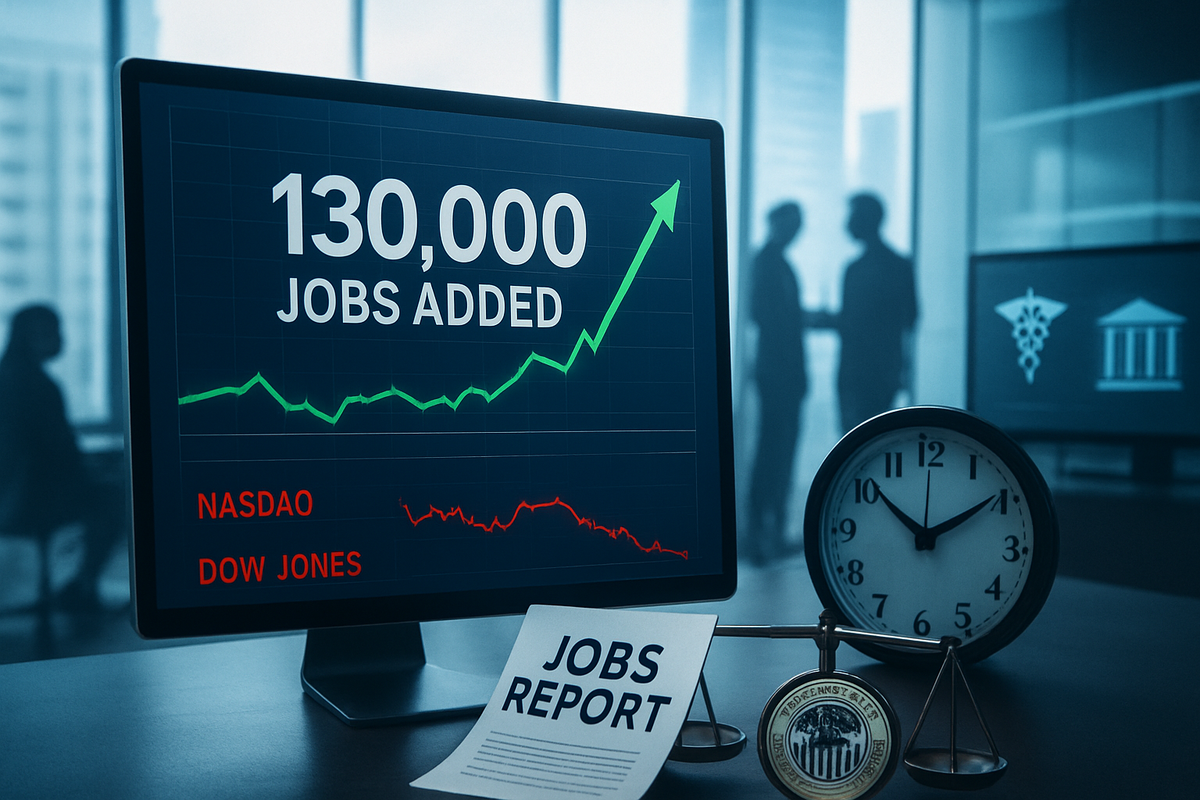
The U.S. labor market threw a curveball at Wall Street on Wednesday, February 11, 2026, as the January Jobs Report revealed a surprising burst of hiring that fundamentally reshaped the outlook for interest rate cuts this year. Nonfarm payrolls surged by 130,000, nearly doubling the consensus estimate of 70,000, while the unemployment rate unexpectedly dipped to 4.3% from 4.4%. The "upside surprise" initially sparked a relief rally, but the gains proved fleeting as investors quickly realized that a resilient labor market gives the Federal Reserve little incentive to lower borrowing costs in the near term.
By mid-morning, the initial 250-point surge in the Dow Jones Industrial Average had evaporated, replaced by a cautious retreat that saw the Nasdaq turn negative. This "good news is bad news" reaction underscores the market's hyper-fixation on the Fed's next move. While the hiring data suggests the economy is avoiding a recessionary cliff, it also implies that the "last mile" of the inflation fight may be longer and more arduous than anticipated, keeping interest rates at their current multi-decade highs for longer than bulls had hoped.
The January Surprise: Resilience Amidst Revisions
The January Jobs Report was not just about the 130,000 new positions; it was a tale of two economies. The headline figure was bolstered largely by the healthcare and social assistance sectors, which accounted for more than 123,000 of the total jobs added. Healthcare alone saw a massive influx of 81,900 workers, reflecting a persistent post-pandemic structural demand for care services. Conversely, the federal government continued to trim its rolls, shedding 34,000 positions as part of ongoing fiscal tightening measures.
However, the "shock and awe" of the January numbers was tempered by the Bureau of Labor Statistics' annual benchmark revisions. In a startling disclosure, the BLS revealed that the "2025 Jobs Mirage" was real: total job growth for 2025 was revised downward from an initially reported 584,000 to a mere 181,000. This suggests that while the start of 2026 looks strong, the underlying foundation of the previous year was significantly more fragile than market participants were led to believe. This discrepancy fueled the mid-morning market retreat, as traders began to question whether the January spike was a sustainable trend or another statistical anomaly.
The timeline of the market's reaction was swift. At 8:30 AM ET, the release of the data triggered an immediate spike in Treasury yields, with the 2-year yield—highly sensitive to Fed policy—surging to 3.502%. By 10:06 AM ET, the reality of "higher for longer" set in. The probability of an interest rate cut at the March Federal Open Market Committee (FOMC) meeting plummeted, with the CME FedWatch tool showing a 94% chance that the Fed will hold rates steady at 3.50%–3.75%.
Corporate Winners and Losers: A K-Shaped Reaction
The "hot" jobs report created clear lines of demarcation between sectors that benefit from economic activity and those punished by high interest rates. In the healthcare space, HCA Healthcare (NYSE: HCA) emerged as a primary beneficiary, as the surge in healthcare hiring aligns with the company’s aggressive expansion of ambulatory services. Conversely, UnitedHealth Group (NYSE: UNH) saw its shares struggle; despite the high demand for care, the report’s 0.4% month-over-month wage growth sparked fears of rising medical care ratios, which had already reached a concerning 88.9% in late 2025.
The financial sector also witnessed a split. Large-cap banks like JPMorgan Chase & Co. (NYSE: JPM) saw modest gains as the prospect of sustained high interest rates bolsters net interest margins (NIM). Capital One Financial Corp (NYSE: COF) also performed well, recently buoyed by strategic acquisitions that investors believe will thrive in a stable-rate environment. However, the news was grim for regional lenders like Citizens Financial Group (NYSE: CFG) and M&T Bank Corp (NYSE: MTB). These institutions are facing "sticky" deposit costs and lack the massive AI budgets of their larger peers to offset labor costs, pushing their expected NIM recovery further into the future.
In the technology sector, the reaction was predominantly negative as rising yields acted as a gravitational pull on premium valuations. Mega-caps like Apple Inc. (NASDAQ: AAPL) and NVIDIA Corp (NASDAQ: NVDA) served as significant drags on the broader market indices. High-growth, rate-sensitive platforms were particularly hard hit, with Robinhood Markets Inc. (NASDAQ: HOOD) tumbling nearly 9% following the report. A notable outlier was Micron Technology Inc. (NASDAQ: MU), which bucked the trend to jump nearly 10% after clarifying that its AI-related chip production was ahead of schedule, proving that idiosyncratic growth stories can still win in a difficult macro environment.
The "No Landing" Narrative and Global Implications
This report reinforces the growing "No Landing" narrative, where the economy continues to grow and the labor market remains tight, preventing inflation from fully cooling to the Fed's 2% target. For the broader industry, this means that the pivot to cheaper capital is on ice. The historical precedent for such a scenario often involves a period of "stagflationary" anxiety, where the Fed is forced to keep rates high even as the underlying "real" economy—as seen in the 2025 downward revisions—shows signs of fatigue.
The ripple effects are already being felt across the globe. As U.S. Treasury yields climb, the dollar has strengthened, putting pressure on emerging markets and international trade partners who must now contend with more expensive dollar-denominated debt. Domestically, the report complicates policy for the Biden administration, which must balance the optics of a "strong" jobs market against the reality of high borrowing costs for mortgages and small business loans during an election cycle.
Furthermore, the concentration of job growth in healthcare and social assistance highlights a narrowing economic base. If the rest of the private sector—particularly manufacturing and tech—remains in a "hiring freeze" due to high rates, the overall health of the economy may be more precarious than the 130,000 headline number suggests. This creates a regulatory environment where the Fed is increasingly "data-dependent," arguably to a fault, making every monthly release a high-stakes event for global liquidity.
What Lies Ahead: The Road to the March FOMC
In the short term, all eyes will shift from the labor market to the upcoming Consumer Price Index (CPI) report. If inflation remains "sticky" alongside this robust job growth, the narrative of a May or June rate cut could also begin to dissolve. For companies, the strategic pivot must now focus on efficiency and margin preservation. We are likely to see an acceleration in the adoption of "agentic AI" and automation as firms look to offset the 3.7% year-over-year wage growth that is currently eating into bottom lines.
The potential scenarios for the second quarter of 2026 are narrowing. If job growth continues to exceed 100,000 while inflation stays above 3%, the Federal Reserve may not only hold rates steady but could theoretically re-introduce the possibility of a "insurance" rate hike—a scenario that is not currently priced into the market and would likely trigger a significant correction. Conversely, if the January spike proves to be a one-off and the 2025 weakness resumes, the Fed may find itself "behind the curve," forced to cut rates aggressively later in the year to prevent a hard landing.
Investor Takeaway: A Market in Transition
The January 2026 Jobs Report has effectively reset the clock for the 2026 market strategy. The era of "waiting for the pivot" has been replaced by the reality of a "higher-for-longer" plateau. Investors should move away from broad-index exposure and toward "quality" names with strong balance sheets and the ability to pass on costs. The massive downward revisions to 2025 serve as a stark reminder that headline data can be misleading, and fundamental analysis is more critical now than at any point in the last three years.
As we move forward, the key indicators to watch will be the "Medical Care Ratio" for insurers, the "Net Interest Margin" for regional banks, and the pace of AI monetization for Big Tech. The market has signaled that it is no longer willing to bid up stocks purely on the hope of Fed intervention. In this new regime, earnings growth and operational efficiency are the only true north stars for a portfolio.
This content is intended for informational purposes only and is not financial advice.