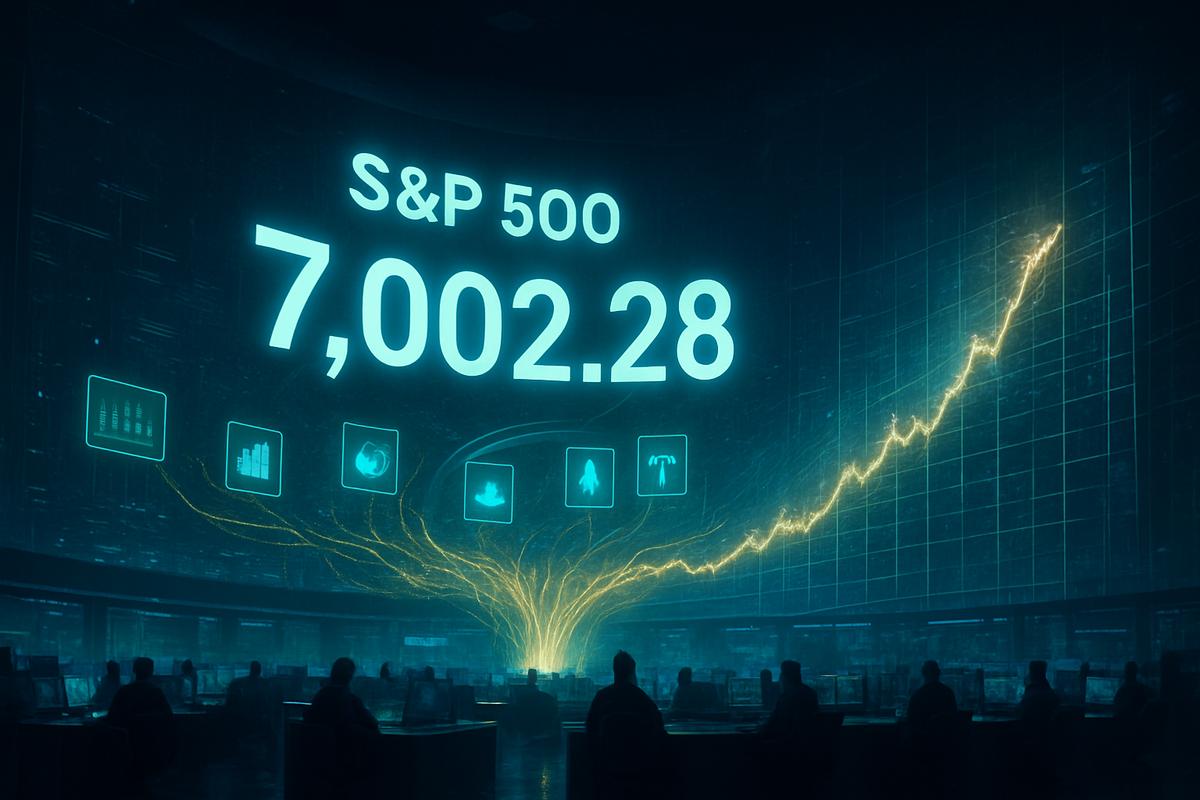
Wall Street reached a monumental psychological and financial peak on January 28, 2026, when the S&P 500 Index surged to an all-time intraday high of 7,002.28. This historic breach marks the first time the benchmark index has ever crossed the 7,000 threshold, crowning a relentless 14-month climb from the 6,000 level. While the index briefly retreated to consolidate around the 6,940 mark in the weeks following, the milestone represents a definitive shift in the global economy: the transition from speculative AI excitement to a regime of "industrialized" artificial intelligence.
The achievement has fundamentally reshaped market expectations, proving that the tech-heavy rally of the mid-2020s possessed more staying power than many skeptics predicted. However, the breach was not without drama. As the index approached the "7k" mark, it collided with a massive "Gamma Wall"—a dense thicket of options market activity that acted as a formidable ceiling, triggering intense intraday volatility and a high-stakes tug-of-war between institutional hedgers and retail momentum.
The Ascent to 7,000: A Timeline of Acceleration
The journey to 7,000 has been one of the most rapid expansions in the history of the S&P 500. After crossing 5,000 on February 9, 2024, the index took only nine months to reach 6,000 in November of that same year. While the subsequent 1,000-point march to 7,000 took a slightly more measured 14 months, the pace remains historic. This latest leg of the bull market was ignited during "Big Tech Week" in late January 2026, when a series of blockbuster earnings reports from the world’s largest companies provided the necessary escape velocity to pierce the 7,000 ceiling.
The specific catalyst for the intraday high of 7,002.28 was a blowout quarterly report from Microsoft Corp. (NASDAQ: MSFT), which revealed a staggering $281 billion backlog in AI-related service contracts. This news, combined with Meta Platforms Inc. (NASDAQ: META) announcing a 2026 capital expenditure plan exceeding $115 billion for AI infrastructure, sent the index into a frenzy. As the clock struck 10:45 AM ET on January 28, the ticker finally flashed the 7,000 handle, sparking cheers on the floor of the New York Stock Exchange and a flurry of activity in Chicago’s options pits.
However, the "Gamma Wall" at 7,000 proved to be a formidable barrier. In the options market, a Gamma Wall occurs when there is a massive concentration of open interest at a specific strike price. As the S&P 500 neared 7,000, market makers—who sell these options—were forced to hedge their positions by selling index futures to remain delta-neutral. This mechanical selling created a "sticky" resistance, effectively pinning the index near the milestone and preventing a runaway breakout. By the closing bell that day, the index had pulled back slightly, finishing at 6,988.42, and has since spent the first half of February consolidating its gains.
The Titans of the 7,000 Era: Winners and Losers
The narrative of the S&P 500's rise to 7,000 is, in many ways, the story of the "Magnificent Seven" and their evolving dominance. Nvidia Corp. (NASDAQ: NVDA) remained the undisputed engine of the rally, becoming the first company in history to eclipse a $5 trillion market capitalization in late 2025. As the primary provider of the H300 and subsequent "Rubin" architecture chips, Nvidia has benefited from a near-monopoly on the hardware required for the AI industrial revolution.
While Nvidia provided the hardware, the software giants proved they could monetize the investment. Alphabet Inc. (NASDAQ: GOOGL) saw a late-cycle surge, gaining 47% in the final quarter of 2025 as its in-house TPU (Tensor Processing Unit) chips began to significantly reduce its reliance on external hardware, boosting margins. Meanwhile, Amazon.com Inc. (NASDAQ: AMZN) leveraged its AWS dominance to capture the lion's share of enterprise AI hosting, further cementing its role as a structural winner in the 7,000-point index.
However, the march to 7,000 was not a "rising tide lifts all boats" scenario. Tesla Inc. (NASDAQ: TSLA) experienced significant volatility as it pivoted from a pure-play EV manufacturer to an AI and robotics firm; while its stock contributed to the rally, it faced stiff headwinds from global competition and margin compression. Similarly, Apple Inc. (NASDAQ: AAPL) saw more modest gains compared to its peers, as investors scrutinized the slower-than-expected rollout of "Apple Intelligence" features across its legacy hardware ecosystem. The divergence between the "AI-native" winners and the "legacy-tech" laggards has never been more pronounced than at the 7,000 level.
Wider Significance: The Mechanics of a New Market Regime
The breach of 7,000 signifies more than just a round number; it represents a fundamental shift in how the market values productivity. Historically, a 1,000-point jump in the S&P 500 would take years, even decades. The compression of these milestones into 9-to-14-month windows suggests that the market is pricing in a "productivity miracle" driven by generative AI and automation. This isn't just a tech bubble; it is the market's attempt to quantify the deflationary impact of AI on labor and the inflationary impact on corporate margins.
The role of the Gamma Wall at 7,000 also highlights the growing influence of the derivatives market over the underlying cash index. In 2026, "zero days to expiration" (0DTE) options now account for nearly 60% of daily S&P 500 options volume. This high-frequency options activity creates a feedback loop that can exacerbate volatility near major milestones. When the S&P 500 hits a psychological level like 7,000, the hedging requirements of market makers can dictate the direction of the entire market, a trend that regulators at the SEC have begun to monitor more closely for potential systemic risks.
Furthermore, this milestone serves as a historical comparison to the "Dot-com" era, but with a crucial difference: earnings. Unlike the late 90s, the current leaders of the S&P 500 are generating record-breaking free cash flow. The "Magnificent Seven" now account for nearly 35% of the index's total weight, a level of concentration that hasn't been seen in decades. This concentration has prompted a debate among policy makers regarding the "Too Big To Fail" status of tech megacaps and whether the S&P 500 is still a true reflection of the broader American economy or merely a proxy for a handful of global technology monopolies.
What Comes Next: The Road to 8,000 and Potential Pitfalls
As the market digests the 7,000 milestone, the short-term outlook remains a battle between momentum and valuation. The consolidation we are seeing in mid-February 2026 is healthy, according to many analysts, as it allows the Gamma Wall to dissipate and earnings to "catch up" to the price action. However, the path to 8,000 will likely require a broader participation from sectors beyond tech. For the index to maintain its upward trajectory, we must see the "S&P 493"—the stocks outside the megacap tech circle—begin to show earnings growth as they implement the AI tools they have been purchasing over the last two years.
Strategic pivots are already underway. Many companies are shifting from "AI experimentation" to "AI integration," which will involve significant restructuring of the workforce. This transition could lead to short-term social and regulatory friction, particularly if AI-driven job displacement becomes a central theme in the 2026 mid-term election cycle. Investors should also keep a close eye on interest rates; while the Fed has maintained a steady hand, any resurgence in inflation driven by the massive capital spending of the tech giants could force a "higher for longer" stance that would challenge current valuation multiples.
Final Thoughts: A New Century of Growth
The S&P 500’s intraday high of 7,002.28 will be remembered as the moment the market fully embraced the AI era. It was a day of technical hurdles and psychological breakthroughs, proving that even the strongest "Gamma Walls" can be breached when backed by fundamental earnings power. The key takeaway for investors is that while the 1,000-point jumps are becoming more frequent, the volatility associated with them is also intensifying.
Moving forward, the 7,000 level will likely act as a "pivot point" for the remainder of 2026. If the index can hold above its 50-day moving average and successfully re-test 7,000 with high volume, the stage is set for a run toward 7,500. Investors should watch for the "industrialization" of AI to spread into healthcare, manufacturing, and energy—sectors that have yet to fully realize the productivity gains seen in the tech sector. The climb to 7,000 was built on the backs of the few; the journey beyond will depend on the many.
This content is intended for informational purposes only and is not financial advice.