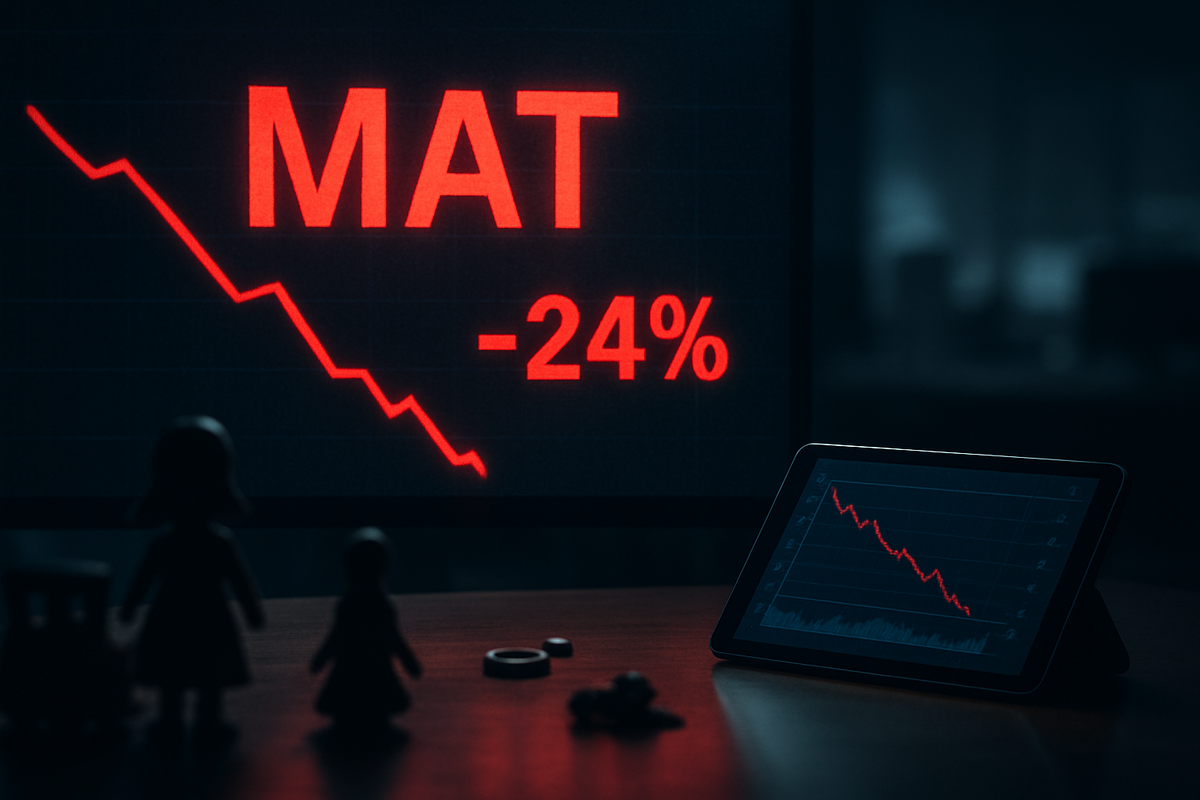
EL SEGUNDO, CA — Shares of toy powerhouse Mattel, Inc. (NASDAQ: MAT) experienced a devastating sell-off on February 12, 2026, plummeting 24% in a single trading session. The move comes on the heels of a disastrous fourth-quarter earnings report and a fiscal year 2026 outlook that left Wall Street questioning the long-term viability of the company’s post-Barbie movie strategy. The sharp decline wiped out billions in market capitalization, marking the stock’s worst performance since the onset of the pandemic.
The primary catalyst for the freefall was a combination of disappointing 2025 holiday sales and a significant downward revision for 2026 earnings per share (EPS). As the "Barbiecore" cultural phenomenon of 2023 and 2024 officially recedes into the rearview mirror, Mattel finds itself grappling with an inventory glut, brand fatigue, and a shifting consumer landscape that is increasingly moving away from traditional physical toys toward digital and collector-focused experiences.
A "Soft" Holiday Season Ends the Barbie Super-Cycle
The detailed earnings report released late yesterday revealed that Mattel (NASDAQ: MAT) missed analyst expectations across nearly every major metric. For the critical fourth quarter of 2025, the company reported an adjusted EPS of $0.39, missing the consensus estimate of $0.54 by a wide margin. Revenue for the quarter came in at $1.77 billion, well below the $1.85 billion forecast by analysts. Management attributed the miss to a "soft" December in North America, where aggressive holiday promotions and heavy discounting were not enough to entice inflation-weary parents.
The timeline leading up to this crash suggests a slow-motion collision. Throughout 2025, Mattel had maintained that its "Barbie Playbook"—the strategy of leveraging high-profile IP and theatrical releases to drive toy sales—would sustain the brand’s momentum. However, by mid-year, worldwide gross billings for the Doll segment began to stagnate. By Q4, despite a marginal 2% increase in reported billings, the numbers were flat in constant currency, indicating that the brand had essentially reached a saturation point. Initial market reactions were swift, with high-volume selling starting in the pre-market hours and accelerating as major brokerages released stinging downgrades.
Winners and Losers: A Widening Gap in the Toy Aisle
While Mattel (NASDAQ: MAT) struggled, the market response created a clear contrast with its primary rival, Hasbro, Inc. (NASDAQ: HAS). Interestingly, Hasbro shares rose 8% on the same day after reporting a significant earnings beat. Hasbro’s success was driven by its "Wizards of the Coast" and digital gaming segments, specifically the ongoing dominance of Magic: The Gathering. By securing a multi-year deal with Warner Bros. Discovery (NASDAQ: WBD) to produce Harry Potter toys starting in 2027, Hasbro demonstrated a forward-looking IP strategy that investors currently prefer over Mattel's aging physical catalog.
Other potential winners include Spin Master Corp. (TSX: TOY), which has successfully pivoted toward the "kidult" market—adult collectors who now represent a massive portion of annual toy sales. Spin Master’s recent announcement of a horror-themed trading card game in partnership with Universal suggests they are capturing the high-margin collector market that Mattel is struggling to dominate. On the losing side, major retailers like Target (NYSE: TGT) and Walmart (NYSE: WMT) may face margin pressure as they are forced to clear excess Mattel inventory through further markdowns, potentially dampening their own retail segment earnings in the coming quarter.
The End of the "Barbie Halo" and the Pivot to Digital
The 24% drop highlights a broader trend: the "Barbie Movie" effect has officially expired. Analysts argue that Mattel (NASDAQ: MAT) relied too heavily on the theatrical success of 2023 to mask structural weaknesses in its core manufacturing business. As consumers move toward "phygital" experiences—toys that have a digital or gaming component—Mattel’s heavy reliance on plastic dolls and die-cast cars is being viewed as a liability. This event serves as a cautionary tale for companies attempting to use Hollywood blockbusters as a permanent substitute for product innovation.
Furthermore, the industry is seeing a permanent shift in demographics. The "kidult" segment is no longer a niche; it is a pillar of the industry. Competitors who have leaned into gaming and high-end collectibles are seeing higher margins and more resilient demand. Mattel’s recent move to acquire full ownership of its mobile games joint venture, Mattel163, is seen as a necessary but late attempt to catch up to the digital-first models already perfected by Hasbro (NASDAQ: HAS) and various mobile gaming giants.
The Road Ahead: $110 Million for a Digital Future
Looking forward, Mattel (NASDAQ: MAT) has announced a strategic "pivot" that includes a $110 million investment in 2026 focused on artificial intelligence and digital gaming infrastructure. This massive spending plan is a primary reason for the weak FY2026 EPS guidance of $1.18 to $1.30, which sits nearly 30% below previous Street expectations of $1.75. In the short term, the company must work through its inventory glut and stabilize its relationship with retail partners who are frustrated by the lack of holiday sell-through.
In the long term, Mattel’s survival may depend on its ability to transform from a toy manufacturer into an IP management firm. This transition will require more than just movie deals; it will require a robust digital ecosystem where children and collectors can engage with brands like Hot Wheels and Barbie in virtual spaces. The market is currently skeptical of this transition, as evidenced by JPMorgan’s recent downgrade to "Underweight" with a price target of $14.
Summary and Investor Outlook
The 24% plunge in Mattel’s (NASDAQ: MAT) stock price is a watershed moment for the toy industry, signaling the definitive end of the post-Barbie boom. The combination of a Q4 earnings miss and a dismal 2026 outlook has forced a structural re-rating of the stock. Investors should take away that brand equity alone is not enough to overcome macroeconomic headwinds and changing consumer habits.
Moving forward, the market will be watching Mattel’s digital execution closely. Key indicators to monitor in the coming months include the integration of the Mattel163 acquisition and the performance of its first-quarter margins. If the $110 million digital investment does not show early signs of traction by mid-2026, the company could face further de-valuation or even become a target for private equity or a larger entertainment conglomerate looking to scoop up legacy IP at a discount.
This content is intended for informational purposes only and is not financial advice.