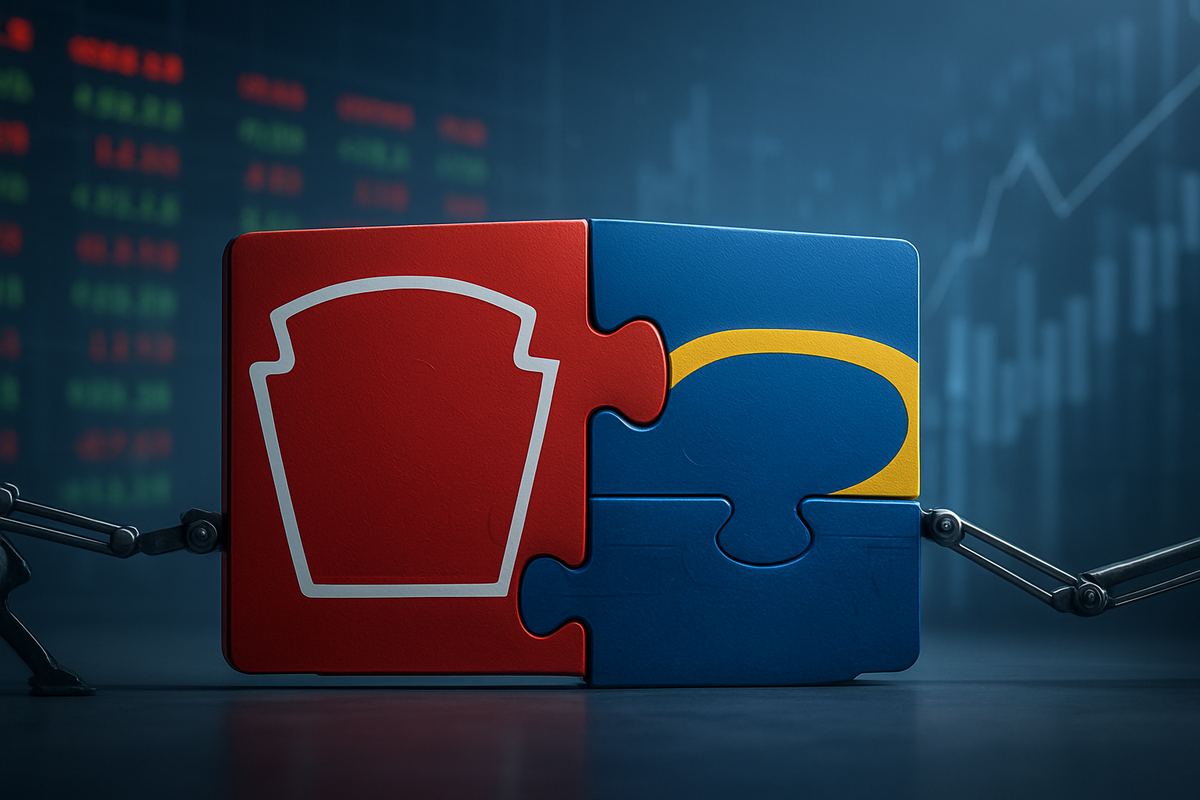
In a dramatic reversal of strategy, The Kraft Heinz Company (NASDAQ: KHC) announced on February 11, 2026, that it is indefinitely pausing its previously detailed plan to split into two independent, publicly traded companies. The decision, revealed during a somber fourth-quarter earnings call, marks a total pivot from the "transformation path" set just six months ago and signals a focus on internal stabilization over corporate restructuring.
The immediate market reaction was swift and unforgiving. Shares of Kraft Heinz fell nearly 8% in early trading as investors grappled with a lowered 2026 earnings outlook and the admission that the company’s core brands are currently too fragile to support a separation. The pause underscores a broader crisis of confidence in the consumer packaged goods (CPG) sector, as legacy brands struggle to maintain volume against a tide of rising costs and aggressive private-label competition.
The $600 Million Pivot: Why the Split Was Scrapped
The decision to halt the separation was spearheaded by Steve Cahillane, the former Kellanova (NYSE: K) chief executive who took the helm of Kraft Heinz on January 1, 2026. Cahillane’s appointment followed the sudden departure of Carlos Abrams-Rivera, who had been the architect of the split. In his first earnings call as CEO, Cahillane was blunt, stating that the organization is "not yet healthy enough to stand alone as two separate entities." He cited a 5% decline in volume and mix in the latter half of 2025 as proof that the company’s foundation needed repair before it could be dismantled.
Originally, the 2025 plan involved carving the giant into two: "Global Taste Elevation Co.," focusing on high-growth condiments like Heinz Ketchup, and "North American Grocery Co.," which would house staples like Oscar Mayer and Kraft Singles. Instead of incurring an estimated $300 million in "dis-synergy" costs to execute the split, Kraft Heinz will now redirect those resources into a massive $600 million reinvestment program. This capital is slated for research and development, marketing, and "product superiority" initiatives aimed at winning back value-conscious consumers who have migrated to store brands.
Winners and Losers: A Shift in the CPG Landscape
The primary loser in this strategic U-turn is the group of activist investors and short-term shareholders who had bet on the split as a catalyst for unlocking value. Analysts at firms like Deutsche Bank (NYSE: DB) noted that the cancellation removes the "valuation floor" many expected from the pure-play condiments business. Furthermore, Carlos Abrams-Rivera, who was slated to lead the North American entity, now finds himself in a temporary advisory role, marking a significant change in the company's long-term leadership trajectory.
Conversely, the move may be a long-term win for the company’s largest shareholder, Berkshire Hathaway (NYSE: BRK.B). Reports suggest that Greg Abel, successor to Warren Buffett, was privately skeptical of the split's timing. By pausing the plan, Kraft Heinz maintains its scale and collective bargaining power with retailers—a crucial advantage as it battles competitors like Mondelez International (NASDAQ: MDLZ) and General Mills (NYSE: GIS). Retailers themselves may also benefit, as a unified Kraft Heinz is more likely to offer integrated promotional deals and simplified supply chain logistics than two smaller, independent firms.
Significance: The End of the "Great De-merger" Era?
This pivot by Kraft Heinz may signal a cooling of the "anti-conglomerate" trend that has swept the industrial and consumer sectors over the last five years. While companies like GE and Kellogg successfully split to find focus, Kraft Heinz’s struggle suggests that separation is not a panacea for poor volume growth. The move highlights a critical industry trend: the "volume-over-price" era. As the post-inflationary environment forces companies to stop relying on price hikes, the need for massive R&D and marketing spend has made corporate scale an asset once again.
Regulatory and policy implications also loom. In an environment of increased scrutiny over food pricing and "shrinkflation," a unified Kraft Heinz may be better equipped to absorb regulatory costs than two smaller entities. Historical precedents, such as the 2012 split of the original Kraft Foods into Mondelez and what became the modern Kraft Heinz, show that while splits can create focus, they can also leave legacy businesses vulnerable. Cahillane seems to be betting that Kraft Heinz cannot afford that vulnerability in 2026.
What Comes Next: A Long Road to Recovery
In the short term, Kraft Heinz faces a "reset year." The company’s projected 2026 earnings per share (EPS) of $1.98–$2.10 sits well below previous analyst estimates of $2.50. Investors should expect high volatility as the company spends heavily on its $600 million reinvestment plan, which will likely suppress margins throughout the next four quarters. The success of this strategy will be measured not in stock price, but in "volume/mix" recovery—whether or not people start putting more Heinz and Kraft products back into their grocery carts.
Long-term, the possibility of a split remains on the table, but only as a "reward for performance." Cahillane has left the door open for a future divestiture, but only after the "North American Grocery" segment proves it can grow organically without the tailwinds of the global condiments business. Until then, the company must execute a delicate balancing act: revitalizing aging brands while simultaneously defending its premium positions in a market that is increasingly price-sensitive.
A New Chapter for a Food Giant
The decision to pause the Kraft Heinz split is a sobering admission that corporate financial engineering cannot replace fundamental brand strength. By prioritizing a $600 million reinvestment over a complex structural breakup, the company is choosing a path of "operational excellence" over "portfolio optimization." This move marks a significant victory for those who believe that the CPG giants of the past must return to their roots of innovation and marketing to survive.
Moving forward, the market will be watching two things: the effectiveness of Steve Cahillane’s leadership and the speed at which the $600 million investment translates into market share gains. For investors, the message is clear: the "easy" value-unlock of a split is gone, replaced by the hard work of brand building. Kraft Heinz remains a massive, cash-generative entity, but its path to growth is now a marathon, not a sprint.
This content is intended for informational purposes only and is not financial advice.