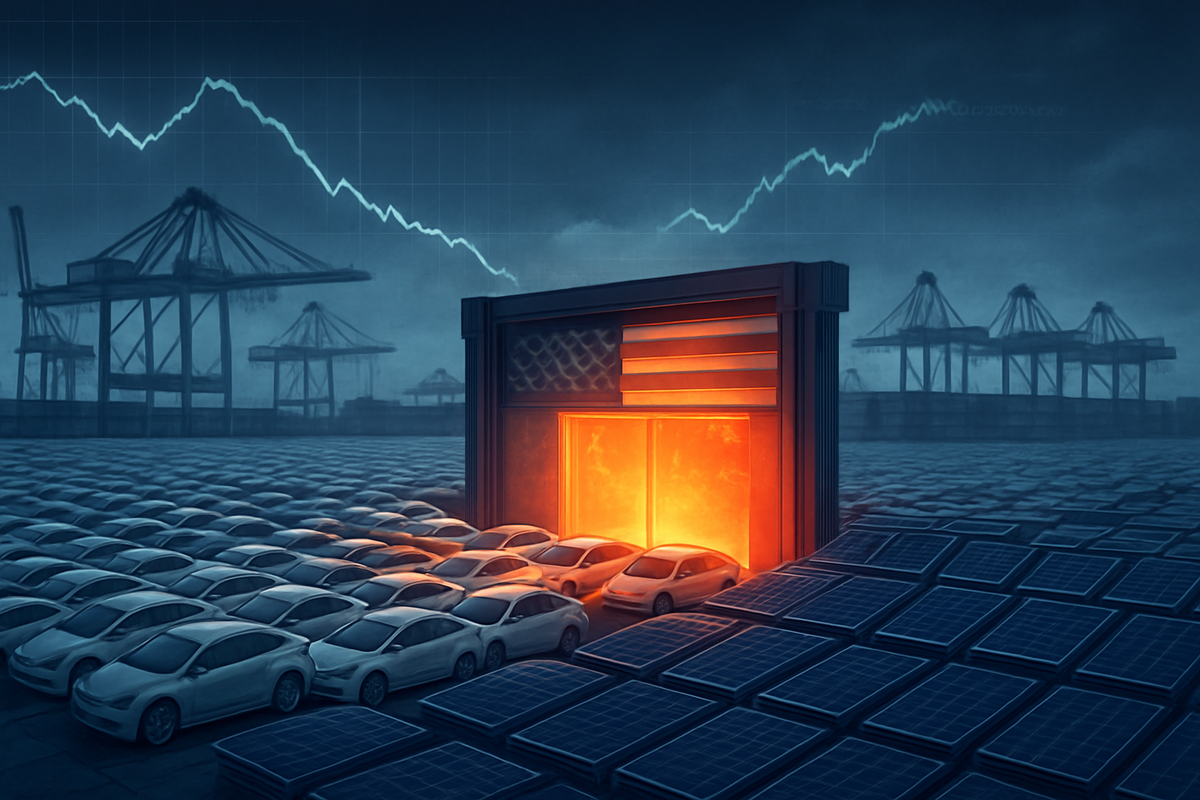
February 11, 2026 — The global economy has entered a precarious state of divergence. As of this week, China continues to battle a relentless deflationary cycle, marked by the 41st consecutive month of falling producer prices. This "exported deflation" is flooding international markets with low-cost goods, yet for the American consumer, the relief is being systematically neutralized at the border. In a historic tug-of-war, the disinflationary force of Chinese overcapacity is meeting the upward pressure of the most aggressive U.S. trade protections in nearly a century.
The implications for the Federal Reserve are profound. While underlying global goods prices are plummeting, the "sticker shock" from 2025’s tariff escalations has kept U.S. headline inflation artificially sticky at 2.7%. Federal Reserve officials, now led by outgoing Chair Jerome Powell and shadowed by nominee Kevin Warsh, are attempting to look through these "one-time price increases" to determine if the underlying disinflationary trend—fueled by Chinese economic stagnation—is the true dragon they need to slay.
A Tale of Two Indexes: China’s PPI vs. the U.S. Import Price Index
The data released earlier this month paints a stark picture of the Chinese industrial complex. In January 2026, China’s Producer Price Index (PPI) fell 1.4% year-on-year. While this is a slight improvement from the deep contractions seen in late 2025, it marks more than three years of negative factory-gate pricing. This trend is driven by massive overcapacity in sectors like electric vehicles (EVs), solar panels, and lithium-ion batteries. With domestic Chinese demand remaining anemic, Beijing has encouraged its industrial titans to export their way out of the slump, effectively selling surplus goods to the rest of the world at or below cost.
The timeline leading to this moment was defined by the "Liberation Day" tariffs of April 2025, which saw U.S. duties on many Chinese categories skyrocket to 145% before settling into a volatile "truce" at 30% for general goods. However, critical sectors remain under heavy fire. By late 2025, the U.S. Import Price Index showed a flat 0.0% annual change—a deceptive figure that masks a 20% drop in Chinese export prices offset by a 6.2% average tariff premium. This has left the Federal Reserve in a "wait and see" posture, with the federal funds rate currently hovering between 3.5% and 3.75% as they weigh the cross-currents of trade war inflation versus industrial deflation.
Corporate Crosswinds: Winners and Losers in the Tariff Tussle
For retail giants like Walmart (NYSE: WMT), the deflationary trend in China has been a tactical weapon. Walmart has reportedly used its massive scale to demand 10% price cuts from its remaining Chinese suppliers, effectively forcing them to absorb the cost of U.S. tariffs. By early 2026, Walmart’s strategic pivot to India and Mexico has accelerated, with the company aiming to source 25% of its imports from India by year-end. This agility has allowed Walmart to raise its 2026 sales guidance, even as rivals like Target (NYSE: TGT) struggle with tighter margins.
In contrast, the technology and automotive sectors are facing a more grueling reality. Apple (NASDAQ: AAPL) has spent the last year in a frantic "China Plus One" sprint. Facing a potential 9% hit to gross margins from current levies, Apple successfully shifted the assembly of all U.S.-bound iPhone 16 Pro models to India in 2025. Meanwhile, the U.S. automotive sector is in a state of crisis. Tesla (NASDAQ: TSLA) remains better positioned than its Detroit rivals due to high domestic content, but still faces rising costs for battery components. Ford (NYSE: F) has been more severely impacted; its "Model e" unit is projected to lose over $4 billion in 2026 as it struggles to compete with the price-efficiency of Chinese rivals like BYD (HKG:1211), which now leads the global EV market despite being effectively locked out of the U.S.
The Fed’s Dilemma and the Regulatory Ripple
The Federal Reserve’s narrative is shifting. In his January 28, 2026, press conference, Jerome Powell argued that most of the current inflation overshoot is a "one-time" artifact of trade policy. If tariffs are stripped out, core inflation would likely be running near or even below the 2% target. This perspective is being challenged by the incoming leadership. Kevin Warsh, the frontrunner to lead the Fed, has suggested that AI-driven productivity and the global "deflationary gift" from China might allow for more aggressive rate cuts once the tariff-induced volatility peaks in mid-2026.
This macro environment is also creating significant policy ripple effects. First Solar (NASDAQ: FSLR) has emerged as a primary beneficiary of protectionist "moats," with 3,400% anti-dumping duties on Southeast Asian imports effectively handing the company total pricing power in the U.S. market. However, even First Solar has faced headwinds, as its own overseas facilities were caught in the crossfire of reciprocal tariffs. This has forced a historic relocation of industrial capacity, with First Solar aiming for 14 GW of domestic U.S. capacity by the end of 2026—a move mirrored by dozens of companies now prioritizing "resiliency" over "efficiency."
The Road Ahead: Reflation or Recession?
As we move deeper into 2026, the primary question is whether China can successfully "reflate" its economy. There are early signs that Beijing is cracking down on "involution"—the destructive price wars between its own manufacturers—which could see Chinese PPI turn positive by the third quarter of 2026. If Chinese factory prices begin to rise at the same time U.S. supply chains are fully re-routed, the global economy could see a sharp reversal from deflationary fears to a new wave of cost-push inflation.
In the short term, companies will likely continue to prioritize supply chain diversification. The shift to "near-shoring" in Mexico and "friend-shoring" in India is no longer a strategic choice but a survival necessity. Investors should prepare for a period of "bifurcated margins," where companies with the scale to dictate supplier pricing (like Walmart) outperform those heavily dependent on specialized Chinese components (like Ford or smaller tech firms).
Summary: What Investors Should Watch
The current global inflation outlook is a paradox of falling production costs and rising trade barriers. While China is "exporting" deflation through its industrial overcapacity, the U.S. is "importing" it at a steep discount, only to tax it back to parity at the border. This has created a unique "inflationary plateau" that the Federal Reserve must navigate with extreme caution.
Moving forward, investors should keep a close eye on three key metrics: China’s PPI for signs of a floor in industrial pricing, the U.S. Import Price Index for the "real" cost of goods excluding duties, and the rhetoric from the "New Fed" under Kevin Warsh. The era of low-cost, frictionless global trade is over, and the market’s new winners will be those who can navigate a world where the price of a product is determined as much by a customs agent as by a factory foreman.
This content is intended for informational purposes only and is not financial advice.