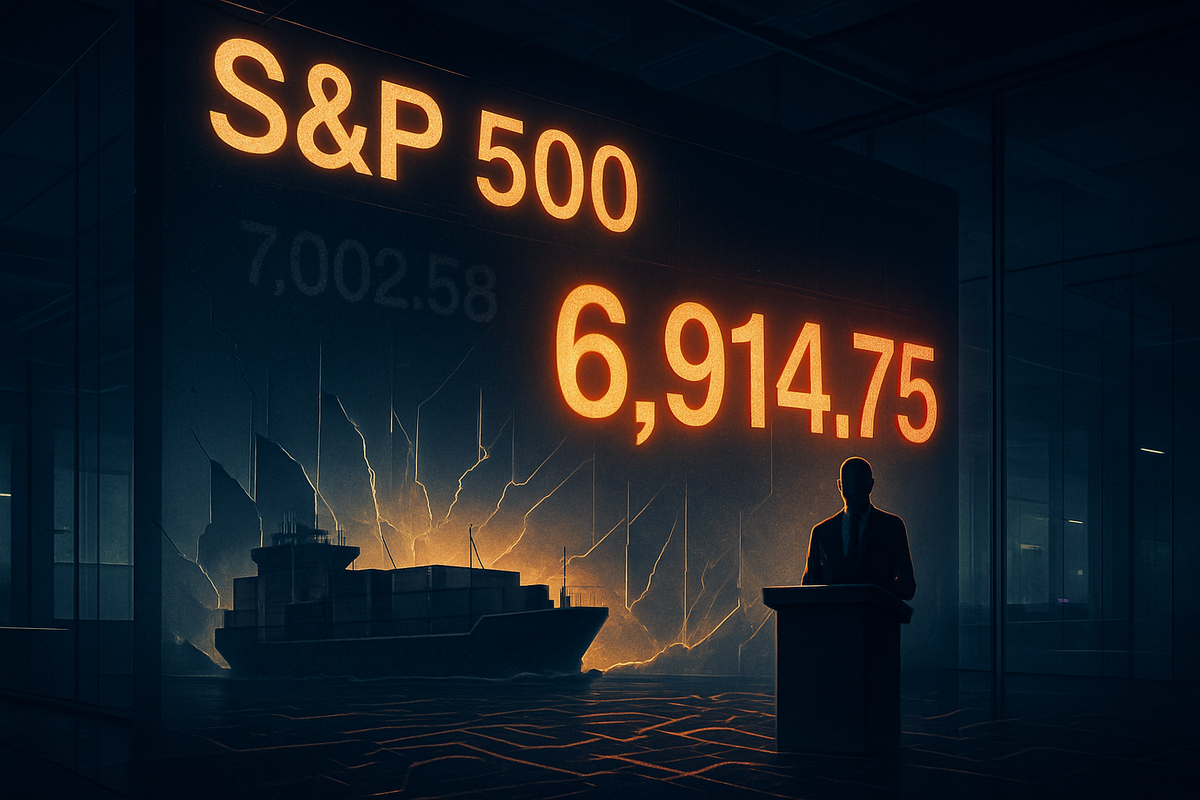
The S&P 500 Index retreated further from its historic peaks on Wednesday, closing at 6,914.75, a decline of 0.39% for the session. This pullback marks a significant cooling period for a market that only weeks ago, on January 28, 2026, celebrated a record-shattering high of 7,002.58. The retreat highlights a growing sense of unease on Wall Street as the initial euphoria surrounding the "AI productivity miracle" meets the sobering reality of a shifting monetary regime and escalating trade tensions.
The market’s decline is being driven by what traders have dubbed the "Warsh Shock"—the nomination of Kevin Warsh to lead the Federal Reserve—combined with a "razor-thin margin for error" in corporate valuations. With the index trading at nearly 23 times forward earnings, investors are increasingly skeptical that the aggressive 14-16% earnings-per-share (EPS) growth forecasts for 2026 can be met in an environment of rising tariffs and higher-for-longer interest rates.
The 'Warsh Shock' and the Unwinding of the Debasement Trade
The primary catalyst for the recent volatility was the January 30 announcement that Kevin Warsh would be nominated to succeed Jerome Powell as Chair of the Federal Reserve. Warsh, known for his hawkish stance and historical criticism of quantitative easing, has signaled a preference for a "hard money" approach. This nomination triggered an immediate and violent repricing of assets. The U.S. Dollar Index (DXY) surged to its highest level in years, while assets previously used as hedges against inflation and currency debasement, such as gold and silver, saw double-digit percentage drops in a matter of days.
Compounding this monetary shift is the "Liberation Day" tariff regime. The market is currently pricing in the impact of a new 10% tariff on several European nations, a move sparked by geopolitical friction over the Greenland purchase proposal. These trade barriers have added a layer of "sticky" inflation to the economy, currently hovering around 2.7%, complicating the Fed’s path and putting upward pressure on the 10-year Treasury yield. The resulting increase in the discount rate has particularly punished high-multiple technology stocks, which had been the primary engines of the S&P 500's ascent to 7,000.
Initial market reactions on February 11 were further weighed down by the rescheduled January jobs report. While employment remains resilient, the cost of labor combined with rising import duties has begun to squeeze corporate margins. This has forced a rotation out of growth-oriented sectors and into defensive postures as investors wait to see if the broader economy can withstand the "Goldilocks" exit strategy being deployed by the incoming Fed leadership.
Corporate Impact: From 'Software-mageddon' to Defense Surge
The retreat from all-time highs has not been felt equally across the board, creating a stark divide between winners and losers. The most visible casualties have been in the enterprise software sector, where a phenomenon known as "Software-mageddon" has taken hold. Companies like Salesforce (NYSE: CRM), ServiceNow (NYSE: NOW), and Intuit (NASDAQ: INTU) have faced aggressive selling as investors fear that "agentic AI"—autonomous digital workers—is beginning to cannibalize traditional per-seat subscription models. This shift in the tech landscape has made high valuations for legacy SaaS firms increasingly difficult to justify.
Conversely, the defense sector has emerged as a rare bright spot. Despite facing tariff-related input costs, Lockheed Martin (NYSE: LMT) and Northrop Grumman (NYSE: NOC) have seen their shares surge. This outperformance is driven by the massive "Golden Dome" missile shield project and a general increase in global defense spending. In the consumer space, the picture is more bleak; retailers such as Target (NYSE: TGT), Best Buy (NYSE: BBY), and Macy’s (NYSE: M) have issued downward guidance, citing the "double whammy" of higher procurement costs due to tariffs and a consumer base that is increasingly price-sensitive as the "wealth effect" from the stock market rally begins to fade.
The automotive and industrial sectors are also feeling the pinch of the new trade policies. Ford (NYSE: F) and GM (NYSE: GM) have reported significant tariff-related headwinds, with some estimates placing the annual cost impact in the billions. Similarly, John Deere (NYSE: DE) has struggled with rising manufacturing costs, leading to a more cautious outlook for the remainder of the 2026 fiscal year. Even AI darling NVIDIA (NASDAQ: NVDA) and data analytics firm Palantir (NYSE: PLTR) have seen their high price-to-earnings multiples challenged as the "Warsh Shock" raises the cost of capital.
A Precarious Balance: EPS Forecasts vs. Valuation Reality
The broader significance of the current market retreat lies in the disconnect between analyst expectations and the macroeconomic environment. The consensus forecast for 14-16% EPS growth in 2026 is historically ambitious, especially when considering the "Other 493"—those stocks in the S&P 500 outside the dominant tech giants. For these companies to meet such targets, they would essentially need to double their earnings pace from 2025, a feat that becomes increasingly difficult as trade friction persists and interest rates remain elevated.
Historically, when the S&P 500 trades at 32x trailing earnings—as it did near the January peak—it enters a zone of extreme sensitivity to any policy misstep. The transition from Powell to Warsh represents a significant "regime change" that the market hasn't experienced in nearly a decade. Investors are drawing parallels to the "taper tantrums" of the past, but with the added complexity of a global trade war and a fundamental shift in how artificial intelligence is expected to drive productivity.
The regulatory environment is also shifting. With a more hawkish Fed likely to prioritize price stability over market liquidity, the "Fed Put"—the long-held belief that the central bank would intervene to support falling asset prices—is effectively being withdrawn. This policy shift, combined with the inflationary nature of the new tariff regime, suggests that the period of low-volatility, liquidity-driven gains may be over, replaced by a "show-me" market where only the most efficient and tariff-resilient companies can thrive.
Looking Ahead: The May Transition and the Search for a Floor
In the short term, all eyes are on the official handover of the Federal Reserve chairmanship in May. The period between now and then is likely to be characterized by "regime transition volatility," as the market attempts to find a sustainable floor. Strategic pivots are already underway; many institutional investors are rotating into defensive sectors like Healthcare and Utilities, with UnitedHealth (NYSE: UNH) and NextEra Energy (NYSE: NEE) seeing increased inflows as hedges against a "stagflation-lite" scenario.
The long-term outlook depends on whether the "AI productivity miracle" can deliver actual earnings growth fast enough to offset the drag of higher rates and trade costs. If corporate America can leverage AI to significantly reduce operating expenses, the 14-16% EPS growth targets might remain within reach. However, if the "Software-mageddon" narrative continues to gain traction, a deeper re-rating of the technology sector could be on the horizon, potentially dragging the S&P 500 further away from the 7,000 level.
The primary challenge for investors in the coming months will be navigating a "bifurcated market." Opportunities may emerge in companies that are "tariff-agnostic" or those that can benefit from the reshoring of manufacturing. However, the margin for error remains razor-thin. Any further escalation in trade tensions or a more aggressive-than-expected first move by the Warsh-led Fed could easily trigger a correction exceeding 10% from the January highs.
Summary and Investor Outlook
The S&P 500's retreat to 6,914.75 serves as a stark reminder that even the most powerful bull markets must eventually contend with the gravity of policy and valuation. The combination of the "Warsh Shock," a new era of protectionist trade policy, and extraordinarily high earnings expectations has created a fragile equilibrium. While the 7,000 milestone was a historic achievement, it also marked a peak in optimism that is now being tested by a more sober reality.
Moving forward, the market's health will be determined by whether the "Other 493" can step up to support the index as the "Magnificent Seven" face valuation headwinds. Investors should watch closely for signs of margin compression in upcoming earnings reports and pay close attention to the rhetoric from the Federal Reserve as the May transition approaches. The "Fed Put" may be gone, but for the discerning investor, this period of volatility could provide the first real entry points in a market that has been overextended for months.
The lasting impact of this period will likely be a shift in focus from "growth at any price" to "resilient earnings." As the S&P 500 attempts to stabilize, the focus will remain on whether the American corporate engine can innovate its way out of the current macroeconomic headwinds or if the retreat from 7,000 is the beginning of a more prolonged cyclical downturn.
This content is intended for informational purposes only and is not financial advice.