The silver market has once again become the epicenter of global financial volatility, reminding investors of its reputation as "the devil's metal." On Monday, February 9, 2026, silver prices staged a dramatic 7% surge, climbing toward the $83-per-ounce mark in a move that caught many short-sellers off guard. The rally, fueled by a sudden rotation of capital out of Asian equities and into hard assets, suggested that the white metal was ready to reclaim its former glory following a tumultuous start to the year.
However, the exuberance was short-lived. By Tuesday, February 10, 2026, the metal retreated below $82 per ounce as a rebounding US dollar and a wave of institutional profit-taking tempered the momentum. This rapid "round trip" in price action highlights the extreme sensitivity of the current market, where silver serves as both a critical industrial component for the green energy transition and a volatile speculative vehicle for global macro traders.
The January Legacy and the February Whiplash
The current price action cannot be understood without the context of the historic "Silver Moonshot" of January 2026. Just weeks ago, a perfect storm of structural supply deficits and a massive institutional short squeeze propelled silver to an all-time high of $121.00 per ounce. This parabolic move was driven by a panic among industrial consumers in the solar and electric vehicle (EV) sectors, who abandoned "just-in-time" inventory models for "just-in-case" stockpiling. The subsequent 50% selloff from those highs left the market searching for a stable floor, which it appeared to find near the $75 level before this week’s sudden 7% eruption.
The timeline leading to the February 9 surge began during the Tokyo trading session. As the Nikkei 225 experienced a bout of early-morning instability, Japanese institutional investors—historically heavy lifters in the precious metals space—began shifting liquidity into silver. This "Tokyo Open" influence created a vacuum of sell-side liquidity, causing a cascade of automated buy programs to trigger as the metal breached key technical resistance levels. By the time New York markets opened on Monday, the momentum was unstoppable, driving the price to its intraday peak of nearly $83.
Mining Giants and Industrial Losers: The Corporate Fallout
The volatility has created a stark divide between winners and losers in the public markets. First Majestic Silver (NYSE: AG), often cited as one of the purest silver plays available to investors, saw its shares skyrocket nearly 12% during Monday’s surge. However, the company’s high beta relative to the spot price made it a target for sellers on Tuesday, as it gave back a significant portion of those gains. Similarly, Pan American Silver (NASDAQ: PAAS) benefited from the rally, though its more diversified portfolio of base metals provided a slightly more stable, albeit less explosive, performance during the 48-hour window.
The "star performer" of the 2026 silver saga continues to be Wheaton Precious Metals (NYSE: WPM). As a streaming company, Wheaton is insulated from the soaring operational costs—such as fuel and labor inflation—that have plagued traditional miners during this period of high volatility. With silver prices oscillating between $80 and $120, Wheaton's high-margin business model has allowed it to report record-breaking cash flows, making it a favorite for institutional funds seeking silver exposure without the direct operational risks of mining. Conversely, industrial consumers like First Solar (NASDAQ: FSLR) are facing increasing margin pressure as silver, a key component in photovoltaic cells, remains stubbornly expensive compared to historical norms.
The Global Macro Tug-of-War
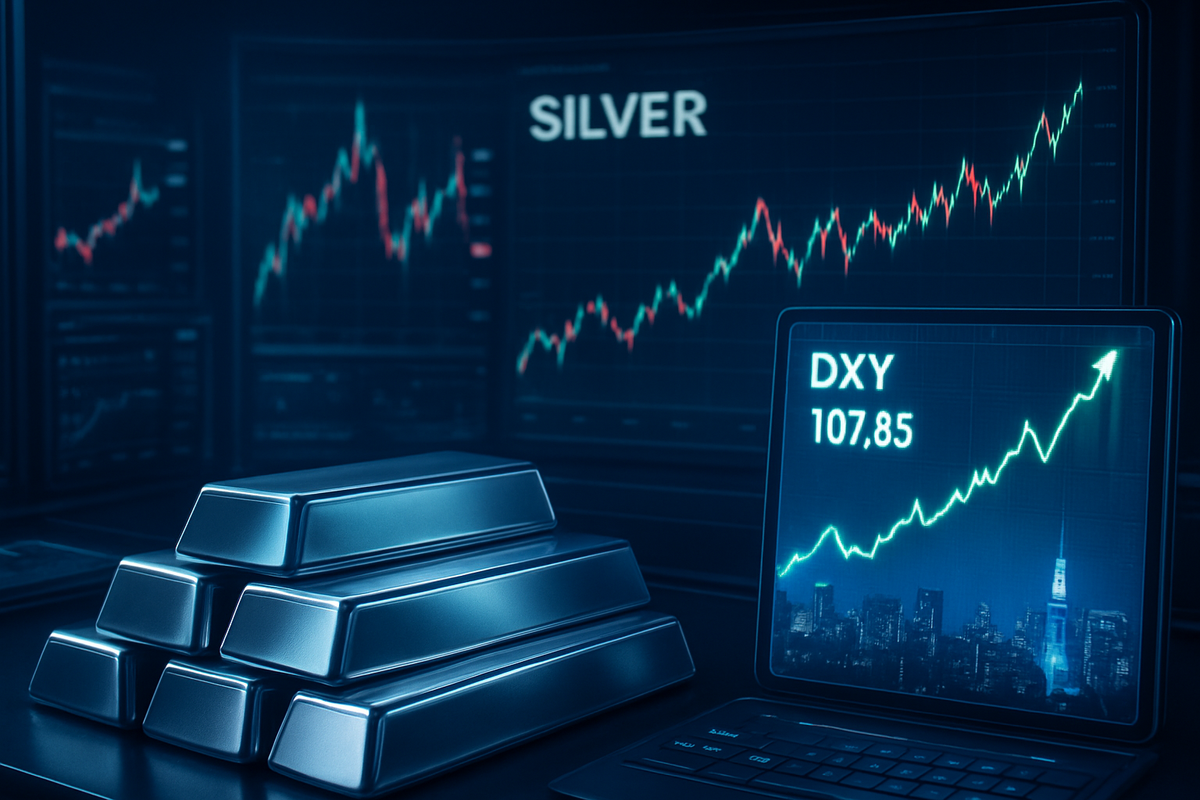
The Tuesday dip below $82 was largely a function of a resurgent US Dollar Index (DXY). As the dollar strengthened on Tuesday morning, it exerted the traditional inverse pressure on dollar-denominated commodities. This currency move was coupled with an improved risk appetite in global equity markets, led by a late-day recovery in Tokyo and strong openings in Europe. When stocks look attractive, the "safe haven" bid for silver often evaporates, leading to the type of profit-taking witnessed today.
This event fits into a broader industry trend where silver is increasingly decoupled from gold. While gold remains a steady store of value, silver’s dual identity as an industrial metal has tied its fate to the global energy transition. The structural deficit in silver—where annual mining output fails to meet the growing demands of the green economy—means that every minor dip is being met by "value hunters," while every spike is met by "profit-takers," creating a high-frequency trading environment that is not for the faint of heart.
Navigating the Path to $100
Looking ahead, the market is bracing for further "margin call" volatility. As the COMEX and other exchanges raise margin requirements to account for these 7% daily swings, smaller leveraged players may be forced out of their positions, leading to further erratic price movements. In the short term, traders are watching the $80 level closely; if silver can maintain this as a support floor, a retest of the $100 psychological barrier remains a distinct possibility before the end of the first quarter.
Strategically, mining companies may need to pivot toward more aggressive hedging strategies to lock in these historically high prices, even if it means capping their upside. For investors, the challenge will be distinguishing between "noise"—such as the Tuesday dip—and the "signal" of long-term industrial demand. The potential for a secondary short squeeze remains high if industrial users return to the market to replenish the inventories they depleted during the January crash.
The New Reality for the White Metal
The events of February 9 and 10, 2026, serve as a microcosm of the "New Era" for silver. The days of $20 or $30 silver appear to be a relic of the past, replaced by a high-stakes environment where double-digit percentage moves can happen within a single trading session. The key takeaway for the market is that while the $121 peak was a moment of speculative excess, the underlying demand from the solar and EV sectors provides a fundamental "gravitational pull" that keeps prices elevated.
As we move forward, investors should keep a close eye on the US dollar's trajectory and the health of the Tokyo stock market, both of which have proven to be leading indicators for silver's next move. The silver rollercoaster is far from over, and while the Tuesday dip may feel like a setback, the long-term structural supply-demand gap suggests that the white metal’s journey in 2026 is only just beginning.
This content is intended for informational purposes only and is not financial advice.