In a move that has further dampened investor sentiment, a top executive at The Campbell’s Company (NYSE: CPB) has offloaded a significant portion of his holdings just as the consumer staples giant closes out one of its most challenging years in recent history. Charles A. Brawley III, the company’s Executive Vice President and General Counsel, sold approximately $325,000 worth of stock in late December 2025, according to recent regulatory filings. The transaction occurred as the stock price languished near decade-lows, highlighting a growing disconnect between the firm's leadership and its long-term equity value.
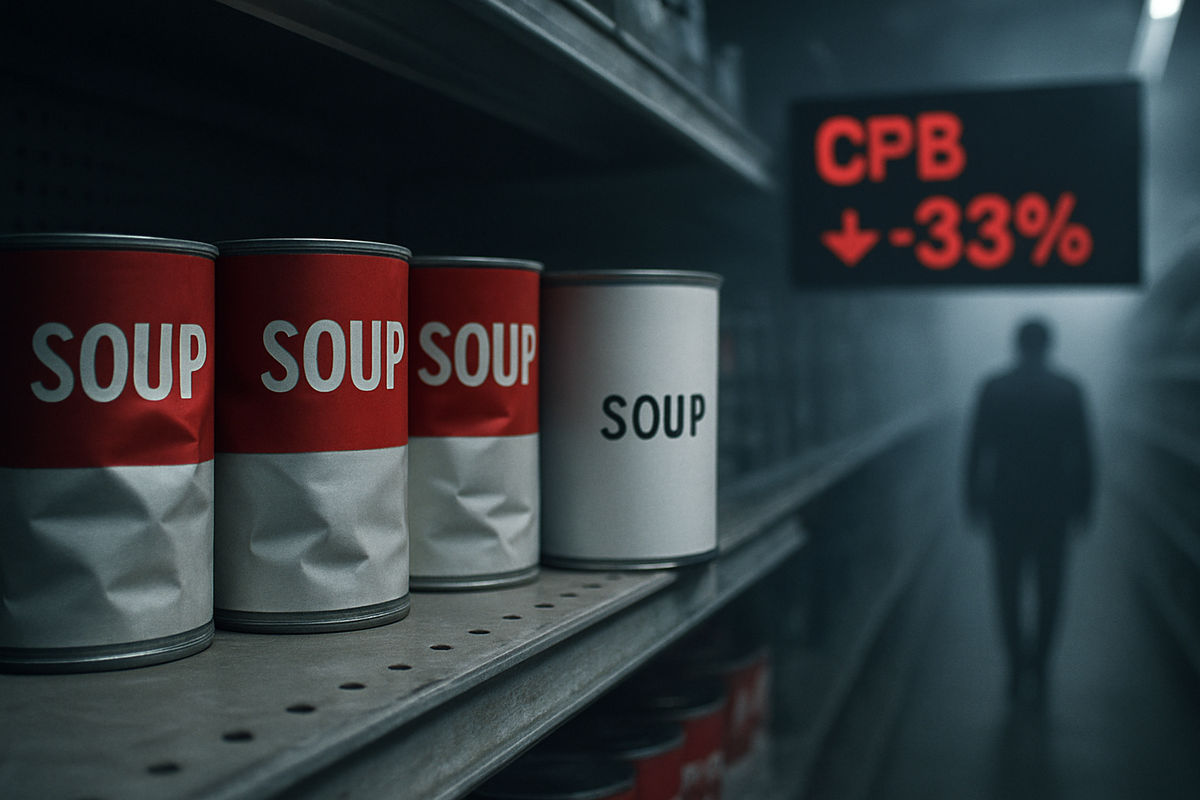
The timing of the sale is particularly conspicuous, coming on the heels of a 33% decline in share price over the past 12 months. As of early January 2026, Campbell’s is grappling with a perfect storm of internal reputational crises, a difficult leadership transition, and a broader industry-wide shift where consumers are increasingly abandoning legacy national brands in favor of cheaper private-label alternatives. For a company that has spent over a century as a cornerstone of the American pantry, the current trajectory suggests a fundamental identity crisis that a simple rebranding to "The Campbell’s Company" has yet to solve.
A Legal Chief’s Exit Amidst a 52-Week Low
The specific transaction, filed with the Securities and Exchange Commission on December 31, 2025, involved the sale of 11,550 shares by Charles A. Brawley III at an average price of $28.14 per share. This divestment represented roughly 21% of Brawley’s direct holdings in the company. While executive sales are often planned in advance for tax or diversification purposes, the decision to execute a trade at a price point nearly 35% lower than its January 2025 peak of $44.00 has raised eyebrows among market analysts.
The timeline leading up to this sale has been marred by a series of operational and PR setbacks. In late 2025, the company was rocked by the "Martin Bally Scandal," involving leaked recordings of a high-ranking executive making disparaging remarks about the company's own products and employees. The fallout from these comments led to immediate consumer boycotts and regulatory inquiries from state attorneys general regarding food labeling and manufacturing processes. This internal turmoil coincided with the first full year under CEO Mick Beekhuizen, who took the helm in early 2025 following the departure of Mark Clouse. Beekhuizen’s tenure has so far been defined by a "muted" growth outlook and a struggle to maintain the momentum of the company’s snacks division.
Initial market reactions to the insider selling and the year-end financial performance have been pessimistic. Major brokerages, including UBS and RBC, have slashed their price targets for CPB to the $26–$27 range, citing deteriorating gross margins. In its Q1 2026 earnings report, Campbell’s revealed a 3.4% decline in revenue, with margins squeezed to 29.9% due to rising supply chain costs and the impact of new tariffs on steel and aluminum—essential materials for the company’s iconic soup cans.
The Rise of the Store Brand: Winners and Losers
While Campbell’s struggles, the primary "winners" in the current environment are not its traditional rivals, but rather the retail giants and their private-label brands. As of 2025, store-brand sales reached a record high of $277 billion. Consumers, battered by years of cumulative inflation, have permanently shifted their spending habits. Retailers like Walmart (NYSE: WMT) and Costco (NASDAQ: COST) are seeing their "Great Value" and "Kirkland Signature" lines capture market share that legacy brands like Campbell's may never recover.
In contrast, Campbell’s direct competitors are also feeling the heat. General Mills (NYSE: GIS) and Conagra Brands (NYSE: CAG) have both reported significant volume declines as they attempt to pass on higher costs to a price-sensitive public. Kraft Heinz (NASDAQ: KHC) has fared even worse, announcing a massive plan to split into two independent companies by late 2026 in a desperate bid to unlock value from its aging portfolio. The collective "Big Food" sector is currently viewed by investors as a "value trap," with the entire group trading at multi-year lows as they fail to compete with the perceived value and improving quality of generic alternatives.
Broader Industry Trends and the "War on Sugar"
The decline of Campbell’s fits into a larger, more ominous trend for the packaged food industry. In early 2026, federal regulators introduced aggressive new dietary guidelines that have been colloquially termed the "War on Sugar and Processed Foods." These policy shifts have placed a target on the back of any company reliant on highly processed, high-sodium, or sugar-laden products. For Campbell’s, whose portfolio is heavily weighted toward shelf-stable soups and salty snacks like Goldfish, the regulatory environment is becoming increasingly hostile.
Historically, companies like Campbell’s were considered "recession-proof" defensive plays. However, the 2025–2026 period has shattered that precedent. The combination of high interest rates, which make the dividend yields of these companies less attractive compared to bonds, and the fundamental shift in consumer health consciousness has removed the traditional safety net. We are seeing a historical pivot similar to the decline of "Big Tobacco" in the late 20th century, where legacy giants must either radically reinvent their product lines or face a slow, painful contraction.
Strategic Pivots and the Road Ahead
Looking forward, Campbell’s faces a grueling path to recovery. In the short term, the company is doubling down on a $375 million cost-saving program intended to run through 2028. Investors should expect a series of strategic divestitures as the company looks to trim "non-core" brands and focus on its high-margin snacking business. However, with the snacks division itself seeing a 5% organic decline in late 2025, the "snack-led growth" thesis is under immense pressure.
One potential scenario is a more aggressive move into the "fresh" or "organic" categories, though such a pivot would require significant capital expenditure at a time when the company’s balance sheet is already strained. Another possibility is that Campbell’s becomes a target for private equity or a larger conglomerate looking to consolidate the struggling packaged food space. For any turnaround to succeed, the company must first address the reputational damage from the Bally scandal and prove to consumers that its products are compatible with modern health standards.
Final Assessment: A Watchful Eye on the Pantry
The $325,000 stock sale by Charles A. Brawley III may be small in the context of the company’s total market cap, but it serves as a potent symbol of the internal uncertainty plaguing the firm. When the chief legal officer reduces his stake while the stock is at a decade-low, it sends a message that the bottom may not yet be in. The 33% decline over the past year is not merely a market correction; it is a reflection of a company struggling to find its footing in a world that is moving away from the canned-goods era.
Moving forward, investors should watch for the company's Q2 2026 earnings and any further updates on the "War on Sugar" regulatory front. The ability of Campbell’s to stabilize its margins in the face of persistent tariff pressures will be the litmus test for its survival as a standalone entity. For now, the "Mmm-Mmm Good" era of the 20th century feels like a distant memory, replaced by the harsh reality of a 21st-century retail landscape that demands more than just nostalgia.
This content is intended for informational purposes only and is not financial advice.