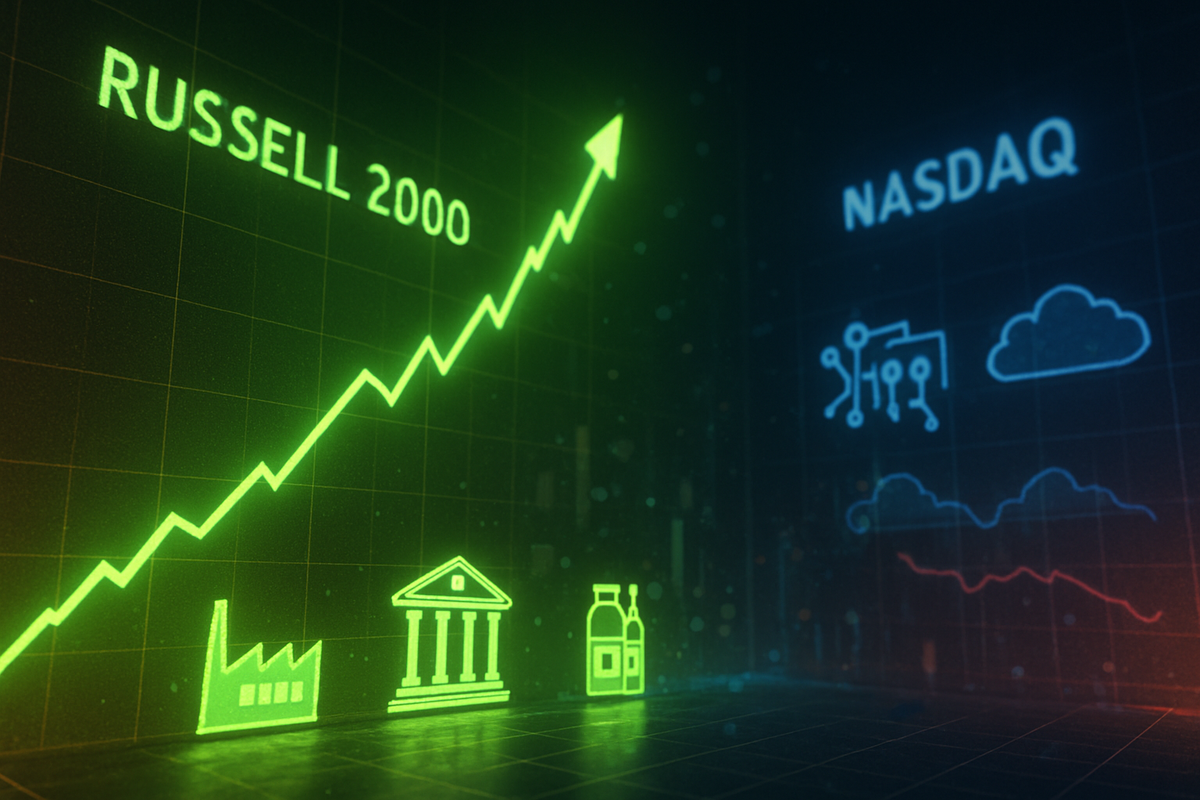
In a dramatic shift that has recalibrated the pulse of Wall Street, the Russell 2000 index (RUT) surged to a new record high on January 8, 2026, signaling a definitive breakout for small-cap stocks. As investors aggressively rotate capital out of the overextended technology giants that dominated the previous three years, the broader market is witnessing what analysts are calling the "Great Rotation." While the tech-heavy Nasdaq Composite (INDEXNASDAQ: .IXIC) struggled to find its footing, finishing the day in the red, the Russell 2000 climbed 1.4% to close at an all-time high of 2,603.90.
This divergence marks a significant turning point for the domestic economy. For years, the "Magnificent Seven" and AI-centric mega-caps provided the bulk of market returns, leaving smaller, domestically focused companies in the shadows. However, a combination of cooling inflation, a more accommodative Federal Reserve, and a massive valuation gap has finally ignited a "Goldilocks" scenario for small-cap equities. The immediate implication is clear: the market's breadth is expanding, and the era of narrow, tech-led leadership may be giving way to a more inclusive and resilient bull market.
The Breakout: A Timeline of the Small-Cap Surge
The journey to today’s record high began in the final quarter of 2025. After languishing in a multi-year consolidation range since 2021, the Russell 2000 began to show signs of life in November 2025 as the Federal Reserve signaled a shift toward "equilibrium management." Following three consecutive 25-basis-point rate cuts that brought the federal funds rate down to a range of 3.50%–3.75%, the cost of capital—a perennial headwind for smaller firms—began to ease. By mid-december, the index had already surpassed its previous 2021 highs, setting the stage for the January 2026 breakout.
The catalysts for today’s milestone were both fundamental and technical. On the fundamental side, small-cap earnings growth for 2026 is projected to hit an inflection point, with consensus estimates forecasting a 17% to 22% increase, significantly outpacing the 14% growth expected for the S&P 500. Technically, the index cleared the psychological barrier of 2,500 with ease, supported by the highest level of market participation seen in three years. On the day of the record, over 60% of the stocks in the Russell 2000 finished in positive territory, a stark contrast to the concentrated gains of years past.
Key players in this movement include institutional heavyweights who have spent the last month rebalancing portfolios. Firms like Goldman Sachs (NYSE: GS) and Morgan Stanley (NYSE: MS) have been vocal about the "mean reversion" trade, noting that small caps were trading at a nearly 30% discount to large caps at the start of the year. This valuation discrepancy, paired with the "One Big Beautiful Act"—a fiscal policy providing nearly $130 billion in corporate tax relief—has created a fertile environment for domestic industrials and regional financial institutions to thrive.
Winners and Losers in the Great Rotation
The primary beneficiaries of this rotation are the "quality" small-caps—companies with strong balance sheets that can capitalize on lower borrowing costs. In the biotech sector, EyePoint Pharmaceuticals (NASDAQ: EYPT) and Revolution Medicines (NASDAQ: RVMD) have seen their valuations soar as a "Dealmaking Renaissance" takes hold, with larger pharmaceutical companies looking to acquire smaller innovators to offset upcoming patent cliffs. Similarly, in the industrial space, Gorman-Rupp (NYSE: GRC) and Energy Services of America (NASDAQ: ESOA) have outperformed as domestic infrastructure redevelopment gains momentum.
Regional banks have also emerged as major winners, benefiting from a steepening yield curve. While the broader Nasdaq faltered, smaller financial players like Community Trust Bancorp (NASDAQ: CTBI) gained ground, fueled by expectations of increased commercial lending and a lighter regulatory environment. Conversely, the "losers" in this new regime are the debt-laden "zombie" firms that still face a daunting "refinancing wall" in 2026. Companies like Atara Biotherapeutics (NASDAQ: ATRA) and Aquestive Therapeutics (NASDAQ: AQST) have struggled to participate in the rally, as investors remain wary of firms that cannot self-fund their operations.
On the other side of the ledger, the Nasdaq's struggle is headlined by the stalling of former market darlings. Apple (NASDAQ: AAPL) and Nvidia (NASDAQ: NVDA) have faced significant profit-taking as "AI fatigue" sets in and institutional desks rotate into value-oriented sectors. Microsoft (NASDAQ: MSFT) also saw its momentum wane, as its valuation premium faced the gravity of a market seeking broader opportunities. However, not all tech is suffering; Alphabet (NASDAQ: GOOGL) and Amazon (NASDAQ: AMZN) have managed to weather the storm, repositioned by analysts as "rebound candidates" due to more attractive valuations relative to their AI monetization success.
Analyzing the Wider Significance
The Russell 2000’s record high is more than just a numerical milestone; it is a barometer for the health of the broader U.S. economy. Historically, small-cap leadership is a hallmark of the early-to-mid stages of an economic expansion. This shift suggests that the "recession fears" that haunted the market throughout 2024 and early 2025 have been firmly put to rest. The rotation fits into a broader trend of "reshoring" and domestic investment, where companies that produce and sell within the United States are finally being rewarded for their proximity to the American consumer.
Furthermore, this event highlights a significant change in market psychology. For the past several years, the "Magnificent Seven" acted as a defensive hedge—investors crowded into these names because they were seen as the only reliable source of growth. The current breakout in the Russell 2000 indicates that risk appetite has returned to "Main Street." This has ripple effects on competitors and partners alike; as small-cap companies grow, they increase their capital expenditures, benefiting mid-cap suppliers and service providers who have also been waiting for a cyclical tailwind.
From a regulatory and policy perspective, the "One Big Beautiful Act" has played a pivotal role. By incentivizing domestic production and providing tax relief for smaller enterprises, the policy has effectively leveled the playing field against multinational giants that have historically utilized offshore tax strategies. This shift echoes the market dynamics of the early 2000s, where a period of tech-led exuberance was followed by a multi-year stretch of small-cap and value-stock outperformance.
What Comes Next: Opportunities and Challenges
Looking ahead, the short-term outlook for small caps remains bullish, though not without hurdles. The "2026 Refinancing Wall" remains a critical challenge; while interest rates have come down, they are still higher than the near-zero levels seen during the pandemic. Small-cap companies will need to prove they can manage their debt loads while still investing in growth. Investors should expect a "quality divide" to emerge, where the gap between profitable small caps and speculative "zombies" continues to widen.
In the long term, the sustainability of this breakout will depend on the Federal Reserve's ability to navigate a "soft landing" without reigniting inflation. If the U.S. GDP continues to grow at the projected 2.6% rate for 2026, the Russell 2000 could see even higher targets. Some analysts, including those at Goldman Sachs, have already raised their year-end targets for the index to 2,825. Strategic pivots may be required for large-cap tech companies, who must now find ways to justify their high multiples in a market that is no longer starved for alternative growth options.
Market Wrap-Up and Investor Outlook
The Russell 2000’s ascent to 2,603.90 is a clear signal that the market's internal mechanics have shifted. The key takeaways for investors are the importance of diversification and the renewed value of domestic cyclicals. After years of tech dominance, the "Great Rotation" of 2026 is rewarding those who looked beyond the mega-cap horizon. The market is moving toward a more balanced state, where earnings growth and fundamental valuation—rather than pure momentum—are the primary drivers of stock performance.
Moving forward, the market is likely to remain volatile as it digests this rotation. Investors should watch for the upcoming quarterly earnings reports from regional banks and industrial leaders to confirm that the projected growth inflection is indeed taking place. While the Nasdaq may continue to face headwinds from "AI fatigue," the broadening of the bull market is a healthy sign for the long-term stability of the financial system. In the coming months, the focus will remain on the "quality" of the small-cap rally and whether the Russell 2000 can maintain its newfound leadership.
This content is intended for informational purposes only and is not financial advice.