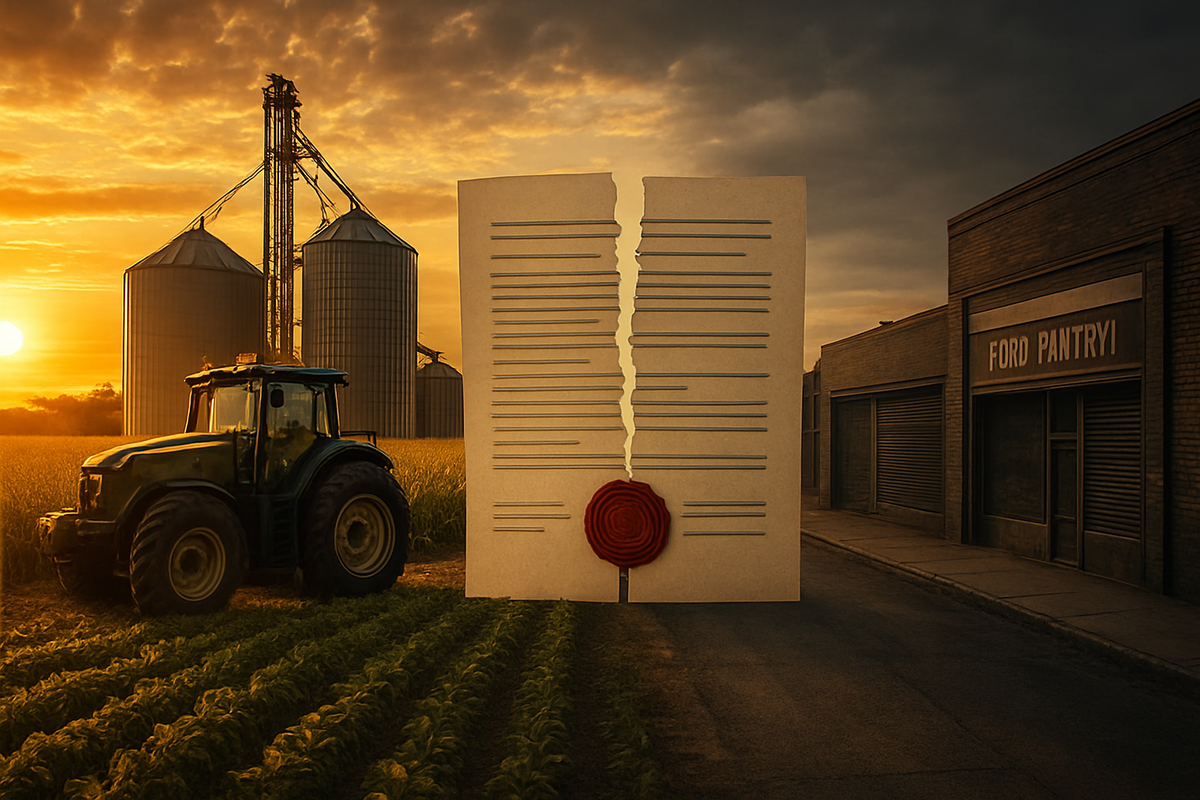
As of early January 2026, the American agricultural landscape is navigating its most significant policy transformation since the New Deal. The traditional "Farm Bill era"—characterized by a decennial, bipartisan omnibus package that married rural commodity subsidies with urban nutrition programs—has effectively ended. In its place stands a fragmented, production-first policy regime dominated by the One Big Beautiful Bill Act (OBBBA), which was signed into law on July 4, 2025. This shift has decoupled the long-standing political alliance between the "plow and the plate," leaving the industry to grapple with a new reality of higher commodity price floors, massive cuts to social safety nets, and a pivot away from climate-centric conservation.
The immediate implications are stark: while the federal government has injected a massive $12 billion "Farmer Bridge Assistance" (FBA) program to support row-crop producers through the 2026 planting season, the broader market is witnessing a sharp divergence in fortune. Commodity prices are increasingly tethered to aggressive new statutory reference prices, while the domestic biofuel sector is benefiting from protectionist feedstock mandates. However, the "decoupling" of the Supplemental Nutrition Assistance Program (SNAP) has introduced unprecedented volatility into the consumer staples sector, as billions in food assistance are stripped from the national economy to fund the enhanced agricultural safety net.
The transition away from the traditional Farm Bill began in earnest during the contentious legislative cycle of 2024 and 2025. After the 2018 Farm Bill extension expired, Congress bypassed the traditional committee-led omnibus process in favor of the OBBBA, a sweeping budget reconciliation measure. This maneuver allowed a Republican-led coalition to pass historic increases in farm subsidies without the need for bipartisan support, effectively severing the tie to nutrition programs. Key players in this shift included Senator John Boozman and Representative Glenn "GT" Thompson, who argued that the "omnibus model" had become a bottleneck for rural economic growth.
The timeline of this transformation reached a crescendo in late 2025. Following the signing of the OBBBA, the USDA, led by Secretary Brooke Rollins, announced the $12 billion FBA program to provide immediate liquidity to farmers facing a cyclical downturn. These payments, scheduled to begin in February 2026, offer roughly $44.36 per acre for corn and $30.88 for soybeans. Meanwhile, the "Skinny Farm Bill"—a smaller package aimed at reauthorizing "orphan" programs like rural development and research—is currently stalled in the House, with a critical expiration deadline looming on September 30, 2026.
Initial market reactions have been mixed. While the American Farm Bureau Federation (AFBF) has praised the $65 billion investment in the farm safety net, nutrition advocates and conservation groups are sounding alarms. The OBBBA redirected nearly $20 billion in "climate-smart" agriculture funds, originally authorized under the Inflation Reduction Act (IRA), into traditional commodity Title I programs. This has effectively signaled the end of the federal government's brief experiment with prioritizing carbon sequestration over raw production volume.
The policy shift has created clear winners among the giants of the agricultural sector. Corteva, Inc. (NYSE: CTVA) has emerged as a primary beneficiary; the company's focus on high-yield seed technology and proprietary crop protection aligns perfectly with the OBBBA’s production-first incentives. Analysts have labeled 2026 a "Golden Age" for ag-tech providers like Corteva, as higher reference prices—now $4.10 for corn and $10.00 for soybeans—encourage farmers to maximize yield at all costs to trigger federal safety net payments.
In the processing and biofuel space, Bunge Global SA (NYSE: BG) and Archer-Daniels-Midland Company (NYSE: ADM) are seeing a structural boost from the OBBBA’s extension of the 45Z Clean Fuel Production Credit. Crucially, the new law restricts these tax credits to domestic feedstocks, effectively banning imported Chinese used cooking oil from the U.S. renewable diesel market. This "domestic-only" mandate has sent soybean crush margins up by 20% on the 2026 curve, positioning Bunge, in particular, for significant earnings growth following its integration of Viterra.
Conversely, the outlook for equipment manufacturers like Deere & Company (NYSE: DE) remains cautious. While the OBBBA made permanent the 100% bonus depreciation and increased Section 179 expensing limits to $2.5 million, the $12 billion in bridge payments is currently being used by farmers to service high-interest debt rather than purchase new machinery. Deere has guided for a 15% to 20% drop in large equipment sales for 2026, as the industry waits for the "bottom of the cycle" to clear. Furthermore, food processors like Tyson Foods, Inc. (NYSE: TSN) face a double-edged sword: while lower feed costs (driven by high production) are a boon, the massive cuts to SNAP—estimated at $120 billion to $186 billion over the next decade—are expected to dampen demand for protein among low-income consumers, leading to a projected 1.8% fall in total grocery sales.
The wider significance of the "Farm Bill era's" end cannot be overstated. For nearly a century, the urban-rural coalition was the bedrock of American agricultural policy, ensuring that food security and farm profitability were viewed as two sides of the same coin. By decoupling these interests, Congress has entered uncharted territory. The new "production-first" paradigm fits into a broader global trend of agricultural nationalism, where the U.S. is prioritizing domestic supply chains and biofuel independence over international climate commitments.
This shift has significant ripple effects on global competitors. By subsidizing production and protecting domestic feedstocks, the U.S. is essentially challenging the market share of Brazilian soy and Argentinian corn. However, the regulatory pivot away from "climate-smart" ag may create a vacuum in the emerging global carbon credit market. While companies like Nutrien Ltd. (NYSE: NTR) continue to support retail farmers through this transition, the lack of federal "green" incentives may slow the adoption of regenerative practices, potentially putting U.S. exports at a disadvantage in markets like the European Union, which are increasingly focused on the carbon footprint of imported goods.
Historically, this moment mirrors the "Freedom to Farm" Act of 1996, which also attempted to move agriculture toward a more market-oriented system. However, the 2025 OBBBA is different in its scale and its use of the reconciliation process to bypass the minority party. This "policy by reconciliation" suggests that agricultural support will become increasingly partisan and volatile, fluctuating wildly with each change in administration or congressional control.
Looking ahead to the remainder of 2026, the market is bracing for the September 30 expiration of the remaining 2018 Farm Bill provisions. This "Skinny Farm Bill" negotiation will be the first test of whether a decoupled system can actually function. Without the "nutrition sweetener" to attract urban votes, discretionary programs for rural broadband, agricultural research, and minority farmer outreach face an uphill battle. Investors should expect heightened volatility in the autumn as the deadline approaches.
Long-term, the industry must adapt to a "subsidy-heavy, demand-uncertain" environment. Farmers will likely shift their strategic pivots toward crops that maximize PLC (Price Loss Coverage) payments, potentially leading to a glut in corn and soybeans by 2027. For the corporate sector, the opportunity lies in "efficiency tech"—tools that help farmers lower their per-bushel cost to stay profitable even if market prices dip below the new federal floors.
The passage of the OBBBA and the collapse of the traditional Farm Bill coalition mark a permanent change in how the U.S. government interacts with the agricultural economy. The era of the "big tent" omnibus is over, replaced by a more aggressive, production-oriented policy that favors large-scale row-crop producers and domestic biofuel processors at the expense of social safety nets and climate initiatives.
Moving forward, the market is likely to see a "K-shaped" recovery in the ag sector. Input providers and processors like Corteva and Bunge are well-positioned to thrive under the new mandates, while equipment manufacturers and consumer-facing food companies face a longer, more arduous path to growth. For investors, the coming months will require a close watch on the "Skinny Farm Bill" negotiations and the impact of SNAP cuts on retail earnings. The "Farm Bill era" may be dead, but the era of "Ag-Policy Volatility" has only just begun.
This content is intended for informational purposes only and is not financial advice.