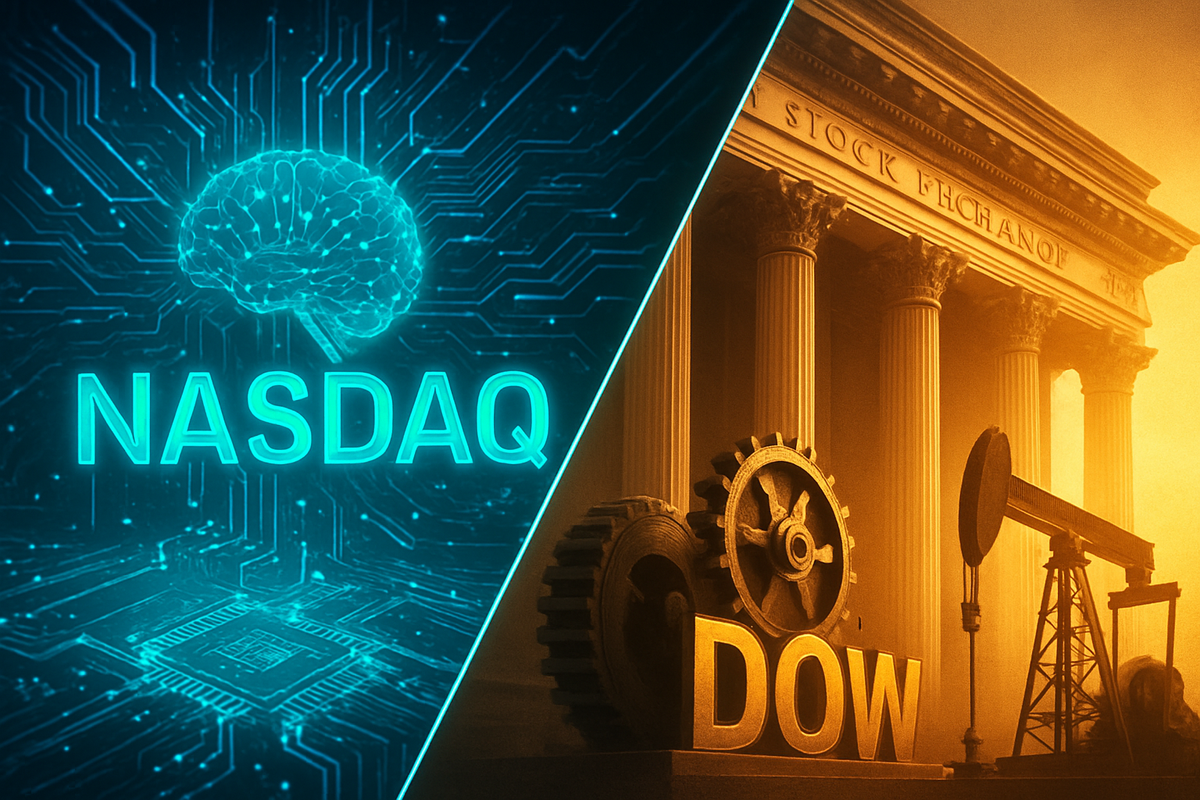
On this Tuesday, January 6, 2026, the U.S. equity markets are witnessing a striking divergence. While the tech-heavy Nasdaq Composite is pushing higher, buoyed by a fresh wave of enthusiasm for next-generation artificial intelligence, the Dow Jones Industrial Average is taking a measured pause. This breather follows a historic session on Monday that saw the blue-chip index flirt with the psychological 49,000 barrier, leaving investors to recalibrate their portfolios between high-growth silicon and the "old economy" titans that dominated the start of the year.
The divergence highlights a market in transition, balancing geopolitical euphoria with technical resistance. As of midday, the Nasdaq is up approximately 0.5%, driven by breakthroughs in "Agentic AI" and semiconductor hardware. Meanwhile, the Dow is trading flat to slightly lower, consolidating the massive gains it accrued over the weekend following significant geopolitical shifts in South America. This split-screen performance underscores a broader debate on Wall Street: whether the rally of 2026 will be defined by industrial recovery or the second coming of the AI revolution.
The Tale of Two Rallies: "Rubin" vs. The Venezuela Shock
The current market dynamic was set in motion by two vastly different catalysts. For the Dow Jones Industrial Average, the momentum began over the first weekend of January 2026. Reports of a significant geopolitical shift in Venezuela—specifically the capture of President Nicolás Maduro by U.S.-led forces—sent shockwaves through the energy and financial sectors. On Monday, January 5, the Dow surged nearly 600 points, closing at a record 48,977.18. This "Venezuela Shock" sparked hopes of a stabilized global oil supply and a reopening of South American markets, causing the Dow’s energy and banking heavyweights to skyrocket in a single session.
However, as the sun rose on January 6, that initial euphoria met the cold reality of technical resistance. With the Dow sitting less than 2% away from the monumental 50,000 mark, institutional profit-taking has become the order of the day. Investors are stepping back to assess the long-term implications of the Venezuelan transition, leading to a natural "cooling off" period for the index's 30 components.
In contrast, the Nasdaq’s gains today are being fueled by a hardware-driven resurgence. The primary spark was the official unveiling of the "Rubin" AI superchip platform by Nvidia (NASDAQ: NVDA). This next-generation architecture is designed to power "Agentic AI"—autonomous systems capable of complex decision-making without human intervention. The announcement has effectively reignited the "AI trade," shifting the focus from simple chatbots to the physical build-out of autonomous corporate infrastructure. This news has cascaded through the semiconductor ecosystem, lifting tech stocks that had previously been lagging behind the Dow’s industrial-led rally.
Winners and Losers in the Bifurcated Market
The primary beneficiary of today’s action is undoubtedly Nvidia (NASDAQ: NVDA), whose Rubin platform has set a new benchmark for the industry. The ripple effect is clearly visible in the semiconductor space, with Micron Technology (NASDAQ: MU) and Taiwan Semiconductor Manufacturing Company (NYSE: TSM) seeing significant gains as they are tapped to provide the high-bandwidth memory and foundry services required for this new era of compute. Additionally, Meta Platforms (NASDAQ: META) is trading higher as it positions itself as a leader in integrating agentic capabilities into consumer and enterprise software.
On the other side of the ledger, the "winners" of Monday’s session are today’s laggards. Energy giants like Chevron (NYSE: CVX) and Exxon Mobil (NYSE: XOM) are paring gains after their 5% surge on Monday. While the long-term outlook for these companies may be improved by the Venezuelan developments, the immediate lack of new catalysts has led to a minor retreat. Similarly, financial powerhouses like Goldman Sachs (NYSE: GS) and UnitedHealth Group (NYSE: UNH) are seeing a quiet session as investors rotate capital back into the growth-oriented Nasdaq names.
Software firms that have been slow to adapt to the "Agentic AI" shift are also finding themselves under pressure. While Salesforce (NYSE: CRM) has managed to keep pace by pivoting its strategy, other legacy enterprise software providers are seeing their valuations questioned as the market prioritizes companies with direct exposure to the Rubin chip ecosystem.
The "Agentic" Shift and the Divided Fed
This divergence is more than just a daily fluctuation; it represents a fundamental shift in how the market views the AI cycle. We are moving from the "Generative AI" era of 2023-2024 into the "Agentic and Physical AI" era of 2026. This phase is characterized by AI that doesn't just talk, but acts—managing supply chains, optimizing power grids, and conducting autonomous research. This transition is providing a fresh valuation floor for the Nasdaq, even as traditional industrial sectors face the headwinds of a maturing economic cycle.
Furthermore, the macro environment is adding a layer of complexity. The Federal Reserve remains "divided" as it approaches its January 28 meeting. While inflation has shown signs of stickiness, the U.S. unemployment rate recently ticked up to 4.6% in late 2025. This has created a "bad news is good news" scenario for the Nasdaq; signs of economic softening are increasing the probability that the Fed will hold or even cut rates to support the labor market. The CME FedWatch Tool currently shows a 75.6% chance of a rate hold, a prospect that tech investors find far more palatable than the "higher-for-longer" rhetoric that dogged the market in previous years.
Historically, such divergences between the Dow and Nasdaq often precede a period of broader market consolidation. We saw similar patterns in late 1999 and mid-2021, where one segment of the market took the lead while the other paused. However, the current divergence is unique because it is driven by a tangible leap in hardware capabilities (Nvidia’s Rubin) rather than pure speculative fervor.
What to Watch: The Road to Dow 50,000
Looking ahead, the immediate focus for the market will be the December Nonfarm Payrolls report, scheduled for release on Friday, January 9. This data will be the final major economic indicator before the Fed’s blackout period and will likely determine whether the Nasdaq can maintain its momentum or if the Dow will find the strength to push through the 49,000 resistance level toward 50,000.
In the short term, expect continued volatility in the energy sector as more details emerge regarding the political transition in Venezuela. For tech investors, the focus will remain on "execution." The market has rewarded the promise of the Rubin chip; now, it will look for evidence of order books filling up. Strategic pivots will be required for companies in the mid-cap tech space, which must now prove they can integrate agentic AI or risk being left behind by the "Magnificent" leaders.
Summary and Investor Outlook
The divergence seen on January 6, 2026, is a classic example of a market that is "digesting" its gains. The Dow’s pause is a healthy reaction to a record-setting run, while the Nasdaq’s rise signals that the appetite for high-growth innovation remains insatiable.
Key Takeaways:
- The Dow's Breather: Profit-taking near 49,000 is to be expected after the "Venezuela Shock" rally.
- The Nasdaq's Engine: Nvidia's "Rubin" platform is the new North Star for the tech sector.
- The Fed Factor: Labor market data on January 9 will be the next major market mover.
For investors, the coming months will require a balanced approach. While the allure of the AI resurgence is strong, the record-high levels of the Dow suggest that "value" and "growth" are in a tight race. Watching the 49,000 level on the Dow and the adoption rates of agentic AI software will be the most critical tasks for those looking to navigate the early weeks of 2026.
This content is intended for informational purposes only and is not financial advice.