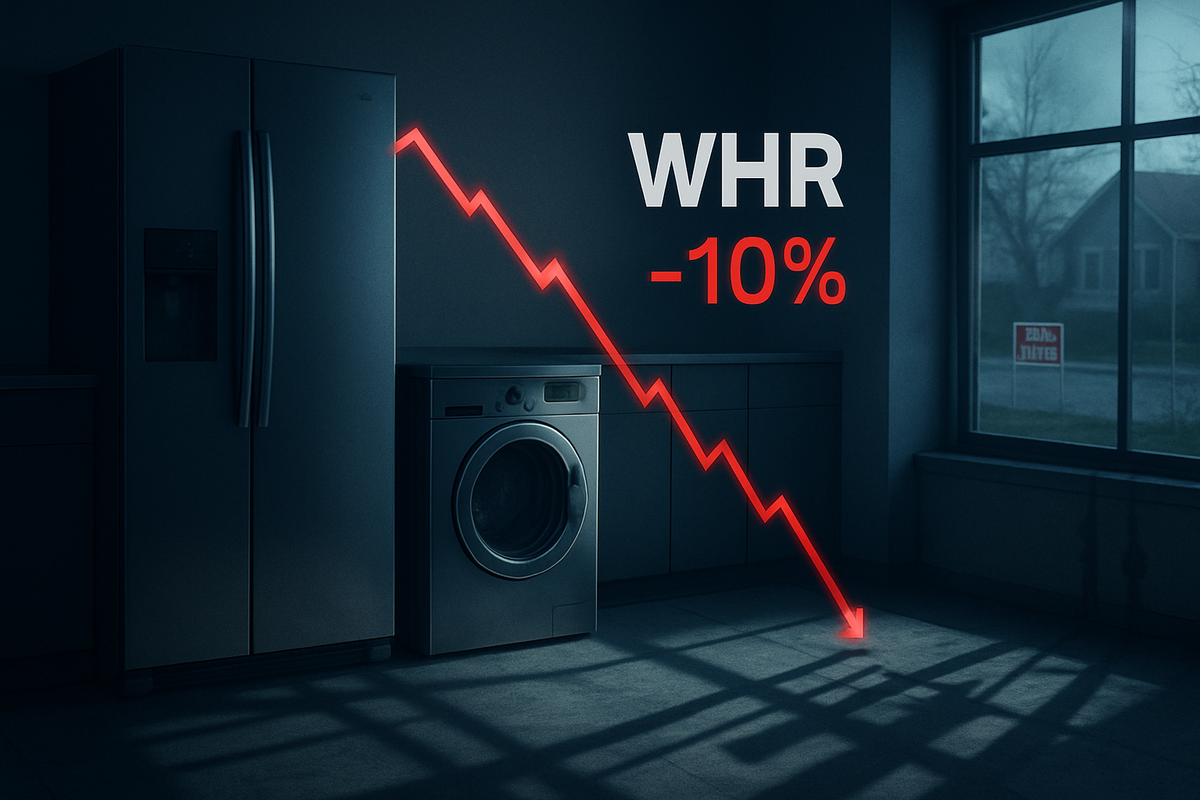
The appliance giant Whirlpool Corporation (NYSE: WHR) saw its shares plummet by 10% on January 30, 2026, following a fourth-quarter earnings report that missed analyst expectations on nearly every key metric. The steep decline reflects growing investor anxiety over a "challenging" consumer environment defined by stubbornly high mortgage rates and a sluggish U.S. housing market that has yet to see the "Great Reset" many analysts predicted for the new year.
The sell-off underscores a broader crisis of confidence in the consumer durables sector. As Whirlpool grapples with margin compression and a cautious forecast for the remainder of 2026, the company is becoming a primary case study for how high-interest-rate environments and new trade barriers are reshaping the competitive landscape for legacy American manufacturers.
A Double Miss: The Numbers Behind the Slide
The carnage began shortly after the market opened on January 29, 2026, when Whirlpool released its Q4 2025 financial results. The company reported revenue of $4.10 billion, falling short of the $4.26 billion consensus estimate. The bottom line was even more concerning; adjusted earnings per share (EPS) arrived at a disappointing $1.10, a staggering 27.6% miss compared to the $1.52 expected by Wall Street. This result represents a sharp retreat from the $4.57 EPS reported in the same period just two years prior, highlighting the rapid erosion of profitability in the appliance space.
Management pointed to a "perfect storm" of headwinds leading up to this moment. Chief among them was a $300 million hit from new "steel equivalent" tariffs enacted in mid-2025, which have significantly increased production costs. Furthermore, the U.S. housing market—a critical driver for appliance replacement and new installations—remained paralyzed. With existing home sales hitting multi-decade lows, the demand for "big-ticket" durables has evaporated.
The industry reaction was immediate. Institutional investors, who had hoped for a signal of a housing rebound, instead faced a soft 2026 guidance. Whirlpool projected its full-year 2026 EPS to be approximately $7.00, well below the analyst range of $7.11 to $7.21. Revenue guidance was similarly muted, estimated between $15.3 billion and $15.6 billion, signaling a year of stagnation rather than recovery.
Divergent Fortunes: Winners and Losers in the Durable Goods War
While Whirlpool (NYSE: WHR) struggles to keep its head above water, the early 2026 earnings season has revealed a widening gap between industry players. The clear "winner" in this environment has been Electrolux (OTC:ELUXY). In a stark contrast to Whirlpool, Electrolux shares surged over 20% this week. Despite facing similar revenue headwinds, the Swedish firm successfully executed a massive cost-cutting program, slashing SEK 4 billion in expenses and pivoting its focus toward high-growth markets in Europe and Latin America.
On the other side of the spectrum, Asian tech giants Samsung (KRX:005930) and LG Electronics (KRX:066570) are navigating a mixed bag of results. Samsung reported record overall revenue driven by AI semiconductors, yet its Digital Appliances division posted an operating loss of roughly $400 million. LG similarly reported a preliminary Q4 operating loss of ₩109.4 billion ($75.2 million). Both companies are losing money in the appliance sector due to aggressive holiday promotions and the same tariff pressures affecting Whirlpool, but they are able to subsidize these losses through other high-performing business units like HVAC and semiconductors—a luxury Whirlpool does not have.
For Whirlpool, the lack of a diversified tech portfolio means it is bearing the full brunt of the appliance market's contraction. The "loser" in this scenario isn't just the company itself, but also its domestic suppliers who are now facing the ripple effects of Whirlpool’s announced $150 million cost-reduction plan for 2026.
The Housing Proxy: Why Whirlpool’s Struggles Matter
Whirlpool's 10% decline is more than just a bad earnings report; it is a diagnostic of the health of the American middle class and the housing market. As a company that manufactures 80% of its U.S. inventory domestically, Whirlpool serves as a direct proxy for the "lock-in effect" of the housing market. With mortgage rates hovering between 6.0% and 6.3%, many homeowners are refusing to sell and vacate their lower pandemic-era rates, effectively freezing the cycle of home sales that typically triggers appliance upgrades.
This event also highlights a shifting consumer psychology. The "Value Seeker" trend has reached a fever pitch in 2026, with nearly half of global consumers prioritizing durability and energy efficiency over brand loyalty. Manufacturers are finding that they can no longer pass on 50% steel tariffs to consumers who are already stretched thin. This has created a "margin trap" where promotional intensity must remain high just to clear inventory, further eroding the capital needed for innovation.
Historically, Whirlpool has been able to weather economic cycles by relying on its dominant market share. However, the current environment—characterized by geopolitical trade wars and a structurally different housing market—suggests that the old playbook may no longer be sufficient. The precedent of the 2008 housing crash looms large, though the current crisis is one of supply and affordability rather than toxic credit.
Navigating the 2026 "Trench War"
Looking ahead, Whirlpool is entering what analysts are calling a "trench war" for the remainder of 2026. The company’s short-term strategy is focused on survival through efficiency, with $150 million in new cost-reduction actions including increased vertical integration and the rollout of more automated manufacturing lines. While these measures may stabilize margins, they do little to address the fundamental lack of demand.
The long-term possibility of a turnaround hinges entirely on a potential pivot toward the rental and multi-family housing markets. As single-family home ownership becomes less attainable for many, Whirlpool may need to shift its strategic focus from retail consumers to large-scale developers and property management firms. Market opportunities may also emerge in the "Smart Home" sector, as showcased by LG at CES 2026, but Whirlpool must catch up in AI-integrated appliances to remain competitive with the Korean giants.
Potential scenarios for the next 12 months include a further consolidation of the industry. If Whirlpool's stock continues to underperform, it could become a target for private equity or a merger-of-equals with another struggling domestic player looking to find safety in scale.
The Final Verdict: A Market in Search of a Floor
Whirlpool’s disastrous January performance serves as a sobering reminder that the "soft landing" promised by economists has not yet reached the kitchen and laundry room. The key takeaways for investors are clear: revenue growth is non-existent, margins are under siege by tariffs, and the housing market recovery remains a mirage. The 10% drop is a painful adjustment to a reality where "flat is the new up."
Moving forward, the market will likely remain volatile for all consumer durables. Investors should closely watch for two indicators in the coming months: any movement in the Federal Reserve’s stance on interest rates that could unlock the housing market, and the impact of the $150 million cost-cutting measures on Whirlpool’s Q1 and Q2 margins.
The significance of this event lies in its finality; the era of pandemic-driven home improvement spending is over, and the era of the "High-Rate Lean" has begun. For Whirlpool, the challenge is no longer just about building better washers—it’s about surviving a market that has fundamentally changed the rules of engagement.
This content is intended for informational purposes only and is not financial advice.