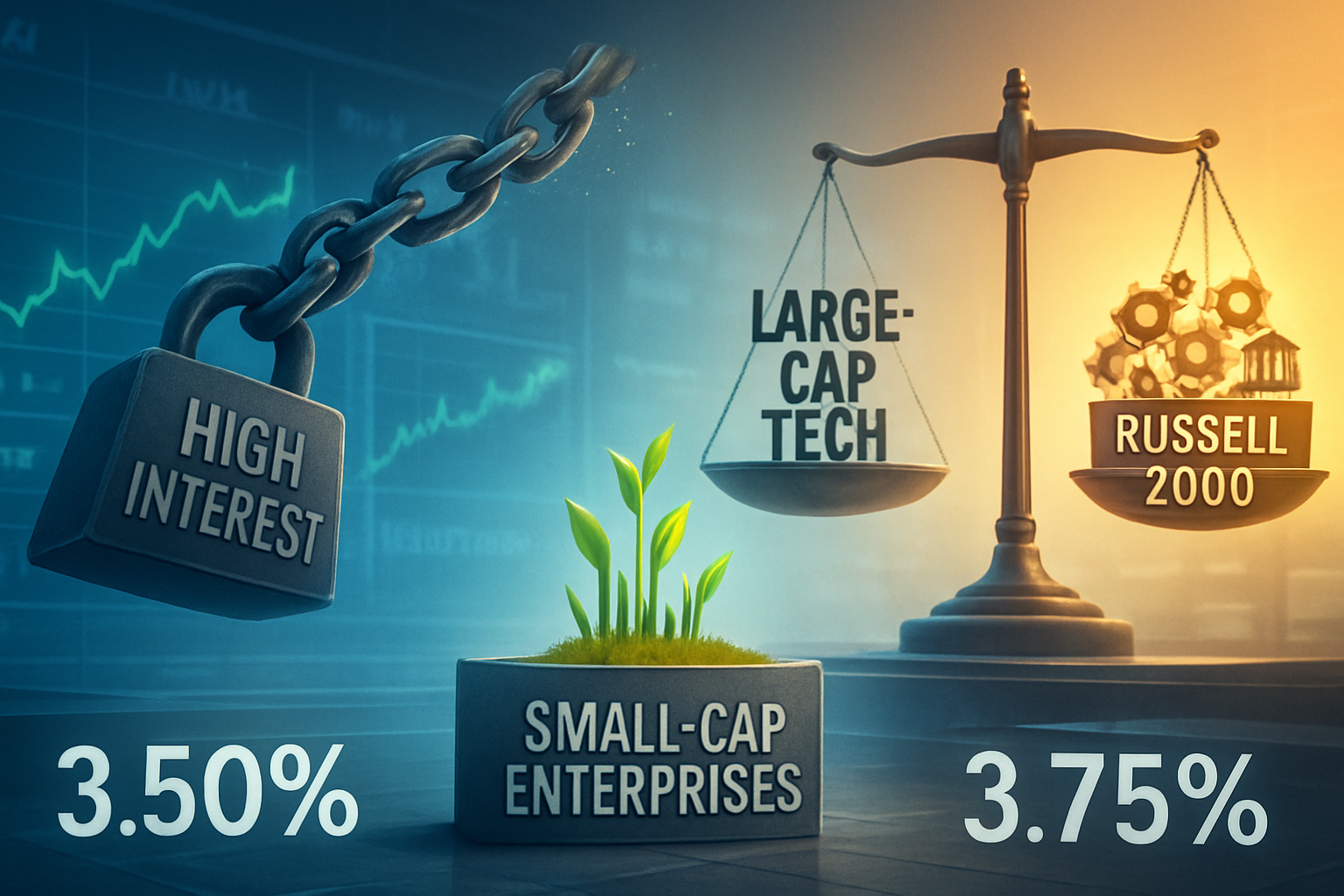
As the Federal Reserve stabilizes interest rates in the 3.50% to 3.75% target range this January 2026, a significant shift is rippling through the equity markets, favoring the long-overlooked small-cap sector. For nearly two years, smaller enterprises have buckled under the weight of "higher-for-longer" monetary policy, but the recent easing cycle has provided a crucial lifeline. This policy pivot is not just a psychological boost; it represents a tangible reduction in overhead for the thousands of companies that comprise the iShares Russell 2000 ETF (NYSEARCA: IWM), many of which are heavily reliant on floating-rate debt to fuel their operations.
The immediate implications are profound: analysts are already upwardly revising earnings-per-share (EPS) estimates for the Russell 2000, projecting a growth rate of nearly 20% for the coming fiscal year. As borrowing costs retreat from their 2024 peaks, the "interest expense ceiling" that suppressed small-cap valuations is finally cracking. Investors are responded by rotating capital away from the safe-haven "Magnificent Seven" and into mid- and small-sized firms that offer higher sensitivity to falling rates.
A Decisive Pivot: The Road to 3.50%
The Federal Open Market Committee (FOMC) concluded its most recent meeting on January 21, 2026, by maintaining the federal funds rate at 3.50% to 3.75%. This current stance follows an aggressive easing campaign that began in the fourth quarter of 2025, during which the Fed delivered three consecutive 25-basis-point cuts. The move was a response to core Personal Consumption Expenditures (PCE) inflation finally cooling to 2.4%, and a labor market that, while still resilient, began showing signs of "healthy normalization" rather than the overheating seen in the post-pandemic years.
The timeline leading to this moment was marked by a tense standoff between the Fed and market expectations. Throughout the first half of 2025, the central bank held rates above 5%, causing significant distress for companies with upcoming "debt walls." However, as the housing market cooled and consumer spending softened in mid-2025, Fed Chair Jerome Powell signaled a "recalibration" of policy. By the time the January 2026 meeting arrived, the narrative had shifted entirely from fighting inflation to preserving a "soft landing" for the broader economy. Market stakeholders, including major institutional players like BlackRock and Vanguard, have noted that this rate environment represents the first time in four years that small-cap companies have had a "predictable and manageable" cost of capital.
Winners and Losers in the New Rate Regime
The primary beneficiaries of this 3.50%–3.75% range are companies within the Russell 2000 that carry a high proportion of floating-rate debt—estimated to be nearly 50% of the total debt held by the index. The Gorman-Rupp Co. (NYSE: GRC), a manufacturer of pumps and fluid control systems, stands out as a winner. With capital-intensive operations often funded by variable-rate credit lines, GRC is seeing an immediate reduction in interest outflows, freeing up cash for research and development. Similarly, Willdan Group (NASDAQ: WLDN), an energy and infrastructure consultancy, is benefiting from lower financing costs on the government-linked projects that form the backbone of its revenue stream.
In the healthcare sector, U.S. Physical Therapy (NYSE: USPH) is positioned to gain as its expansion-through-acquisition strategy becomes significantly cheaper to finance. Conversely, the "losers" in this scenario include certain Business Development Companies (BDCs) like Nuveen Churchill Direct (NYSE: NCDL). While lower rates reduce the risk of defaults within their portfolios, BDCs typically lend at floating rates; as the Fed cuts, the yields these companies earn on their loans compress, potentially squeezing their dividend payouts. Furthermore, the massive tech titans of the SPDR S&P 500 ETF Trust (NYSEARCA: SPY) are seeing their relative dominance challenged as their "cash-rich" status provides less of a competitive advantage when borrowing becomes affordable for everyone else.
The Broader Significance: Breaking the 25-Year Valuation Gap
This event fits into a broader industry trend known as the "Great Rotation." For much of 2024 and 2025, the valuation gap between large-cap and small-cap stocks reached a 25-year extreme, with the Russell 2000 trading at a nearly 30% discount to the S&P 500. The Fed’s move to a 3.50% range acts as the catalyst to close this gap. It signals to the market that the era of "emergency" tightening is over, allowing smaller, domestically focused firms to compete for investor dollars on a more level playing field.
The ripple effects extend to the regional banking sector as well. Peoples Bancorp (NASDAQ: PEBO) and Metropolitan Bank (NYSE: MCB) are seeing their Net Interest Margins (NIM) stabilize as the yield curve steepens. Historically, when the Fed enters a cutting cycle while the economy remains in growth territory, small-caps outperform large-caps by an average of 12% over the following twelve months. This historical precedent is giving confidence to "value" investors who have waited years for the Russell 2000 to regain its footing against the tech-heavy benchmarks.
What Comes Next: Navigating the 2026 Landscape
Looking ahead, the short-term focus will be on the "terminal rate"—the point at which the Fed stops cutting. While the current 3.50% to 3.75% range is a relief, the Fed's "dot plot" suggests a final resting place near 3.4% by the end of 2026. Companies will likely use this window of stability to refinance short-term floating debt into long-term fixed-rate bonds, a strategic pivot that could insulate them from future volatility. We may also see an uptick in small-cap M&A (Mergers and Acquisitions) activity, as larger firms use their improved stock currency and lower borrowing costs to swallow up smaller competitors.
However, challenges remain. If the "soft landing" turns into a "no landing"—where inflation suddenly reignites due to lower rates—the Fed could be forced to pause or even reverse these cuts. Small-cap companies must remain disciplined; those that over-leverage during this period of easing may find themselves vulnerable if the 3.50% floor turns out to be a temporary base rather than a permanent ceiling.
Summary and Investor Outlook
The Federal Reserve’s decision to move the target range to 3.50%–3.75% marks a turning point for the 2026 market. The most significant takeaway is the "unshackling" of the Russell 2000, particularly for the 40% of its members that were previously unprofitable or struggling under high variable-rate interest burdens. This policy shift has transformed the index from a high-risk gamble into a legitimate growth opportunity for the current year.
Moving forward, the market appears poised for a broader participation rally. Investors should keep a close eye on the quarterly earnings reports of leveraged industrials and regional banks to ensure that the projected "interest savings" are actually translating into bottom-line growth. While the road ahead is not without risks, the current interest rate environment provides the most favorable backdrop for small-cap stocks in over half a decade, signaling that the "Great Rotation" may be just getting started.
This content is intended for informational purposes only and is not financial advice.