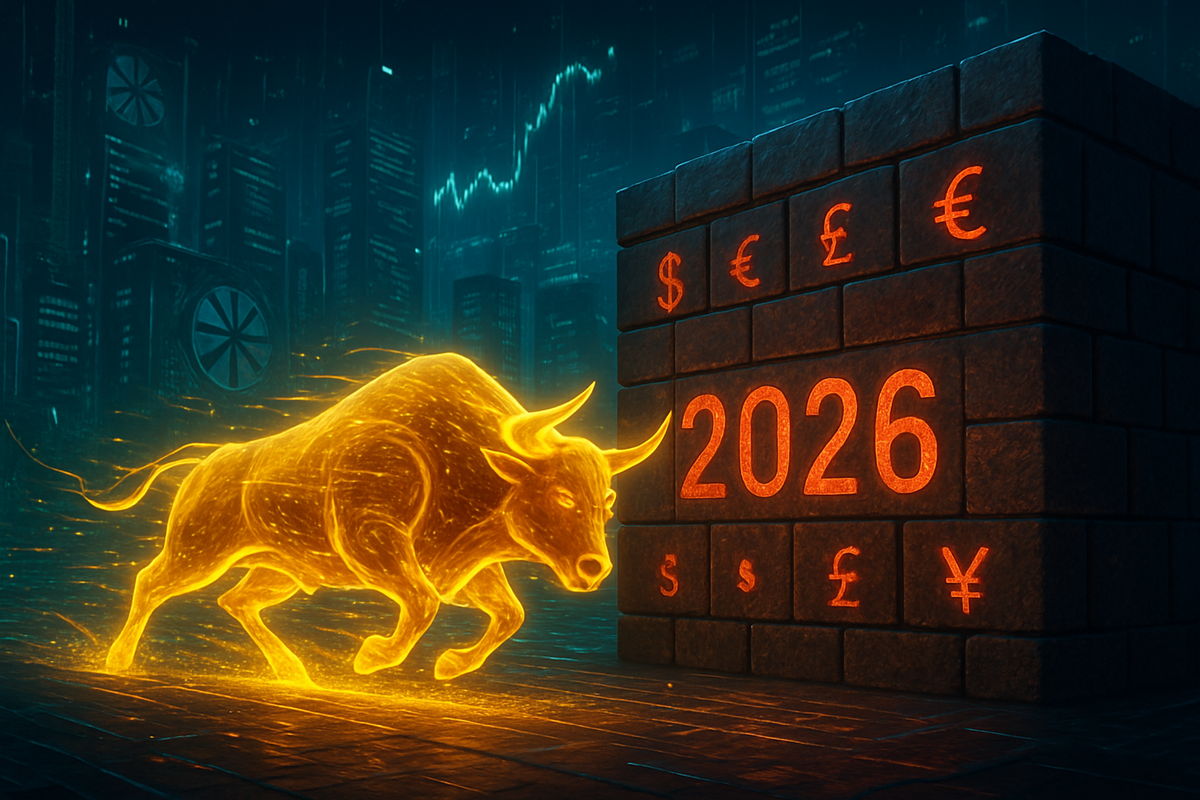
As the sun rises on January 2, 2026, the global financial markets find themselves at a precarious but tantalizing crossroads. Investors are entering the new year with a "New Year, New Bull" sentiment, fueled by a resilient 2025 that saw the S&P 500 climb 18% despite a series of unprecedented policy shocks and a record-breaking government shutdown. However, as trading begins, the exuberance of a fresh calendar year is being met by the cold reality of "technical hurdles"—most notably a looming $1 trillion refinancing wall in commercial real estate and a pivot from artificial intelligence (AI) speculation to the demanding era of AI monetization.
The immediate implications are clear: 2026 is being branded by Wall Street as the "Year of Execution." While the Federal Reserve’s late-2025 pivot to a 3.50%–3.75% interest rate range has provided a much-needed liquidity cushion, the market must now prove that corporate earnings can justify current valuations. With the S&P 500 hovering just below the psychological 7,000 mark and the Dow Jones Industrial Average eyeing the historic 50,000 milestone, the first few weeks of January will determine if the "bull" has enough stamina to leap over the structural debris left behind by a volatile 2025.
Resilience Amidst Chaos: A 2025 Retrospective
The path to 2026 was anything but linear. The past year was defined by two major disruptions that nearly derailed the bull market. First was the "April Tariff Shock," often referred to by traders as the "Liberation Day" sell-off, which saw a massive retreat in global equities following aggressive trade policy shifts. This was followed by a record-breaking 43-day U.S. government shutdown that ended on November 13, 2025. The shutdown effectively blinded the Federal Reserve and investors alike, as critical economic data like CPI and jobs reports were suspended, leading to a period of extreme market "opaqueness."
Despite these hurdles, the market displayed remarkable grit. The Nasdaq Composite (INDEXNASDAQ: .IXIC) led the charge in 2025 with a 22% gain, while the Dow Jones Industrial Average (INDEXDJX:.DJI) finished up 14.5%. Key to this resilience was the Federal Reserve’s decisive pivot in the final quarter of 2025. Under Chair Jerome Powell, the Fed delivered three consecutive 25-basis-point rate cuts in September, October, and December. This move was widely seen as a preemptive strike against a cooling labor market, successfully guiding the economy toward the elusive "soft landing" as we enter the current year.
The legislative landscape also played a pivotal role. The passage of the "One Big Beautiful Bill Act" (OBBBA) in late 2025 provided a massive fiscal stimulus aimed at infrastructure and domestic manufacturing. This legislation has front-loaded growth expectations for 2026, with Goldman Sachs (NYSE: GS) projecting a robust 2.6% GDP growth for the year. However, the market’s reaction to this stimulus is now being tested by "sticky" inflation, which remains stubbornly anchored in the 2.6% to 2.8% range, complicating the Fed's path forward in 2026.
Winners and Losers: The Great AI Pivot and the Debt Wall
As we look at the corporate landscape for 2026, the "AI Hype" has officially transitioned into the "AI Utility" phase. The biggest winners are no longer just the chipmakers, but the companies providing the literal power for the AI revolution. Constellation Energy (NASDAQ: CEG) and Vistra Corp (NYSE: VST) have emerged as top picks for 2026, as their nuclear and gas-fired power plants become the backbone for massive new data centers. NextEra Energy (NYSE: NEE) is also positioned to win, leveraging its renewable portfolio to meet the carbon-neutral mandates of big tech firms.
Conversely, the "losers" of 2026 are likely to be found in the sectors most sensitive to the "debt wall." Commercial real estate firms like SL Green (NYSE: SLG) and Vornado Realty Trust (NYSE: VNO) are facing a brutal reality: approximately $1 trillion in debt must be refinanced this year at rates significantly higher than those of the 2016–2021 era. SL Green has already signaled distress by shifting from monthly to quarterly dividends to preserve cash. Similarly, Boston Properties (NYSE: BXP) faces a major $1 billion maturity in February that will serve as a bellwether for the entire office sector.
In the technology space, the focus has shifted to return on investment (ROI). While NVIDIA (NASDAQ: NVDA) remains a consensus "Strong Buy" due to its dominant Blackwell and upcoming "Rubin" architectures, Microsoft (NASDAQ: MSFT) is facing increased scrutiny. Investors are demanding to see a clearer path to high-margin revenue from its $80 billion-plus capital expenditure on AI. Meanwhile, Apple (NASDAQ: AAPL) enters 2026 with a "Moderate Buy" rating, as analysts wait to see if the iPhone 18 and "Apple Intelligence" can trigger the long-awaited multi-year upgrade cycle.
Broader Significance: Policy Shifts and Historical Precedents
The market outlook for 2026 is not just about earnings; it is about a fundamental shift in the regulatory and monetary environment. A major looming event is the expiration of Jerome Powell’s term as Fed Chair in May 2026. With the White House expected to nominate a successor as early as this month, the market is bracing for a potential shift in monetary philosophy. Historical precedents suggest that leadership transitions at the Fed often lead to increased volatility in the Treasury markets, which could ripple through to equity valuations.
Furthermore, 2026 represents a critical test of the "Sovereign AI" trend—where nations invest in their own computing infrastructure rather than relying solely on U.S. cloud giants. This shift has massive implications for global trade and the competitive moat of companies like Alphabet (NASDAQ: GOOGL) and Amazon (NASDAQ: AMZN). The "OBBBA" legislation in the U.S. is a direct response to this trend, aiming to cement American dominance in the next decade of digital infrastructure.
From a technical perspective, the S&P 500 (INDEXSP:.INX) is currently battling a "multiple compression" hurdle. With valuations at historically high levels, the market can no longer rely on price-to-earnings (P/E) expansion to drive gains. Instead, earnings per share (EPS) growth—projected at 12.1% by analysts at Morgan Stanley (NYSE: MS)—must do the heavy lifting. This mirrors the post-dot-com recovery period, where the market eventually rewarded companies with tangible cash flows over those with mere "vision."
The Road Ahead: Strategic Pivots and Scenarios
In the short term, all eyes are on the January 29 Federal Reserve meeting. The market is currently pricing in a "pause," but any surprise hawkishness could trigger a sharp correction, given the technical resistance at the 7,000 level. Investors should also watch for a "catch-up" trade in small-caps. As AI capital spending spills over from mega-caps into the broader economy, the Russell 2000 (INDEXRUSSELL:RUT) could outperform if the 2026 GDP growth targets are met.
Longer-term, the strategic pivot for most corporations will be "efficiency through automation." As the labor market remains tight and inflation stays sticky, companies that can successfully integrate AI to lower operational costs will be the ones to survive the "execution year." We may see a wave of M&A activity in the financial sector, led by giants like JPMorgan Chase & Co. (NYSE: JPM), as smaller banks struggle to keep up with the technological and regulatory requirements of the new era.
Potential scenarios for 2026 range from a "Golden Path" where AI productivity leads to a non-inflationary boom, to a "Stagflationary Stall" where the debt wall triggers a series of regional banking crises that force the Fed to reverse its tightening cycle. Most analysts lean toward the former, but the margin for error has never been thinner.
Closing Thoughts: The Year of Execution
As we navigate the opening weeks of 2026, the "New Year, New Bull" sentiment is grounded in solid corporate fundamentals but shadowed by significant structural risks. The key takeaway for investors is that the "easy money" of the initial AI hype and the post-shutdown recovery has been made. The coming months will separate the innovators from the imitators.
The market moving forward will likely be characterized by high dispersion—where the gap between winners and losers widens significantly. Investors should maintain a diversified stance, favoring high-quality "cash cows" in tech and infrastructure-heavy utilities, while remaining cautious on highly leveraged real estate and cyclical energy plays like ExxonMobil (NYSE: XOM), which faces a projected supply glut.
In summary, 2026 is the year the "AI dream" must meet the "bottom line." Watch the 10-year Treasury yield and the Fed leadership nominations closely; they will be the true north for a market that is eager to run but wary of the hurdles ahead.
This content is intended for informational purposes only and is not financial advice.