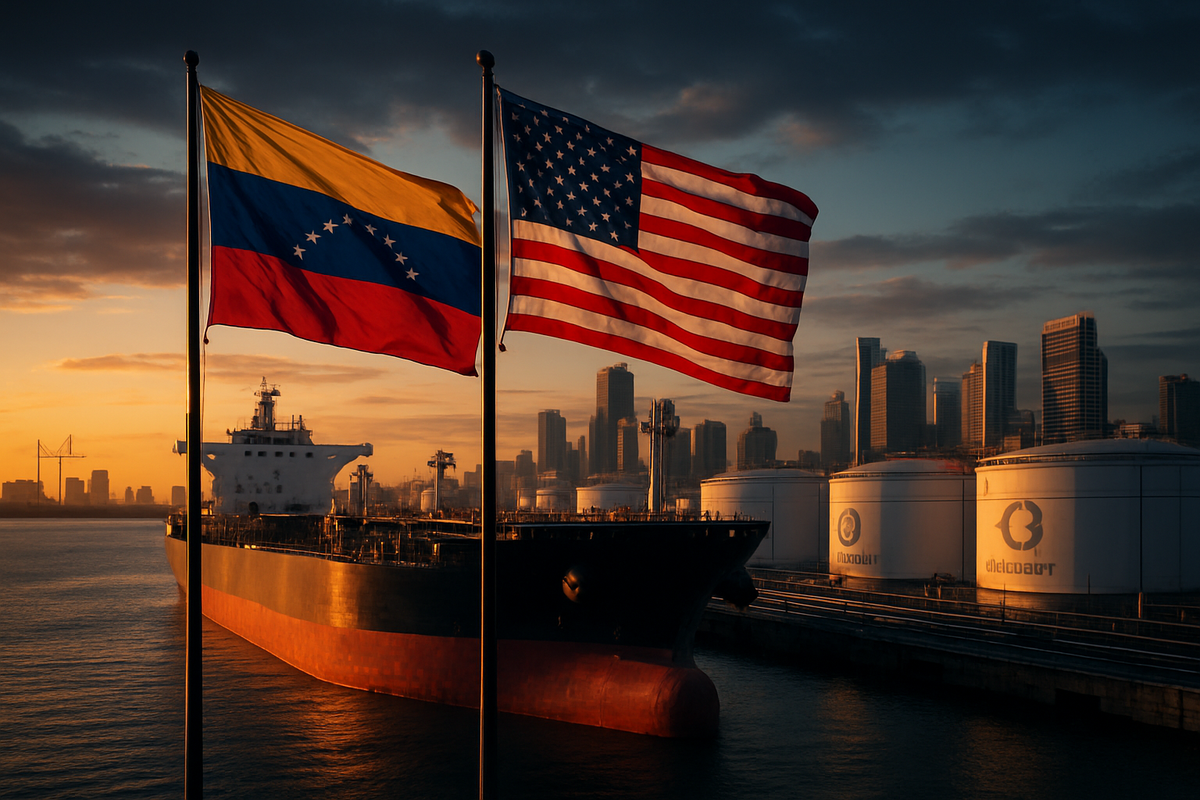
In a move that signals a radical departure from traditional foreign policy and a return to "transactional diplomacy," the Trump administration on January 16, 2026, finalized the first major sale of Venezuelan crude oil since the military ouster of Nicolás Maduro earlier this month. The deal, valued at approximately $500 million, marks the beginning of a U.S.-managed liquidation of Venezuela’s vast energy reserves, with the administration claiming the proceeds will be used to stabilize the region and benefit the American public.
However, the awarding of the contracts has immediately sparked a firestorm of controversy. The primary beneficiaries of the deal are global commodity giants Vitol and Trafigura, with the former being led by John Addison, a prominent political megadonor who contributed over $6 million to pro-Trump political action committees during the recent election cycle. This policy shift, characterized by the direct U.S. control of foreign sovereign assets, has sent shockwaves through the global energy sector and rewritten the rules of international engagement in South America.
A $500 Million Opening Gambit in Caracas
The January 16 announcement is the culmination of a high-speed restructuring of the Venezuelan energy landscape that followed the January 3 military operation to remove the Maduro regime. Energy Secretary Chris Wright confirmed that the first two contracts, each worth $250 million, were awarded to Vitol and Trafigura. The crude was sold at a price of roughly $50 per barrel—a significant premium over the "black market" rates the previous regime was forced to accept under heavy sanctions, but still a notable discount relative to current global benchmarks.
The timeline leading to this deal has been remarkably short. Just one week prior, on January 9, President Trump hosted a closed-door summit at the White House with top energy executives, including Addison. During the meeting, the President reportedly urged oil leaders to "rebuild the Venezuelan prize" while ensuring that American interests remained at the forefront. The administration has also introduced a unique financial mechanism for these transactions: the proceeds are not being sent to a Venezuelan transitional government but are instead being deposited into U.S.-controlled bank accounts in Qatar.
Initial market reactions have been explosive. While critics in Congress have launched investigations into the rapid turnaround between political donations and the awarding of these contracts, the energy industry has largely viewed the move as a long-awaited opening of the world's largest proven oil reserves. Secondary tariffs of 25% have also been threatened against any nation—specifically China—that attempts to bypass the U.S.-managed framework to purchase Venezuelan oil independently.
Winners and Losers: The New Energy Hegemony
The clear winner in this new landscape is Chevron (NYSE: CVX). As the only major U.S. oil company to maintain a continuous, albeit restricted, presence in Venezuela throughout the sanctions era, Chevron is uniquely positioned to capitalize on the transition. Following the announcement, Chevron (NYSE: CVX) saw its stock price climb between 5% and 7%. The company’s strategic advantage was further cemented by the news that board member John Hess had contributed $2 million to pro-administration PACs shortly before the military intervention. CEO Mike Wirth has already announced plans to increase production in Venezuela by 50% within the next 24 months.
Other major players are also seeing significant movement. Shares of ExxonMobil (NYSE: XOM), Halliburton (NYSE: HAL), and ConocoPhillips (NYSE: COP) all surged in early January trading as investors anticipated a "gold rush" of infrastructure and drilling contracts. For companies like Halliburton (NYSE: HAL), the potential for massive service contracts to repair Venezuela’s dilapidated oil infrastructure represents a multi-billion dollar opportunity. Conversely, the biggest losers appear to be the state-owned firms of Russia and China, which had previously held significant influence in Caracas and are now being systematically excluded from the new American-led energy order.
The acquisition of Citgo also serves as a pillar of this shift. Amber Energy, an affiliate of Elliott Investment Management—headed by another top-tier donor, Paul Singer—was awarded the right to purchase the refining giant for a "discounted" price of $5.9 billion. While some analysts valued Citgo’s assets as high as $15 billion, the administration’s expedited auction process effectively handed control of the most valuable Venezuelan asset abroad to a key political ally, further blurring the lines between private investment and public policy.
Redefining "Plunder" or Restoring Order?
This event represents a massive pivot in global industry trends, moving away from the use of sanctions as a tool of isolation and toward the direct management of a foreign state's resources by the U.S. executive branch. Historically, the U.S. has avoided such direct control over the "spoils" of regime change, typically favoring the establishment of local provisional governments to manage national resources. The decision to hold funds in Qatari accounts at the "discretion of the U.S. government" creates a precedent that some legal scholars are calling a "sovereign receivership."
The ripple effects on global competitors are profound. By imposing secondary tariffs on non-compliant buyers, the U.S. is effectively redirecting the global supply chain of heavy crude toward Gulf Coast refineries, which are specifically designed to process the grade of oil produced in Venezuela. This not only bolsters U.S. energy security but also exerts significant inflationary pressure on adversaries like China. Critics, however, argue that this "mercantilist" approach risks alienating long-term allies and could lead to retaliatory measures in other commodity markets.
Regulatory implications are also surfacing. The use of executive orders to bypass traditional competitive bidding processes for sovereign assets is being challenged in the D.C. Circuit Court of Appeals. Nevertheless, the administration has doubled down, arguing that the "extraordinary circumstances" of the Venezuelan collapse require a hands-on approach that prioritizes "repayment for decades of regional instability."
The Road Ahead: A Volatile Reconstruction
In the short term, the market will be watching for the next round of tenders. With the first $500 million deal serving as a proof of concept, the administration is expected to put another $2 billion worth of crude on the market by the end of Q1 2026. The strategic challenge for companies like Chevron (NYSE: CVX) and ExxonMobil (NYSE: XOM) will be navigating the legal and security risks inherent in operating in a country that remains under U.S. military oversight.
The long-term outlook depends heavily on whether the administration can successfully transition from "selling off" existing inventory to "rebuilding" production capacity. This will require hundreds of billions of dollars in foreign direct investment. Market opportunities will likely emerge in the shipping and refining sectors, as the volume of Venezuelan exports begins to rival the peaks of the early 2000s. However, any potential pivot in U.S. domestic politics or a successful legal challenge to the Citgo sale could throw these multi-billion dollar investments into a tailspin.
Summary and Investor Outlook
The January 16 deal marks the dawn of a new era in the global energy market, where political loyalty and energy production are inextricably linked. The awarding of contracts to Vitol and the discounted sale of Citgo to Elliott Investment Management underscore a "private-sector-first" approach to foreign policy that prioritizes immediate American economic gains over traditional diplomatic norms.
For investors, the key takeaways are clear: the Venezuelan "opening" is real, but it is currently a "closed-shop" environment favorited toward those with established ties to the current administration. Watch for increased production figures from Chevron (NYSE: CVX) and potential service contract announcements from Halliburton (NYSE: HAL) in the coming months. While the legal and ethical debates will continue to rage in Washington, the financial reality is that Venezuelan oil is once again flowing into the global market—this time with a "Made in the USA" stamp of approval.
This content is intended for informational purposes only and is not financial advice.