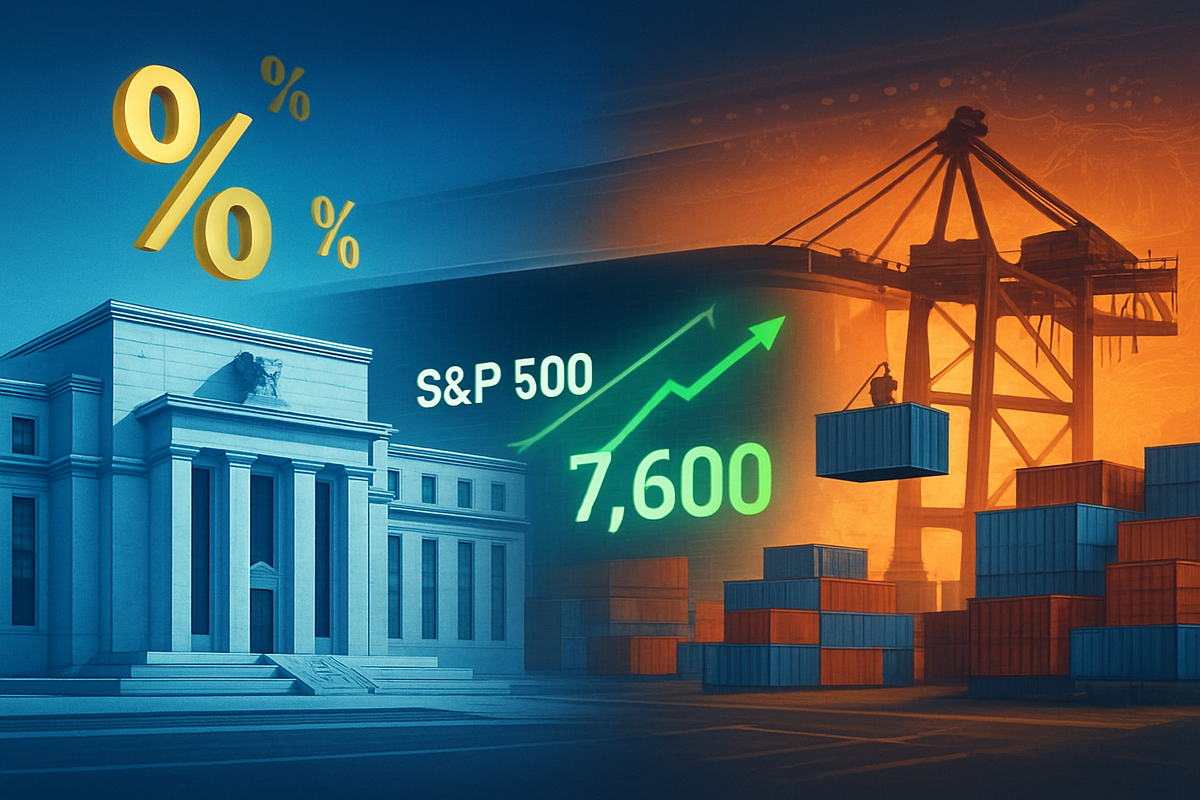
As of January 16, 2026, the financial markets are navigating a complex "policy-driven tug-of-war" that has set the stage for a volatile yet potentially lucrative year. Investors are balancing the tailwinds of a Federal Reserve that is nearing the end of its easing cycle against the headwinds of an administration doubling down on aggressive, sector-specific trade protections. Despite these friction points, the consensus among major Wall Street institutions is a projected 12% total return for the S&P 500, targeting a year-end level between 7,600 and 7,700.
The immediate implications are clear: the era of "easy money" has transitioned into an era of "strategic money." With the federal funds rate expected to settle into a terminal range of 3.00%–3.25% by mid-year, the focus has shifted from the cost of capital to the cost of goods. The administration’s recently codified "Silicon Surcharge" and the looming expiration of Federal Reserve Chair Jerome Powell’s term in May are the two primary catalysts driving market sentiment as the first quarter of 2026 gets underway.
Normalization Meets the 'Silicon Surcharge'
The journey to this moment began in late 2024, followed by a relentless easing cycle throughout 2025 that saw the Federal Reserve cut rates by a cumulative 175 basis points. As we enter the early weeks of 2026, the Fed is widely expected to deliver its final two 25-basis-point cuts in March and June. This "normalization" phase aims to stick the landing of a soft economy while keeping an eye on a "second wave" of inflation triggered by the depletion of corporate inventory buffers.
On the trade front, the administration has moved past broad-based "Liberation Day" tariffs to a more surgical approach. In January 2026, a 25% tariff on advanced computing chips not contributing to domestic capacity—dubbed the "Silicon Surcharge"—took effect. This policy is intricately linked to the "Tariff Offset Program," which offers duty credits to companies that commit to physical production on U.S. soil. The administration is also currently in a 180-day negotiation window with global allies to establish supply quotas for critical minerals, a move intended to stabilize prices for the burgeoning green-tech sector.
Key stakeholders, including Treasury officials and leaders at major financial institutions like Goldman Sachs (NYSE: GS) and JPMorgan Chase (NYSE: JPM), are closely monitoring the "Powell Cliff." With Jerome Powell’s term as Fed Chair expiring on May 15, 2026, the market is pricing in significant leadership uncertainty. Speculation is rampant regarding whether the administration will appoint a "political" figure to accelerate cuts or a "conventional" economist, such as Chris Waller, to maintain the central bank's institutional independence.
Navigating the K-Shaped Divide: Winners and Losers
The 2026 market landscape is increasingly "K-shaped," with distinct winners emerging from the domestic manufacturing and AI sectors, while traditional importers face significant margin compression. National champions like Intel (NASDAQ: INTC) and GlobalFoundries (NASDAQ: GFS) are the primary beneficiaries of the new chip tariffs and the "Offset Program" credits. These firms are seeing a surge in domestic demand as tech giants are forced to pivot their supply chains to avoid the 25% surcharge.
In the AI sector, "monetizers" such as Nvidia (NASDAQ: NVDA), Microsoft (NASDAQ: MSFT), and Alphabet (NASDAQ: GOOGL) continue to lead the S&P 500's charge toward the 12% return goal. These companies have successfully integrated AI into their software and application layers, providing a direct revenue stream that offsets increased hardware costs. Conversely, the retail and automotive sectors are bearing the brunt of the trade shift. Big-box retailers and pharmacies like Walgreens (NASDAQ: WBA), CVS Health (NYSE: CVS), and Macy’s (NYSE: M) are facing 15-year highs in margin pressure as the "second wave" of inflation forces them to pass 10–15% price hikes onto consumers.
Automakers such as General Motors (NYSE: GM) and Ford (NYSE: F) are also under fire, with analysts estimating a $3.5 billion to $4 billion hit from parts tariffs unless they can accelerate their onshoring initiatives. Furthermore, pharmaceutical companies that rely on active ingredients imported from abroad are facing selective 200% tariff threats, creating a climate of high risk for the healthcare sector.
Inflationary Pressures and Global Realignments
The current situation bears historical parallels to the trade tensions of 2018–2019, but with a crucial difference: the maturity of the AI cycle. While the tariffs of the late 2010s were largely seen as a drag on growth, the 2026 policies are being cushioned by unprecedented productivity gains from AI and a "fiscal stimulus offset." The administration’s "One Big Beautiful Bill" (OBBBA), which includes tax refunds for overtime and the $2,000 "Tariff Dividend" checks, is designed to keep consumer spending afloat even as shelf prices rise.
However, the wider significance of these policies extends to the global stage. The administration's "Sovereign AI" restrictions have created a rift between U.S.-aligned markets and China-exposed exporters. While Mexico and Canada are benefiting from their proximity and USMCA status, Chinese firms are facing an average tariff rate of 51%. This decoupling is no longer a theory; it is a structural reality of the 2026 market.
Regulatory and policy implications are also hanging on the Supreme Court case Learning Resources, Inc. v. Trump. A ruling against the administration’s use of emergency powers for tariffs could trigger an immediate "tariff holiday" and over $150 billion in duty refunds to corporations. This legal wildcard is perhaps the single largest factor that could push the S&P 500 beyond its 12% target toward the "bull case" projection of 8,100.
Looking Ahead: The Road to 2027
In the short term, the market will be hyper-fixated on the Federal Reserve’s March meeting and the subsequent announcement of Powell’s successor. A move toward a more "dovish" or politically aligned Chair could spark a relief rally in the short term but may raise long-term concerns about the Fed's ability to combat the very inflation the tariffs are generating. Companies will likely need to engage in "strategic pivots," focusing less on global supply chain efficiency and more on domestic resilience and government subsidy capture.
Long-term, the challenge for the market will be the transition from a fiscal-supported economy to one that must stand on its own as "Tariff Dividend" checks and reshoring credits eventually taper off. The market opportunities lie in "quality small-caps"—U.S.-focused firms with domestic supply chains and less debt—which are set to benefit most from lower local interest rates and protectionist trade barriers.
Potential scenarios range from an AI-fueled "Roaring 20s" expansion to a stagflationary environment where tariff-induced price hikes outpace wage growth. The 12% return projection for the S&P 500 assumes a middle path: one where corporate earnings grow by 12–13% to roughly $310 per share, supported by a weakening dollar and massive productivity gains.
The 2026 Verdict: A Year of Measured Optimism
The 2026 market outlook is a testament to the resilience of the American corporate engine in the face of radical policy shifts. The projected 12% total return for the S&P 500 is not a guarantee but a baseline predicated on the Fed successfully "sticking the landing" and the administration’s fiscal policies effectively offsetting the inflationary bite of new tariffs.
Key takeaways for investors include the critical importance of sector selection. While the broader index may rise, the divergence between the "onshored" winners and the "import-dependent" losers has never been sharper. Moving forward, the market will be driven by headlines out of the Supreme Court and the Federal Reserve’s transition team.
In the coming months, investors should watch for core CPI data to see if the "second wave" of inflation remains manageable and monitor the "Tariff Offset Program" enrollment numbers as a gauge of how quickly corporate America is truly coming home. While the 2026 outlook is bright, it is a light filtered through the lens of heavy-handed policy and historical trade realignments.
This content is intended for informational purposes only and is not financial advice