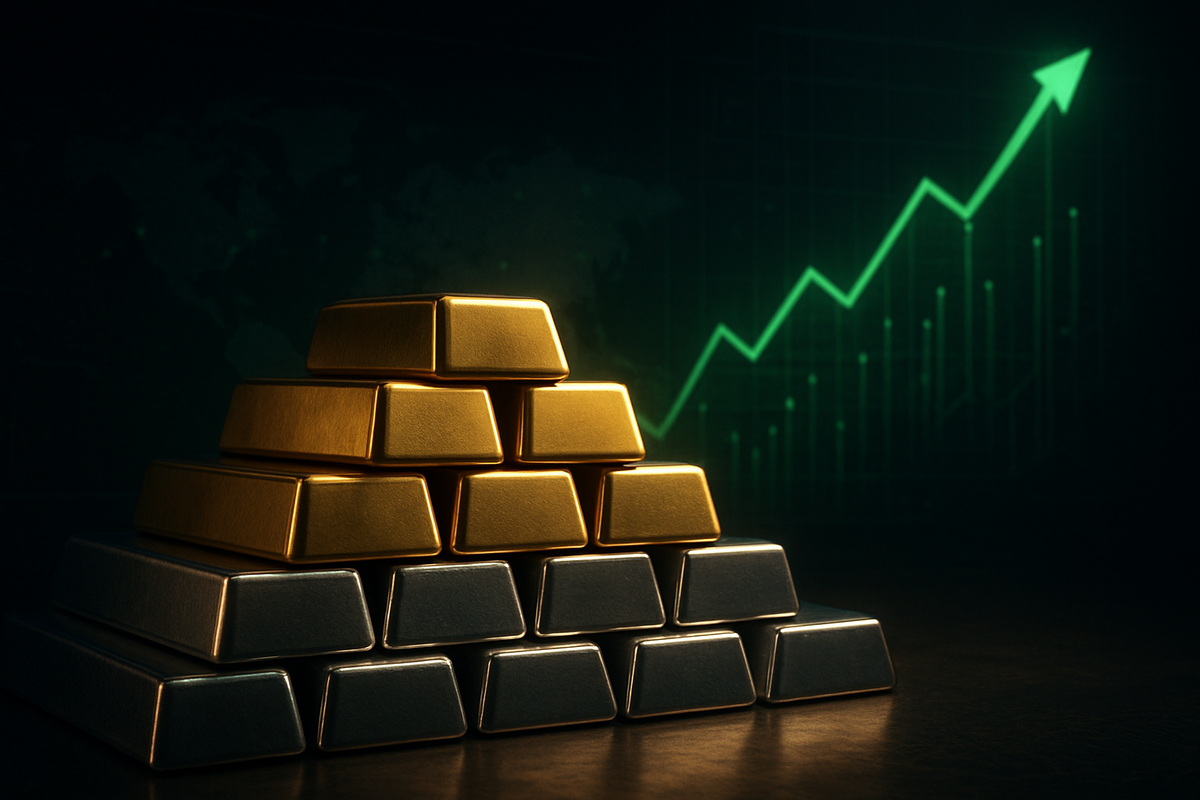
As the final bells ring on the 2025 trading year, the global financial landscape looks fundamentally different than it did twelve months ago. In what historians are already calling the "Golden Renaissance," gold and silver have concluded their most explosive year of growth in over four decades. Driven by a volatile cocktail of geopolitical instability, aggressive de-dollarization, and a structural supply deficit in industrial metals, precious metals have reclaimed their throne as the ultimate arbiters of value.
The immediate implications are profound: a massive transfer of wealth has occurred from traditional paper assets and high-multiple technology stocks into "hard money." For the first time since the late 1970s, the average investor’s portfolio has been defined not by its exposure to Silicon Valley, but by its weight in bullion. As the U.S. dollar faces its most significant challenge as the world’s reserve currency, the 2025 rally signals a shift toward a multipolar monetary system where tangible assets serve as the primary strategic collateral.
A Year of Broken Barriers and Parabolic Breaks
The ascent of 2025 was not a slow climb, but a series of violent upward breaks that caught many institutional bears off guard. Gold (XAU/USD) entered the year hovering near $2,100 but ended the final session of December 2025 at a staggering all-time high of $4,561 per ounce—a gain of approximately 70%. This represents the yellow metal's strongest annual performance since 1979, the year of the Iranian Revolution and the Great Inflation.
The timeline of this breakout was punctuated by two major catalysts. First, the "April Breakout" occurred as several Global South nations announced a formal move to settle energy contracts in gold-backed instruments. Second, the "Autumn Tariff Surge" saw gold prices jump 15% in a single month as the implementation of aggressive global trade barriers stoked fears of a renewed inflationary spiral and currency devaluations. Throughout the year, central banks remained the "invisible hand" beneath the market, purchasing a record-breaking 1,100 tonnes of gold to insulate their reserves from sovereign debt risks.
Silver (XAG/USD), however, was the year’s true "alpha" asset. Closing the year at $82.40 per ounce, silver delivered a parabolic return of over 150%. While gold acted as the safe-haven anchor, silver benefited from a "dual-engine" of demand. Beyond its monetary role, silver’s critical necessity in AI data center cooling systems and high-efficiency solar panels created a structural deficit that saw global inventories at the COMEX and London Bullion Market Association (LBMA) reach 20-year lows.
The Mining Giants and the Great Margin Expansion
The primary beneficiaries of this price surge have been the major producers, who saw their profit margins expand at a rate rarely seen in the industrial sector. Newmont Corporation (NYSE: NEM) emerged as a titan of the year, with its stock price surging 170%. By maintaining its All-In Sustaining Costs (AISC) near $1,500 per ounce while selling its product for three times that amount, Newmont reported record free cash flows exceeding $4.5 billion in the third quarter alone.
Similarly, Barrick Gold (NYSE: GOLD) saw its shares rise 182%, bolstered by its heavy exposure to copper, which also rallied alongside the precious metals complex. Investors flocked to the SPDR Gold Shares (NYSE Arca: GLD) and the iShares Silver Trust (NYSE Arca: SLV), which saw record inflows as retail participants abandoned "Magnificent Seven" tech stocks in favor of metal-backed ETFs. In the silver space, First Majestic Silver (NYSE: AG) became a market darling, rising 220% following its strategic acquisition of the Cerro Los Gatos mine, which allowed it to capitalize on the silver supply squeeze.
Conversely, the "losers" of 2025 were the traditional 60/40 portfolios and currency-hedged funds that remained underweight in commodities. Fixed-income instruments, particularly long-dated sovereign bonds, suffered as the "sovereign debt black swan" theme took hold, with investors viewing government debt as increasingly risky compared to the "zero-counterparty-risk" of physical gold and silver.
Geopolitics and the End of the Unipolar Reserve
The wider significance of the 2025 rally cannot be overstated. This was not merely a speculative bubble; it was a fundamental rejection of the post-Bretton Woods fiat order. The aggressive "de-dollarization" trend seen in the BRICS+ nations (Brazil, Russia, India, China, South Africa, and newly joined members) reached a tipping point this year. By reallocating nearly 12% of their foreign exchange reserves into gold, these nations have effectively created a "neutral" floor for global trade that bypasses the U.S. banking system.
Historical comparisons to 1979 are frequent, but 2025 differs in its technological and regulatory context. While 1979 was a reaction to consumer inflation, 2025 is a reaction to systemic debt. The U.S. debt-to-GDP ratio reaching new milestones has forced a "Great Rotation" where even conservative pension funds are now mandated to hold 5-10% of their assets in precious metals. This shift has prompted regulatory discussions in Washington and Brussels regarding the "remonetization" of gold in bank capital requirements—a move that would have been unthinkable just five years ago.
The 2026 Horizon: Consolidation or Continuation?
As we look toward 2026, the market faces a critical juncture. The short-term outlook suggests a period of "healthy consolidation" as traders take profits following the vertical move in December. However, most analysts at major institutions like Goldman Sachs and JPMorgan maintain that the "Golden Renaissance" is only in its middle innings. Price targets for gold in 2026 are already being revised toward the $5,000 mark, contingent on the Federal Reserve’s anticipated interest rate cuts to manage the massive interest burden on national debt.
Strategic pivots will be required for industrial consumers of silver. Companies in the electric vehicle and renewable energy sectors may be forced to seek substitutes or enter into long-term "offtake agreements" directly with miners like Agnico Eagle Mines (NYSE: AEM) or Wheaton Precious Metals (NYSE: WPM) to secure supply. The challenge for 2026 will be the potential for "resource nationalism," where silver-producing nations may impose export taxes to keep the metal for their own domestic green-energy transitions.
A New Era for Investors
The "Golden Renaissance" of 2025 has vindicated long-time "gold bugs" and forced a total re-evaluation of modern portfolio theory. The key takeaway for the year is that in an era of unprecedented debt and geopolitical fragmentation, "trustless" assets are the ultimate premium. The market has moved from a "return on capital" mindset to a "return of capital" mindset, prioritizing safety and intrinsic value over speculative growth.
Moving forward, investors should watch for the development of new gold-backed digital currencies and the continued depletion of silver stockpiles. The 2025 rally has set a new floor for the metals market; while volatility is certain, the era of "cheap" gold and silver appears to be firmly in the rearview mirror. As we enter 2026, the question is no longer if you should own precious metals, but how much you can afford not to.
This content is intended for informational purposes only and is not financial advice.