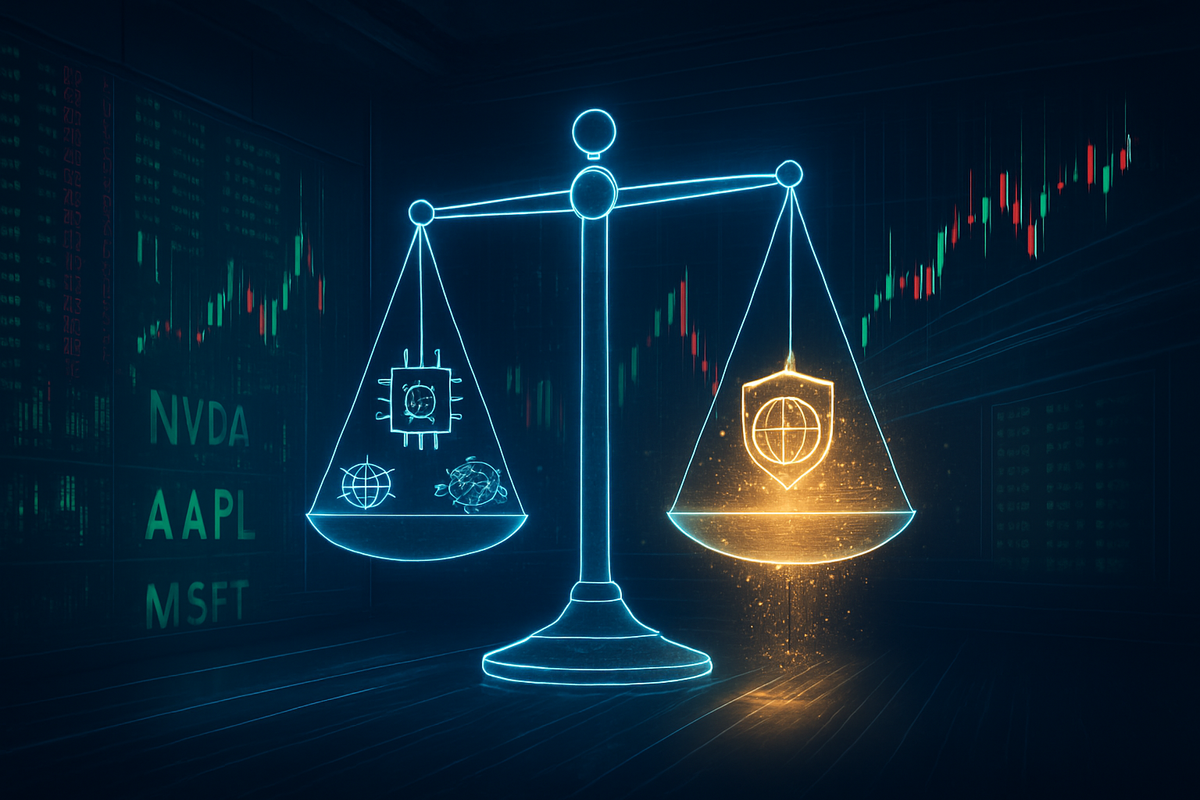
As the final trading days of 2025 unfold, the global financial markets are witnessing a massive "mechanical de-risking" event dubbed by analysts as the "Great Rebalancing." Following a historic year where the S&P 500 breached the monumental 7,000 level, institutional investors are now aggressively trimming their most successful positions. This tactical shift is creating significant selling pressure on the technology sector, which has dominated market gains for much of the year, as fund managers move to lock in profits and realign their portfolios for 2026.
The immediate implications of this $1 trillion capital shuffle are being felt across the Nasdaq and S&P 500, with high-flying semiconductor and software stocks seeing their sharpest pullbacks since the autumn volatility. While the broader market remains resilient, the rotation out of "AI infrastructure" and into defensive value sectors suggests that the "growth at any price" mantra of 2025 is being replaced by a more disciplined focus on quality and valuation.
The Mechanics of the December Flush
The sell-off currently gripping the technology sector is not the result of a sudden fundamental breakdown, but rather a confluence of structural market forces. Throughout October and November 2025, the technology sector experienced a parabolic rally, driven by the realization of massive AI-related earnings. NVIDIA (NASDAQ: NVDA) made history in late October by becoming the first company to surpass a $5 trillion market capitalization, a milestone that signaled the peak of the year's AI euphoria. However, as the calendar turned to December, the reality of portfolio concentration risks began to set in for institutional giants.
By mid-December, NVIDIA and other members of the "Magnificent Seven" had grown to represent an unsustainable portion of major indices and private fund holdings. For many pension funds and mutual funds, internal diversification mandates require that no single stock exceed a certain percentage of the total portfolio. With NVIDIA reaching nearly 8% of the S&P 500 at its peak, fund managers have been forced into a "mechanical" sell-off to maintain compliance. This has been exacerbated by the "60/40" rebalancing act; because equities significantly outperformed fixed income in 2025, institutions are now selling stocks en masse to purchase bonds, ensuring their asset allocations remain within target ranges.
The timeline of this retreat began in early December after Apple (NASDAQ: AAPL) reported record fiscal 2025 revenue of $416 billion. Despite the stellar numbers, the stock’s forward price-to-earnings ratio of 33x triggered a "sell on the news" reaction from institutional desks. This initial crack in the tech facade widened as the Federal Reserve signaled that interest rate cuts might slow in early 2026 to combat persistent inflationary pressures. By December 29, 2025, the tech-heavy indices have officially entered a cooling period, with major players trading well off their Q4 highs.
Winners and Losers in the Year-End Shuffle
The primary "losers" in this week's trading are the year's biggest winners. NVIDIA (NASDAQ: NVDA), which peaked near $207 in late October, has seen its price retreat to the $187-$190 range as investors question the sustainability of its 33x price-to-sales ratio. Similarly, Microsoft (NASDAQ: MSFT) and Alphabet (NASDAQ: GOOGL) have faced institutional selling as managers seek to harvest gains. Alphabet, in particular, saw its stock nearly double from its mid-year lows before pulling back roughly 5% this month due to a combination of regulatory headwinds and valuation "catch-up."
Conversely, the "winners" of this period are found in two distinct camps: "window dressing" targets and defensive rotations. To improve the appearance of their year-end reports, fund managers are aggressively accumulating stocks that showed exceptional momentum in the latter half of the year. This has benefited companies like Western Digital (NASDAQ: WDC), Seagate (NASDAQ: STX), and Micron (NASDAQ: MU), which have seen year-to-date gains exceeding 200%. Palantir (NYSE: PLTR) has also emerged as a beneficiary of late-year buying, as it is increasingly viewed as a "must-own" AI software name for 2026.
Beyond tech, the capital exiting the "Mag Seven" is flowing into "AI adopters"—companies in the healthcare, utilities, and energy sectors that are successfully using AI to drive productivity rather than just providing the infrastructure for it. Meanwhile, the practice of tax-loss harvesting has put additional pressure on the year's underperformers. Stocks like Lululemon (NASDAQ: LULU), which saw its value nearly halved in 2025, and Nike (NYSE: NKE) are being purged from portfolios as investors look to offset the massive capital gains realized from their tech holdings.
A Broadening Market and New Macro Realities
The current volatility highlights a significant shift in the broader industry trend: the transition from "AI hype" to "AI execution." For much of 2024 and 2025, the market was driven by the providers of AI hardware. As we head into 2026, the focus is shifting toward the "S&P 493"—the companies that were previously left behind but are now beginning to show margin expansion through AI integration. This broadening of market leadership is generally viewed as a healthy development for the long-term stability of the bull market.
However, this transition is occurring against a backdrop of complex regulatory and policy implications. Earlier in 2025, a "tariff shock" introduced new layers of volatility into global supply chains, prompting many institutional investors to pivot toward "inward-looking" domestic strategies. This has favored US-centric companies over those with heavy international exposure, a trend that is expected to persist as the market navigates the "Execution Reality" of 2026 trade policies.
Historically, this year-end behavior mirrors the "Dot-com" era rebalancing of the late 90s, but with a crucial difference: the current tech giants are backed by massive cash flows and record-breaking buyback programs. While the selling pressure is significant, it appears to be a controlled "flush" of overextended winners rather than a systemic collapse. The ripple effects are being felt by competitors and partners alike, as the cost of capital remains a key differentiator between the "haves" and "have-nots" in the burgeoning AI economy.
Looking Ahead to 2026: The Path Forward
In the short term, the market is expected to remain volatile as the final "wash-sale" trades are executed before the New Year’s Eve closing bell. Investors should anticipate a period of "price discovery" in January, as the capital that was sidelined during the December rebalancing begins to find its way back into the market. A key question for the first quarter of 2026 will be whether the "AI adopters" can deliver the earnings growth required to justify their newfound institutional support.
The long-term outlook remains cautiously optimistic, but strategic pivots will be required. Market participants will likely move away from broad-index exposure in favor of more granular, sector-specific strategies. The emergence of "AI sovereign" projects and domestic manufacturing incentives provides a potential roadmap for new market opportunities. However, the challenge will be navigating a Federal Reserve that is no longer in a hurry to provide liquidity, forcing companies to rely on organic growth and operational efficiency rather than cheap debt.
Summary of the December Rebalancing
The year-end sell-off of 2025 marks a pivotal moment in the current market cycle. While the headlines focus on the billions of dollars in market cap shed by tech giants like NVIDIA and Apple, the underlying story is one of a maturing bull market. The "Great Rebalancing" is a necessary cooling-off period that prevents the market from becoming dangerously top-heavy, allowing for a more sustainable distribution of capital across different sectors.
Moving forward, investors should watch for "earnings execution" as the primary driver of stock performance in 2026. The era of trading on AI potential is largely over; the market now demands proof of AI profitability. Key indicators to monitor in the coming months include the Fed’s January policy meeting, the impact of new trade tariffs on tech margins, and the sustainability of the rotation into value and defensive sectors. While the "December Flush" has been painful for some, it has set the stage for a more diversified and resilient market in the year to come.
This content is intended for informational purposes only and is not financial advice