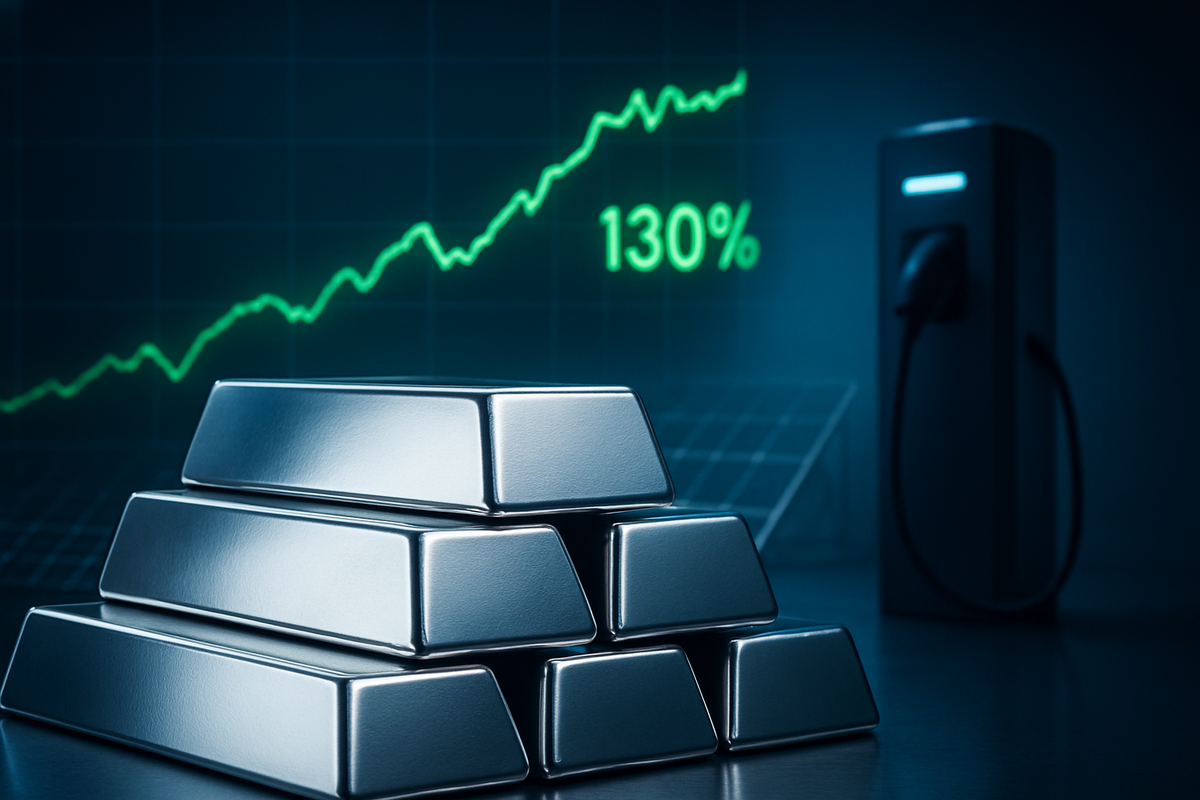
As 2025 draws to a close, the financial narrative of the year has shifted from the resilience of technology stocks to the explosive ascent of a centuries-old commodity. While the S&P 500 (INDEXSP: .INX) delivered a commendable performance, gaining roughly 18% to reach record highs above 6,200 points, it was silver that truly captured the market's imagination. Trading at a staggering $69.62 per ounce as of late December, silver has posted a year-to-date return of over 130%, effectively crushing the broader market and marking its best annual performance since 1982.
This dramatic outperformance has been fueled by a "perfect storm" of industrial necessity and structural scarcity. Unlike previous rallies driven primarily by safe-haven investment, the 2025 silver surge is rooted in the metal's indispensable role in the global energy transition. With industrial demand now accounting for 58% of total consumption, silver has shed its reputation as gold’s volatile younger sibling, emerging instead as a critical industrial asset that the modern world simply cannot produce enough of to meet its green energy ambitions.
The Anatomy of a Record-Breaking Rally
The road to $69 silver began in early 2025, as the global manufacturing sector pivoted toward high-efficiency technologies. The primary catalyst was the rapid adoption of TOPCon (Tunnel Oxide Passivated Contact) solar cells. Unlike traditional photovoltaic cells, TOPCon technology requires up to 50% more silver per unit. As the European Union and China exceeded their 700 GW installation targets this year, the solar industry’s silver appetite reached a fever pitch, consuming nearly 200 million ounces in 2025 alone. Simultaneously, the electric vehicle (EV) sector saw silver intensity per vehicle rise to 50 grams, driven by more complex battery management systems and the massive expansion of global charging infrastructure.
Throughout the second and third quarters of 2025, the rally was further supported by a shifting macroeconomic landscape. As the Federal Reserve initiated a series of interest rate cuts to navigate a cooling labor market, the S&P 500 faced a significant 10.4% correction in April. During this period of equity volatility, silver began its steady climb, decoupling from the broader market. By the time the U.S. government officially added silver to its Critical Minerals List in late 2025, institutional investors were already scrambling to secure physical positions, recognizing the metal’s strategic importance to national security and high-tech infrastructure.
The year culminated in a dramatic market squeeze in December. Global stockpiles at the London Metal Exchange and COMEX fell to historic lows, with registered COMEX inventories dropping over 70% from their 2020 peaks. This supply-side fragility was laid bare when a cooling failure at a major data center led to a 10-hour trading halt on the COMEX, causing physical premiums to spike as buyers realized that "paper" silver contracts were increasingly disconnected from the scarce physical bars available for delivery.
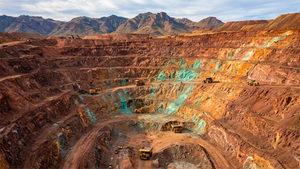
Mining Titans and the Race for Production
The primary beneficiaries of this price surge have been the major mining operations that spent 2024 and early 2025 aggressively expanding their portfolios. Pan American Silver (NYSE: PAAS) emerged as a dominant force following its $2.1 billion acquisition of MAG Silver in early 2025. This deal gave the company a 100% stake in the high-grade Juanicipio mine, allowing them to revise their 2025 production guidance upward to nearly 25 million ounces. The company’s stock has reflected this growth, significantly outperforming its peers as it moves to restart the massive Escobal mine in Guatemala.
First Majestic Silver (NYSE: AG) also executed a transformative growth agenda, acquiring Gatos Silver in January 2025. This move contributed to a 76% year-over-year increase in the company's silver output, with 2025 guidance projecting upwards of 31 million silver equivalent ounces. By increasing its capital budget to $193 million, First Majestic has positioned itself as a high-beta play on the silver price, benefiting from the Santa Elena plant expansion and new discoveries at the Navidad project. Meanwhile, Hecla Mining (NYSE: HL) maintained its status as a low-cost leader, reporting record milling at its Lucky Friday mine and lowering cash costs to under $0.75 per ounce, providing massive margins at current market prices.
Conversely, the "losers" in this environment are the industrial end-users who failed to hedge their silver requirements. Manufacturers of consumer electronics and mid-tier solar panel producers have seen their margins compressed by the rising cost of silver paste and components. Some smaller electronics firms have been forced to delay product launches or seek alternative materials, though silver’s unique conductivity makes it nearly impossible to substitute in high-performance applications like AI data centers and 5G infrastructure.
A Structural Shift in the Silver Market
The events of 2025 represent a fundamental shift in how silver is valued. For decades, silver was treated as a speculative investment or a byproduct of lead and zinc mining. However, the designation of silver as a "critical mineral" by the U.S. government marks a policy pivot that could have long-lasting implications. This status allows for expedited permitting for domestic silver mines and potential government subsidies for exploration, similar to the treatment of lithium and cobalt in previous years.
Historically, silver has experienced boom-and-bust cycles, most notably the Hunt Brothers squeeze of 1980. However, analysts argue that the 2025 rally is different because it is driven by a structural deficit rather than cornering the market. This is the fifth consecutive year where global demand has outstripped supply, with the 2025 deficit projected to reach 149 million ounces. The ripple effects are being felt across the commodity sector, as competitors in the copper and gold space look to increase their silver-rich exploration targets to capitalize on the "silver bonus" in their ore bodies.
Furthermore, the scarcity of physical silver has sparked a debate about the transparency of the futures markets. With inventories at multi-decade lows, the industry is seeing a move toward direct-to-miner contracts, where large industrial consumers like Tesla (NASDAQ: TSLA) or solar manufacturers bypass traditional exchanges to secure supply directly from producers like Hecla or Pan American Silver. This "de-financialization" of the physical market could lead to even higher volatility and price discovery that favors producers over speculators.
The Road to 2026: Supply Chains and Strategic Pivots
Looking ahead to 2026, the silver sector faces both immense opportunity and significant logistical challenges. The short-term focus will be on whether mining companies can successfully bring dormant projects back online fast enough to satisfy the relentless industrial demand. Strategic pivots are already underway, with companies like First Majestic investing heavily in automated mining technology and on-site processing to mitigate labor shortages and energy costs. The market will also be watching for further consolidation, as larger miners use their record cash flows to acquire junior explorers with promising silver-dominant deposits.
However, the high-price environment may eventually trigger a search for thrifting—using less silver in industrial processes. While TOPCon solar cells currently require more silver, the next generation of HJT (Heterojunction) cells is experimenting with copper-plated alternatives. While these technologies are still years away from mass adoption, the "silver at $70" reality will undoubtedly accelerate R&D into substitution. Investors should also prepare for potential regulatory intervention if the silver shortage begins to significantly hamper national green energy targets, potentially leading to strategic stockpiling by governments.
Closing the Books on a Historic Year
The year 2025 will be remembered as the moment silver finally broke free from the shadow of the broader equity markets. By outperforming the S&P 500 by a factor of seven, the metal has proven that in an era of rapid technological evolution, physical assets are just as vital as digital ones. The key takeaway for investors is that the silver story is no longer just about inflation protection; it is a play on the backbone of the 21st-century economy.
As we move into 2026, the market remains in a state of high alert. With COMEX inventories depleted and industrial demand showing no signs of slowing, the "silver lining" for mining companies appears to be a permanent fixture of the financial landscape. Investors should keep a close eye on quarterly production reports from the major miners and any further shifts in government policy regarding critical minerals. For now, silver remains the undisputed heavyweight champion of the 2025 market.
This content is intended for informational purposes only and is not financial advice.