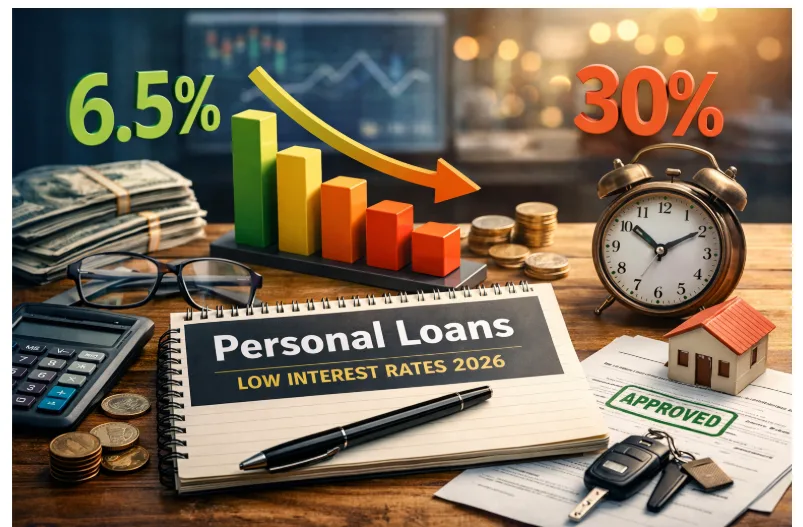
Finding the best personal loans with low interest rates can significantly reduce the total cost of borrowing. In 2026, personal loan APRs vary widely — starting around 6.5%–8% APR for top-tier borrowers and climbing above 30% APR for weaker credit profiles.
Source: Bankrate personal loan rate surveys and Experian Consumer Credit Review data (2025–2026), which show minimum advertised APRs in the mid-single-digits for excellent credit and maximum APRs exceeding 30% for subprime borrowers.
This guide explains what qualifies as a low-interest personal loan in 2026, how lenders set rates, and which lenders currently offer competitive options across different credit tiers. Whether you’re consolidating debt, covering emergency expenses, or funding a major purchase, understanding APRs, fees, and eligibility criteria will help you choose the most affordable personal loan for your situation.
What Is a Low-Interest Personal Loan?
A personal loan is an unsecured installment loan repaid in fixed monthly payments over a defined term, typically 2 to 7 years. Unlike credit cards, personal loans have a clear payoff date and usually come with a fixed interest rate, making them easier to budget.
Interest Rate vs APR
- Interest rate: The annual cost of borrowing the principal.
- APR (Annual Percentage Rate): Includes the interest rate plus mandatory fees, such as origination fees, giving a more accurate picture of total loan cost.
What Is Considered “Low Interest” in 2026?
In 2026, most personal loan APRs fall roughly between 6.5% and 35.99%, depending on credit score, income, and loan term.
- Excellent credit: Under ~10%–12% APR is considered low
- Good credit: Low-teens APRs are competitive
- Fair credit: Anything below the high-20% range may be relatively low
- Bad credit: APRs under the low-30s can already be favorable for this risk band
What Affects Personal Loan Interest Rates?
Lenders price personal loans using risk models designed to estimate the likelihood of repayment. Key factors include:
Credit Score
Borrowers with higher FICO scores are statistically less likely to default, so they receive lower APRs. In 2026:
- Excellent credit borrowers may qualify for single-digit APRs
- Poor credit applicants may see offers above 30% APR
Income and Debt-to-Income (DTI) Ratio
Lenders assess how much of your monthly income is already committed to debt. Lower DTIs generally qualify for better rates and higher loan limits.
Loan Amount and Term
- Shorter terms often receive lower APRs
- Longer terms and larger balances increase lender risk and may raise rates
Fixed vs Variable Rates
Most online personal loans are fixed-rate. Variable-rate options may start lower but can increase later with market conditions.
Lender Risk Model
Some lenders use alternative data. For example, Upstart evaluates education and employment history, helping certain borrowers qualify despite limited credit history.
Simple explanation:
Lenders charge lower rates when your profile signals low risk and predictable repayment, and higher rates when the data suggests greater uncertainty
Average Personal Loan Interest Rates in 2026
Market data from early 2026 shows average personal loan APRs in the low-teens for solid credit profiles, with wide variation by score band.
Typical APR Ranges by Credit Tier
- Excellent credit (720+): ~10%–16% APR (best borrowers may see under 10%)
- Good credit (690–719): ~13%–18% APR
- Fair credit (630–689): High-teens to mid-20s APR
- Bad credit (below ~630): Low-30s to mid-30s APR
One large lender reports an average APR of about 12.27% for a 3-year personal loan to a borrower with a 700 FICO score and a $5,000 loan amount in early 2026. These benchmarks help you evaluate whether a quote is competitive for your credit tier.
Source: LendingTree marketplace data and Bankrate lender-reported averages for 36-month personal loans issued to borrowers with approximately 700 FICO scores in early 2026.
Best Personal Loans With Low Interest Rates in 2026
Rates, terms, and availability vary by state and applicant profile. Always verify current offers before applying.
| Lender | Est. APR Range (2026) | Loan Amounts | Terms | Credit Focus | Funding Speed |
| SoFi | ~7.74%–35.49% | $5,000–$100,000 | 2–7 yrs | Good–excellent | Often 1 day |
| LightStream | ~6.49%–24.89% | $5,000–$100,000 | 2–7 yrs | Good–excellent | ~1 day |
| Discover | ~7.99%–24.99% | $2,500–$40,000 | 3–7 yrs | Good–excellent | Next day |
| Upstart | ~6.5%–35.99% | $1,000–$50,000 | 3 or 5 yrs | Fair–good | ~1 day |
| CreditCube | High-APR bad-credit loans | Small amounts | Short terms | Bad credit | Fast online |
Snapshot: Leading Low-Interest Personal Loan Lenders
CreditCube (Bad-Credit Focused)
CreditCube targets borrowers with poor or limited credit access. While it does not offer low-APR products, it provides access to installment loans when traditional lenders decline.
You can learn more about how these personal loans work for subprime borrowers here:
Best Low-Interest Personal Loans by Credit Score
Best for Excellent & Good Credit
Borrowers with strong credit enjoy:
- The lowest APRs
- Larger loan limits
- Longer repayment terms
Top lenders:
- SoFi – Large loans, no mandatory origination fees
- LightStream – Among the lowest advertised APRs; Rate Beat program
- Discover – Predictable costs, no origination or prepayment fees
Best for Fair Credit
Fair-credit borrowers usually see mid-teens to mid-20s APRs.
- Upstart – Alternative underwriting can help thin credit files
- Loan marketplaces – Prequalification tools show multiple offers without hard pulls
Focus on transparency, soft-pull prequalification, and total repayment cost.
Low-Interest Options for Bad Credit
For bad credit, “low interest” is relative.
- APRs often exceed 25%–30%
- Loan amounts are smaller
- Terms are shorter
Options:
- Upstart (select approvals)
- CreditCube (access-focused lending)
At this level, borrow only what you need, avoid penalties, and aim to refinance after improving your credit.
How to Qualify for a Low-Interest Personal Loan
Steps that can directly reduce your APR:
- Improve your credit score: On-time payments and lower utilization matter most
- Reduce existing debt: Lower DTI improves pricing
- Choose shorter terms: Lower APRs, less total interest
- Compare multiple lenders: Soft-pull prequalification helps identify the best offer
Some lenders also offer autopay or direct-deposit discounts that slightly reduce APR.
Fixed vs Variable Interest Rates – Which Is Better?
Fixed-Rate Personal Loans
- Stable monthly payments
- Easier budgeting
- Protection if rates rise
Variable-Rate Personal Loans
- Lower starting rate (sometimes)
- Payments can increase later
- Better for short-term borrowers comfortable with risk
In 2026’s elevated-rate environment, fixed-rate personal loans are generally safer for most borrowers.
Fees That Can Increase the True Cost of a Loan
APR matters because it reflects both interest and required fees.
Common Fees
- Origination fees: Often 1%–8% (some lenders charge none)
- Late payment fees: Can add up quickly
- Prepayment penalties: Rare, but still worth checking
A loan with a slightly higher interest rate but no fees can be cheaper overall than a “low-rate” loan with heavy charges.
How to Compare Personal Loans Effectively
When comparing personal loans with low APR, look beyond marketing headlines.
- APR vs monthly payment: Lower payment may mean longer term
- Total repayment amount: Shows true cost
- Transparency: Clear disclosures are a trust signal
- Customer support: Important if issues arise
Example:
A $10,000 loan at 9% APR for 3 years may cost far less overall than 12% APR for 5 years, even though the monthly payment is higher.
FAQ: Best Personal Loans With Low Interest Rates
What lender has the cheapest interest rate for a personal loan?
In 2026, lenders like LightStream and SoFi often offer the lowest starting APRs (around 6.5%–8%) for highly qualified borrowers.
Which lender has the lowest interest for a personal loan in 2026?
No single lender is always cheapest. Prequalifying with multiple lenders is the best way to find the lowest APR for your profile.
Which lenders give low interest rates on personal loans online?
Top online lenders with competitive APRs include SoFi, LightStream, Discover, and Upstart, while borrowers with poor credit may find access-focused options through CreditCube.
Final Takeaway
The best personal loans with low interest rates in 2026 depend heavily on your credit profile. Excellent credit unlocks single-digit APRs, while fair and bad credit borrowers should prioritize transparency, manageable payments, and total cost.
Understanding APRs, fees, and lender risk models — and comparing multiple offers — is the most reliable way to secure an affordable personal loan.