Rising Demand for Agentic AI, Multi-Cloud Automation, and Enterprise Data Interoperability Drives Market Expansion at 17.48% CAGR
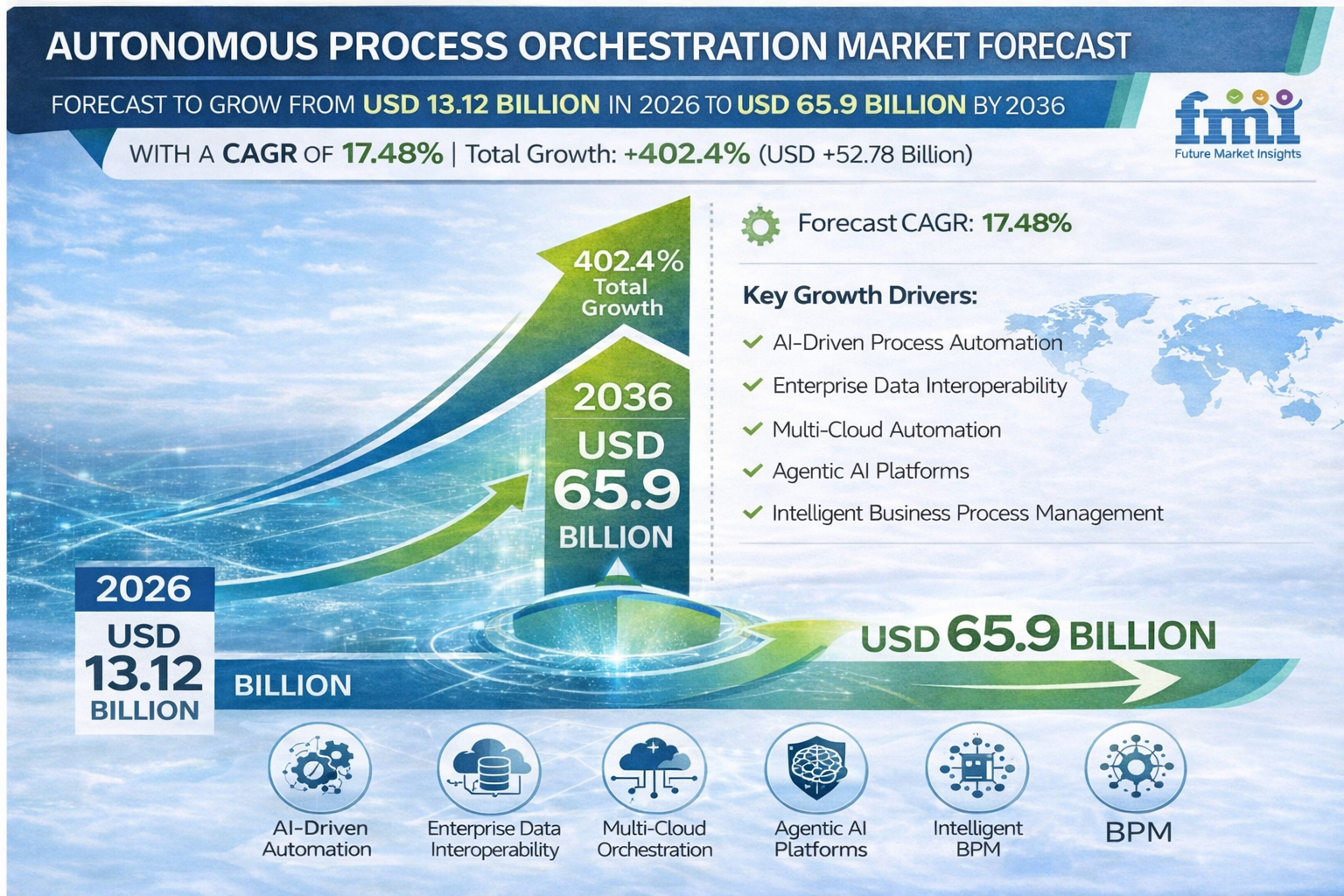
NEWARK, DE / ACCESS Newswire / March 6, 2026 / The global Autonomous Process Orchestration market is entering a rapid expansion phase as enterprises accelerate investments in AI-driven automation platforms capable of coordinating complex workflows across multi-cloud environments. Valued at USD 11.17 billion in 2025, the market is projected to reach USD 13.12 billion in 2026 and surge to USD 65.9 billion by 2036, expanding at a CAGR of 17.48% during the forecast period.
This remarkable growth reflects a structural shift in enterprise IT architecture. Organizations are moving beyond fragmented task automation toward agent-driven orchestration platforms capable of coordinating business processes, IT infrastructure, and data pipelines autonomously across distributed systems.
Industry analysts emphasize that the next decade will witness the emergence of intelligent orchestration control layers, where AI agents dynamically manage enterprise operations, optimize workflows, and resolve system disruptions without continuous human oversight.
Brows More Industry Reports :
https://www.futuremarketinsights.com/reports/sample/rep-gb-32172
Intelligent Automation Transforms Enterprise Operations
The Autonomous Process Orchestration Market gained significant momentum in 2025 as organizations struggled with rising integration complexity across cloud platforms, enterprise applications, and microservices architectures.
Legacy robotic process automation tools are increasingly being replaced by AI-powered orchestration platforms that synchronize multiple systems simultaneously. These platforms enable organizations to consolidate complex workflows into unified operational control frameworks capable of executing decisions in real time.
By 2030, the market is expected to exceed USD 31 billion, creating an incremental opportunity of more than USD 20 billion during the first half of the forecast period.
Enterprises in IT services, telecommunications, banking, and digital commerce are leading adoption as they deploy orchestration platforms to coordinate network provisioning, cybersecurity responses, application scaling, and compliance workflows.
An industry expert noted:
"Enterprises are no longer looking for isolated automation tools. They want unified orchestration platforms capable of managing AI agents, enterprise applications, and infrastructure within a single intelligent control plane."
Technology Evolution: From Task Automation to Agentic Orchestration
Autonomous orchestration platforms are rapidly evolving into intelligent operational ecosystems capable of coordinating complex enterprise environments.
Key technology innovations driving the market include:
AI-driven workflow orchestration engines capable of autonomous decision-making
Microservices-based orchestration architectures enabling modular system coordination
Event-driven automation frameworks that respond instantly to operational changes
Integrated observability platforms providing real-time performance monitoring
Multi-cloud orchestration engines coordinating workloads across distributed environments
AI-agent coordination frameworks enabling cross-system task execution
Between 2030 and 2036, the market is expected to evolve toward fully autonomous enterprise operations, where AI agents manage infrastructure provisioning, cybersecurity remediation, and business process optimization simultaneously.
Enterprise Digital Transformation Accelerates Market Adoption
The rapid adoption of orchestration platforms is largely driven by enterprise-wide automation mandates and the need to manage increasingly complex digital infrastructures.
Several factors are accelerating market expansion:
Rising integration complexity:
Modern enterprises operate hundreds of interconnected applications across hybrid cloud environments. Orchestration platforms provide centralized control to manage these distributed systems.
Expansion of AI-agent ecosystems:
Organizations deploying generative AI and autonomous agents require orchestration frameworks to coordinate their interactions securely and efficiently.
Global technical skills shortages:
Companies are increasingly automating infrastructure management and operational workflows due to limited availability of specialized IT professionals.
Regulatory and compliance requirements:
Industries such as finance, healthcare, and telecommunications require automated audit trails and governance frameworks that orchestration platforms can provide.
Segment Spotlight
Software Platforms Lead the Component Segment
Software platforms account for approximately 70% of the market share, reflecting enterprise demand for comprehensive orchestration control towers capable of managing end-to-end workflows.
Organizations increasingly prefer integrated automation suites rather than piecemeal automation tools, as unified platforms reduce technical debt and simplify enterprise integration.
Cloud Deployment Dominates Infrastructure Adoption
Cloud-based orchestration architectures represent approximately 55% of total deployments, driven by the scalability and flexibility required to manage large-scale enterprise workflows.
Cloud orchestration platforms allow IT teams to deploy AI-driven automation capabilities without major infrastructure investments while enabling continuous software upgrades and security updates.
Microservices Drive the Technology Landscape
Microservices architectures capture roughly 40% of the technology segment, reflecting the industry's shift toward modular software development.
By breaking applications into smaller, independently orchestrated services, enterprises can improve operational resilience, accelerate development cycles, and reduce system downtime.
Industry-Specific Adoption Trends
Autonomous process orchestration platforms are gaining traction across multiple industries:
IT & Telecommunications:
Network operators are deploying orchestration engines to automate infrastructure provisioning, network optimization, and cybersecurity response.
Financial Services:
Banks and fintech companies are leveraging orchestration platforms to coordinate compliance workflows, fraud detection systems, and digital transaction processing.
Manufacturing:
Industrial organizations are integrating orchestration tools to coordinate IT and operational technology systems within smart factories.
Public Sector:
Government agencies are deploying orchestration frameworks to automate administrative services and improve digital governance efficiency.
Risk Landscape
Despite strong growth potential, the market faces several operational challenges:
Complex system integration requirements across legacy enterprise infrastructure
Shortage of AI and automation specialists capable of deploying advanced orchestration platforms
Data governance and cybersecurity concerns associated with autonomous decision systems
Vendor interoperability challenges across multi-cloud environments
However, vendors developing low-code orchestration interfaces, pre-configured automation templates, and integrated security frameworks are expected to overcome these barriers effectively.
Regional Growth Insights (2026-2036 CAGR)
Country |
CAGR |
Key Growth Driver |
|---|---|---|
India |
22.0% |
Expansion of IT and BPO automation ecosystems |
China |
20.0% |
State-driven enterprise digitalization initiatives |
United States |
19.0% |
Multi-cloud infrastructure complexity and cybersecurity automation |
Germany |
17.0% |
Industrial automation and Industry 4.0 adoption |
United Kingdom |
16.0% |
Financial sector compliance and AI adoption |
Canada |
16.0% |
Public sector digitization and data sovereignty mandates |
Japan |
15.0% |
Workforce shortages driving infrastructure automation |
Asia Pacific, North America, and Europe are expected to remain the largest regional markets, supported by enterprise digital transformation programs and expanding cloud infrastructure investments.
Competitive Landscape: Platform Ecosystems Define Market Leadership
The autonomous orchestration market is becoming increasingly competitive as technology vendors race to develop AI-powered orchestration ecosystems capable of coordinating enterprise operations across hybrid environments.
Key market participants include:
ServiceNow
Microsoft
SAP
UiPath
Databricks
Leading vendors are investing heavily in AI-agent orchestration frameworks, real-time observability systems, and advanced security capabilities to strengthen their competitive positions.
Strategic partnerships with hyperscale cloud providers and enterprise software vendors are also shaping market dynamics.
Future Outlook: Toward Fully Autonomous Enterprise Operations
Looking toward 2036, several transformative trends are expected to redefine the autonomous orchestration ecosystem:
AI-agent networks coordinating enterprise workflows autonomously
Real-time orchestration of multi-cloud infrastructures
Self-healing IT systems capable of automatic incident remediation
Integrated observability and cybersecurity automation frameworks
Industry-specific orchestration platforms for finance, healthcare, and manufacturing
As enterprises continue to modernize digital infrastructure and deploy AI-driven operational frameworks, autonomous orchestration platforms will become the central control systems powering next-generation enterprise operations.
With accelerating enterprise automation mandates, rapid advancements in AI technologies, and expanding digital transformation initiatives, the global Autonomous Process Orchestration Market is positioned for strong and sustained growth over the next decade, fundamentally reshaping how organizations manage workflows, infrastructure, and decision-making processes across the digital economy.
For an in-depth analysis of evolving formulation trends and to access the complete strategic outlook for the Autonomous Process Orchestration Market through 2036, visit the official report page at: https://www.futuremarketinsights.com/reports/autonomous-process-orchestration-market
Brows More Industrial Automation Industry Reports:
Compact Power Equipment Rental Market - https://www.futuremarketinsights.com/reports/global-compact-power-equipment-rental-market
Hydronic Underfloor Heating Market - https://www.futuremarketinsights.com/reports/hydronic-underfloor-heating-market
Aircraft Electric Motor Market - https://www.futuremarketinsights.com/reports/aircraft-electric-motor-market
Pump Jack Market - https://www.futuremarketinsights.com/reports/pump-jack-market
Critical Power and Cooling Market - https://www.futuremarketinsights.com/reports/critical-power-and-cooling-market
About Future Market Insights (FMI)
Future Market Insights (FMI) is a leading provider of market intelligence and consulting services, serving clients in over 150 countries. Headquartered in Delaware, USA, with a global delivery center in India and offices in the UK and UAE, FMI delivers actionable insights to businesses across industries including automotive, technology, consumer products, manufacturing, energy, and chemicals.
An ESOMAR-certified research organization, FMI provides custom and syndicated market reports and consulting services, supporting both Fortune 1,000 companies and SMEs. Its team of 300+ experienced analysts ensures credible, data-driven insights to help clients navigate global markets and identify growth opportunities.
For Press & Corporate Inquiries
Rahul Singh
AVP - Marketing and Growth Strategy
Future Market Insights, Inc.
+91 8600020075
For Sales - sales@futuremarketinsights.com
For Media - Rahul.singh@futuremarketinsights.com
For web - https://www.futuremarketinsights.com/
SOURCE: Future Market Insights, Inc.
View the original press release on ACCESS Newswire