EVOH-free MAP meat trays are gaining traction as recyclable packaging solutions replace multilayer formats, driven by sustainability regulations, retailer commitments, and modern cold-chain expansion.
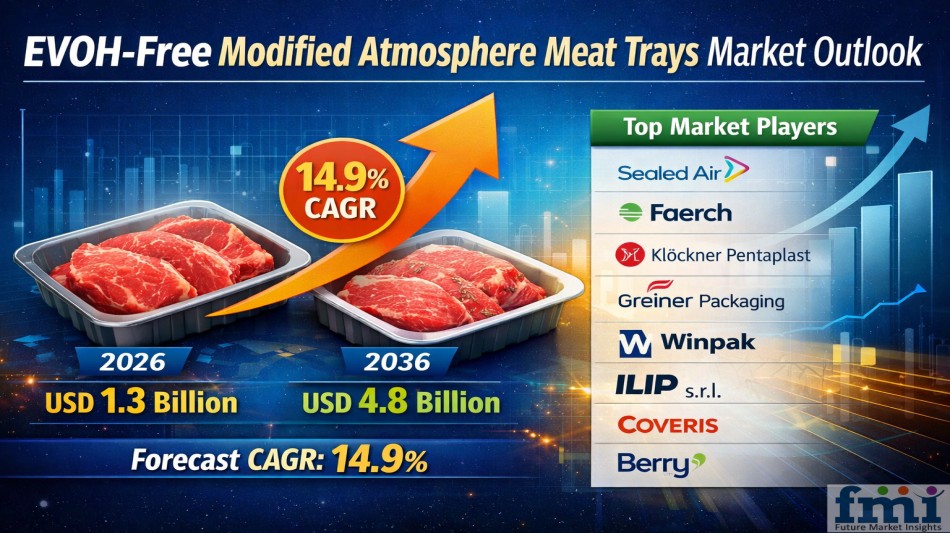
NEWARK, DE / ACCESS Newswire / March 6, 2026 / The global EVOH-Free Modified Atmosphere Meat Trays Market is entering a high-growth phase as sustainability mandates reshape the future of food packaging. Valued at USD 1.3 billion in 2026, the market is projected to surge to USD 4.8 billion by 2036, expanding at a robust CAGR of 14.9% over the forecast period.
According to a newly released strategic outlook from Future Market Insights (FMI), the transition toward EVOH-free packaging formats reflects a structural shift in the meat packaging ecosystem. Governments, retailers, and food processors are increasingly eliminating conventional EVOH-barrier multilayer trays in favor of recyclable, monomaterial packaging platforms capable of maintaining the shelf life of chilled meat products.
EVOH-Free Modified Atmosphere Meat Trays Market Metrics (2026-2036)
Metric |
Value |
|---|---|
Market Size (2026) |
USD 1.3 Billion |
Projected Market Value (2036) |
USD 4.8 Billion |
Global CAGR (2026-2036) |
14.9% |
Top Growth Region |
Asia Pacific |
Dominant Material Platform |
Polypropylene (54% share) |
Request Your Sample Now - Unlock Growth Potential and Discover Key Market Opportunities!
https://www.futuremarketinsights.com/reports/sample/rep-gb-32157
The Packaging Transition: From Multilayer Barriers to Recyclable Innovation
Traditionally, ethylene vinyl alcohol (EVOH) layers have been used in modified atmosphere packaging (MAP) trays because of their strong oxygen-barrier properties. However, these multilayer structures are difficult to recycle and often contaminate mechanical recycling streams.
To address this challenge, packaging manufacturers are shifting toward EVOH-free barrier technologies, including:
Water-based barrier coatings
Oxide coatings and vapor-deposited barriers
Sol-gel hybrid systems
Active barrier technologies
These alternatives allow packaging producers to maintain oxygen transmission rates required for chilled meat shelf-life extension while improving compatibility with existing recycling infrastructure.
Regulatory Pressure and Retailer Commitments Drive Adoption
The transition toward recyclable meat trays is strongly influenced by regulatory frameworks and retailer sustainability targets. In Europe and North America, policymakers are enforcing packaging standards that require recyclable designs within the next decade.
At the same time, major grocery chains are committing to 100% recyclable packaging for private-label products by 2025-2030, forcing suppliers to replace traditional multilayer formats with recyclable alternatives.
These policies are accelerating the adoption of EVOH-free modified atmosphere trays, despite their 15%-25% price premium compared with conventional packaging formats. Meat processors increasingly view these costs as necessary to maintain shelf access in large retail chains.
Segment Spotlight: Material Platforms and Barrier Technologies
Polypropylene (PP) trays dominate the market, accounting for an estimated 54% share in 2026. Their popularity stems from several structural advantages:
Compatibility with established polyolefin recycling streams
Strong puncture resistance during distribution
Stable thermoforming performance at lower material weights
Reduced contamination risk compared with PET or fiber-based alternatives
Barrier coating innovation is another critical segment shaping market growth. Water-based barrier coatings lead with roughly 44% market share, offering recyclability advantages while maintaining acceptable oxygen-barrier performance for many meat products.
Other emerging barrier technologies include oxide coatings and hybrid sol-gel systems designed to replicate EVOH's performance without compromising recyclability.
Application Focus: Poultry Leads Global Demand
Among meat categories, poultry packaging represents the largest application segment, holding around 39% of market share in 2026.
The dominance of poultry packaging stems from several factors:
Poultry is the highest-volume meat category globally
Shorter shelf-life requirements enable simpler barrier technologies
Large retail distribution networks require standardized packaging formats
Because poultry products are often sold through high-volume supermarket channels, retailers are prioritizing recyclable packaging solutions to align with sustainability targets.
Red meat segments such as beef and pork are also adopting EVOH-free trays, though these applications typically require higher-performance barrier systems to maintain extended shelf life.
Regional Growth Engines: Asia Pacific Emerges as the Fastest-Growing Market
While North America and Europe remain the primary early adopters due to regulatory pressure, Asia Pacific is projected to deliver the fastest growth in the global market.
Several emerging economies are rapidly modernizing their food supply chains, enabling greater adoption of modified atmosphere packaging for chilled proteins.
Top country growth forecasts (2026-2036):
India: 16.6% CAGR
Vietnam: 16.1% CAGR
Indonesia: 15.9% CAGR
Philippines: 15.5% CAGR
Thailand: 15.2% CAGR
India: Fastest-Growing Market
India is expected to record the highest growth rate globally as organized retail networks expand and cold chain infrastructure improves. Increasing supermarket penetration and stricter food safety standards are encouraging meat processors to adopt MAP packaging technologies.
Vietnam and Southeast Asia: Export-Driven Demand
Vietnam and neighboring Southeast Asian markets are experiencing strong growth due to their position in global poultry and seafood export supply chains. Processors in these regions are adopting recyclable packaging formats to meet European and North American import standards.
Thailand and Indonesia: Export and Retail Convergence
Thailand's poultry export industry and Indonesia's growing supermarket sector are further accelerating demand for recyclable MAP trays that comply with international sustainability standards.
Sustainability and Technology: The Decade's Defining Trends
Looking ahead to 2036, several trends are expected to reshape the competitive landscape of the EVOH-free MAP tray market.
Recyclability as a Baseline Requirement: Packaging regulations and retailer mandates will continue to prioritize monomaterial structures compatible with mechanical recycling systems.
Barrier Technology Innovation: Advancements in bio-based coatings and inorganic oxide barriers are expected to close the performance gap between recyclable alternatives and traditional EVOH barriers.
Cold Chain Infrastructure Expansion: Emerging markets will increasingly adopt MAP packaging as refrigerated logistics networks expand and chilled meat distribution becomes more common.
Material Cost Optimization: As coating application technologies improve and production scales increase, the cost premium associated with EVOH-free trays is expected to gradually decline.
Competitive Landscape: Integrated Packaging Specialists Lead
The EVOH-free modified atmosphere meat trays market remains relatively concentrated, with large packaging converters and barrier technology providers controlling a significant share of global capacity.
Roughly 40% of production capacity is held by vertically integrated manufacturers that operate both thermoforming and barrier coating facilities. These integrated suppliers have a competitive advantage due to their ability to control coating quality and maintain consistent oxygen-barrier performance.
Shelf-life reliability remains the primary competitive factor in the industry. Even minor variations in barrier coating performance can lead to reduced shelf life and immediate product delisting from retail shelves.
Major packaging suppliers are therefore investing heavily in:
Advanced coating application equipment
Quality testing infrastructure
Long-term supply agreements with meat processors and retailers
Recent Industry Developments
Several innovations highlight the industry's rapid transition toward recyclable packaging technologies:
Berry Global and Mitsubishi Gas Chemical Company partnered in March 2024 to introduce recyclable EVOH-free barrier coatings for polypropylene packaging.
Sealed Air Corporation launched a compostable overwrap tray under its CRYOVAC brand in January 2024, featuring biobased materials derived from wood cellulose.
These innovations demonstrate the growing emphasis on sustainable material platforms that maintain product safety and shelf life while improving recyclability.
Key Players in the EVOH-Free Modified Atmosphere Meat Trays Market
Leading companies shaping the global market include:
Sealed Air Corporation
Faerch A/S
Klöckner Pentaplast
Greiner Packaging International
Winpak Ltd.
ILIP S.r.l.
Coveris
Berry Global Group, Inc.
Groupe Guillin
Amcor plc
For an in-depth analysis of evolving formulation trends and to access the complete strategic outlook for the EVOH-Free Modified Atmosphere Meat Trays Market through 2036, visit the official report page at: https://www.futuremarketinsights.com/reports/evoh-free-modified-atmosphere-meat-trays-market
Explore More Research Reports by FMI
Demand for Compostable Foodservice Packaging in South Korea - https://www.futuremarketinsights.com/reports/south-korea-compostable-foodservice-packaging-market
IV Bag Market - https://www.futuremarketinsights.com/reports/iv-bag-market
Nutraceutical Packaging Market - https://www.futuremarketinsights.com/reports/nutraceutical-packaging-market
Blister Packaging Market - https://www.futuremarketinsights.com/reports/blister-packaging-market
Cap & Closure Market - https://www.futuremarketinsights.com/reports/caps-and-closures-market
About Future Market Insights (FMI)
Future Market Insights (FMI) is a leading provider of market intelligence and consulting services, serving clients in over 150 countries. Headquartered in Delaware, USA, with a global delivery center in India and offices in the UK and UAE, FMI delivers actionable insights to businesses across industries including automotive, technology, consumer products, manufacturing, energy, and chemicals.
An ESOMAR-certified research organization, FMI provides custom and syndicated market reports and consulting services, supporting both Fortune 1,000 companies and SMEs. Its team of 300+ experienced analysts ensures credible, data-driven insights to help clients navigate global markets and identify growth opportunities.
For Press & Corporate Inquiries
Rahul Singh
AVP - Marketing and Growth Strategy
Future Market Insights, Inc.
+91 8600020075
For Sales - sales@futuremarketinsights.com
For Media - Rahul.singh@futuremarketinsights.com
For web - https://www.futuremarketinsights.com/
SOURCE: Future Market Insights, Inc.
View the original press release on ACCESS Newswire