Electrification mandates, heat pump integration, and smart energy controls propel next-generation radiant heating adoption worldwide
NEWARK, DE / ACCESS Newswire / March 2, 2026 / The global hydronic underfloor heating market is entering a decisive growth phase, fueled by electrification mandates, decarbonization policies, and rising demand for high-efficiency residential comfort systems. Valued at USD 5.0 billion in 2026, the market is projected to expand to USD 8.9 billion by 2036, registering a 6.0% CAGR over the forecast period, according to the latest analysis by Future Market Insights (FMI).
As governments tighten building energy codes and promote low-temperature heating systems compatible with renewable sources, hydronic radiant technology is evolving from a premium comfort feature to a strategic infrastructure upgrade.
Get Access of Report Sample: https://www.futuremarketinsights.com/reports/sample/rep-gb-15063
Regulatory Tailwinds Accelerate Adoption
Energy policy is becoming the single largest catalyst for hydronic system deployment. In September 2024, the California Energy Commission confirmed that updated 2025 Building Energy Efficiency Standards are projected to deliver USD 4.8 billion in energy savings, reinforcing a pivot toward electric-ready heating frameworks.
Hydronic systems particularly when paired with heat pumps operate at lower water temperatures (120-150°F), achieving distribution efficiencies of 95-98%, as validated by the U.S. Department of Energy in April 2024.
The conversation has shifted from compliance to profitability-especially for commercial retrofits and institutional investors electrifying heating assets.
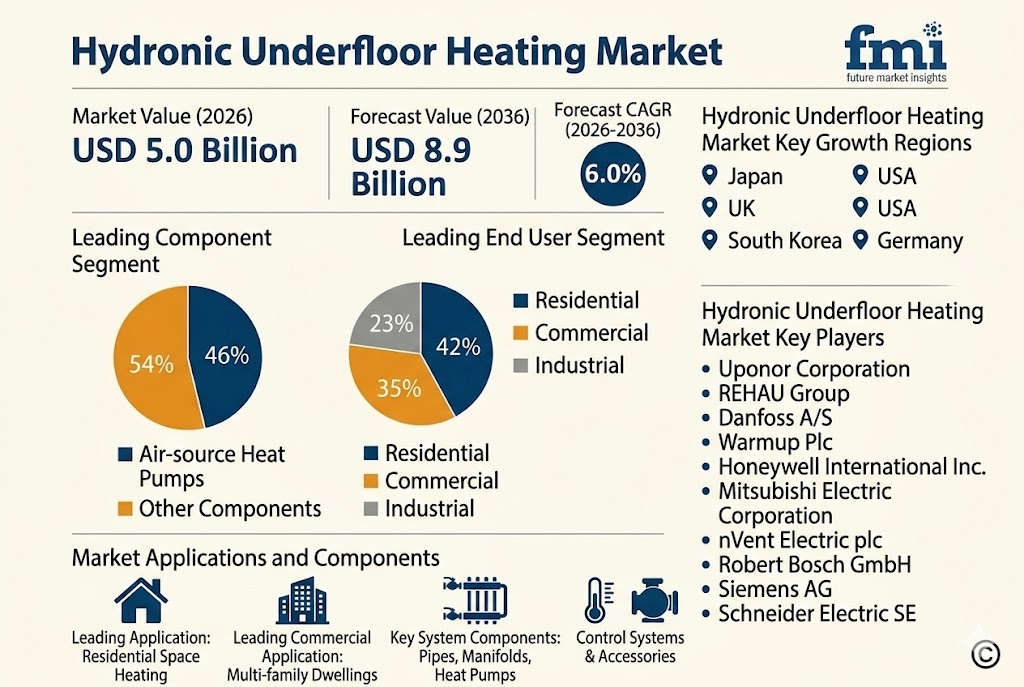
Market Snapshot (2026-2036)
Metric |
Details |
|---|---|
Market Value (2026) |
USD 5.0 Billion |
Forecast Value (2036) |
USD 8.9 Billion |
Projected CAGR |
6.0% |
Leading Component |
Air-source Heat Pumps (46%) |
Leading End User |
Residential (42%) |
Primary Application |
Residential Space Heating |
Why Air-Source Heat Pumps Dominate
Air-source heat pumps are projected to command 46% of the heat source segment, offering the most accessible pathway to electrification. Unlike ground-source systems, they require minimal excavation and lower upfront capital investment.
This integration enables:
Dual-function heating and domestic hot water
Reduced mechanical plant footprint
Lower installation barriers
Eligibility for renewable incentives
Manufacturers are prioritizing plug-and-play manifolds and air-to-water compatibility to streamline system integration in both new builds and renovations.
Residential Segment Leads Global Demand
Residential applications are expected to hold a 42% market share, driven by:
Growing preference for invisible heating
Elimination of radiators to reclaim wall space
Rising investment in premium housing
Demand for dust-free, wellness-oriented interiors
In Japan, data from the Statistics Bureau indicates over 59,524 housing starts in November 2025, maintaining steady demand for advanced radiant solutions.
Hydronic systems align perfectly with Zero Energy House (ZEH) targets, positioning them as foundational to future housing standards.
Country-Level CAGR Analysis (2026-2036)
Japan: 6.2%
United Kingdom: 6.1%
South Korea: 6.0%
United States: 5.9%
Germany: 5.7%
Japan: Tech-Driven Radiant Innovation
Japan's hydronic market is deeply integrated with ZEH initiatives and hybrid heat pump systems. The country's advanced smart home ecosystem allows seamless integration between radiant loops and AI-enabled climate control platforms.
United Kingdom: Future Homes Standard Impact
The UK market is expanding rapidly under the Future Homes Standard, which phases out gas boilers in new construction. Renovation activity remains strong, with private housing repair growing 3.7% in 2025, supporting retrofit installations.
South Korea: Green Remodeling Momentum
Rooted in traditional "Ondol" heating, South Korea is modernizing toward high-efficiency hydronic systems in public infrastructure. Government mandates for zero-energy public buildings are accelerating adoption.
United States: Electrification & IRA Incentives
The U.S. market is being reshaped by federal incentives under the Inflation Reduction Act and state-level decarbonization mandates. Building codes increasingly encourage electric heat pump systems, positioning hydronic loops as an ideal distribution partner.
Germany: Regulatory Benchmark for Europe
Germany continues setting the regulatory pace through its Building Energy Act (GEG), mandating that new heating systems use at least 65% renewable energy. This effectively necessitates low-temperature distribution systems like hydronic underfloor heating.
Key Industry Trends
Smart Energy Integration
Digital thermostats and AI-based zoning systems are optimizing performance. Companies like Warmup Plc report energy reductions of up to 30% using predictive algorithms.
Low-Temperature Standardization
Hydronic systems are increasingly standardized for renewable compatibility, improving heat pump efficiency and lowering operating costs.
Modular & Retrofit-Friendly Designs
Manufacturers are introducing thin-profile panels and bio-based PEX piping to simplify renovations and reduce installation time.
Competitive Landscape: Climate Ecosystems Take Shape
The market is consolidating as major players transition from component suppliers to full-scale climate solution providers.
Leading companies include:
Uponor Corporation
REHAU Group
Danfoss A/S
Honeywell International Inc.
Mitsubishi Electric Corporation
Robert Bosch GmbH
Siemens AG
Schneider Electric SE
Strategic M&A is intensifying as firms seek to expand renewable portfolios and offer "Energy-as-a-Service" models, combining hardware, software, and lifecycle optimization.
Companies are increasingly using their own headquarters as carbon-neutral testbeds to validate system performance, building both credibility and operational efficiency.
The Road to 2036: From Comfort Upgrade to Infrastructure Essential
Global energy demand for heating rose by 2.2% in 2024, according to international energy data, underscoring the urgency for efficient distribution systems. Hydronic underfloor heating addresses this need by:
Enhancing energy efficiency
Supporting electrification
Reducing carbon emissions
Improving indoor air quality
Increasing real estate value
By 2036, hydronic radiant systems are expected to be viewed not merely as luxury upgrades but as foundational infrastructure in climate-resilient buildings.
As electrification accelerates and renewable integration deepens, hydronic underfloor heating stands at the intersection of energy policy, consumer wellness, and long-term operational profitability positioning the industry for sustained global expansion over the next decade.
For an in-depth analysis of evolving formulation trends and to access the complete strategic outlook for the Dredging Market through 2036, Full Report Request: https://www.futuremarketinsights.com/reports/hydronic-underfloor-heating-market
Related Reports:
Europe Hydronic Underfloor Heating Market- https://www.futuremarketinsights.com/reports/europe-hydronic-underfloor-heating-market-share-analysis
Residential Hydronic Underfloor Heating Market- https://www.futuremarketinsights.com/reports/residential-hydronic-underfloor-heating-market
Underfloor Heating Market- https://www.futuremarketinsights.com/reports/underfloor-heating-market
About Future Market Insights (FMI)
Future Market Insights (FMI) is a leading provider of market intelligence and consulting services, serving clients in over 150 countries. Headquartered in Delaware, USA, with a global delivery center in India and offices in the UK and UAE, FMI delivers actionable insights to businesses across industries including automotive, technology, consumer products, manufacturing, energy, and chemicals.
An ESOMAR-certified research organization, FMI provides custom and syndicated market reports and consulting services, supporting both Fortune 1,000 companies and SMEs. Its team of 300+ experienced analysts ensures credible, data-driven insights to help clients navigate global markets and identify growth opportunities.
For Press & Corporate Inquiries:
Rahul Singh
AVP - Marketing and Growth Strategy
Future Market Insights, Inc.
+91 8600020075
For Sales - sales@futuremarketinsights.com
For Media - Rahul.singh@futuremarketinsights.com
For web - https://www.futuremarketinsights.com/
SOURCE: Future Market Insights, Inc.
View the original press release on ACCESS Newswire