Recyclable thermoforms market grows as sustainable food packaging demand rises, driven by design innovation, recycling standards, and circular economy goals.
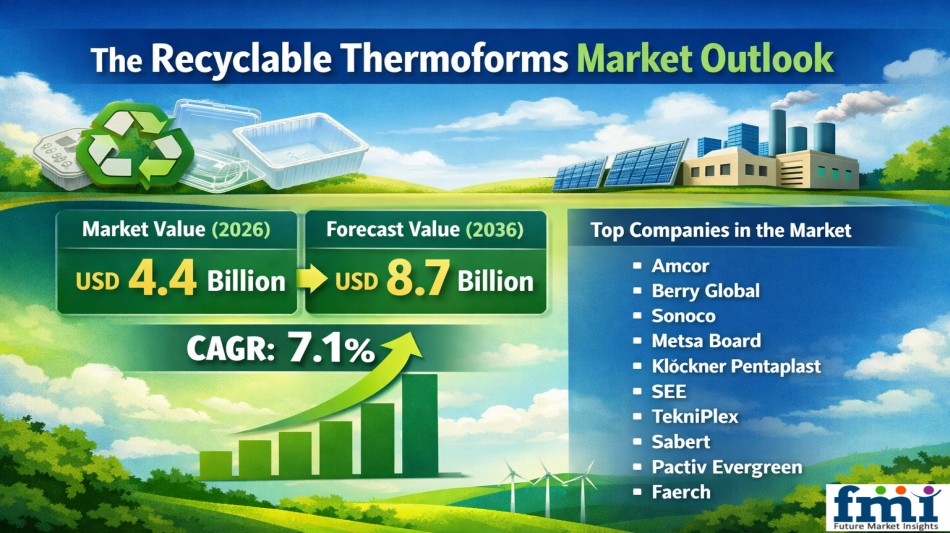
NEWARK, DE / ACCESS Newswire / March 18, 2026 / The global recyclable thermoforms market is entering a decade of structural reinvention, as sustainability imperatives converge with the enduring functional value of rigid and semi-rigid packaging. Valued at USD 4.4 billion in 2026, the market is projected to nearly double to USD 8.7 billion by 2036, expanding at a steady CAGR of 7.1%. This growth trajectory reflects a decisive industry shift: thermoformed packaging is no longer being phased out-it is being redesigned for circularity.
According to a comprehensive strategic analysis by Future Market Insights (FMI), the market's expansion is closely tied to rising demand for recyclable food packaging, evolving regulatory frameworks, and the need to retain the performance advantages of thermoforming while aligning with real-world recycling systems.
Recyclable Thermoforms Market Metrics (2026-2036)
Metric |
Value |
Market Value (2026) |
USD 4.4 Billion |
Forecast Value (2036) |
USD 8.7 Billion |
CAGR |
7.1% |
Leading Material |
PET (43.4% Share) |
Leading Product Type |
Trays (36.7% Share) |
Top End Use |
Fresh Food (47.3% Share) |
Explore Opportunities - Get Your Sample of Our Industry Overview Now!
https://www.futuremarketinsights.com/reports/sample/rep-gb-32348
The Circularity Imperative: Reinventing Thermoforms for Sustainability
The recyclable thermoforms market is undergoing a material transformation. Historically criticized for recyclability challenges, thermoformed packaging formats-such as trays, clamshells, and blisters are now being reengineered to meet stringent environmental standards.
Manufacturers are increasingly focusing on design-for-recycling principles, simplifying material structures, optimizing labeling systems, and eliminating incompatible additives. This shift is turning thermoforms from a sustainability liability into a circular packaging solution.
"Recyclable thermoforms are gaining because thermoforming never disappeared," notes Ismail Sutaria, Senior Consultant at FMI. "What has changed is the expectation-today's packaging must justify its place within a circular economy. The market is rewarding integrated design approaches where structure, labeling, and materials are engineered together."
Market Drivers: Functionality Meets Environmental Accountability
Fresh-Pack Demand Remains Unshaken
Thermoformed packaging continues to dominate applications where product visibility, hygiene, and structural integrity are critical. Fresh food, dairy, deli products, and healthcare packaging rely heavily on thermoforms due to their ability to maintain shape, ensure stackability, and protect sensitive contents.
Design Guidance Accelerates Adoption
Industry frameworks and recyclability guidelines are playing a pivotal role in shaping innovation. Organizations such as the Association of Plastic Recyclers (APR) are pushing manufacturers toward standardized, recyclable formats, accelerating the transition from conventional to recyclable thermoforms.
Rigid-Pack Pragmatism Drives Redesign
Despite the rise of flexible packaging, many applications still require rigid or semi-rigid solutions. Rather than replacing thermoforms entirely, brands are choosing to redesign within the format, preserving functionality while improving recyclability.
Segment Spotlight: Materials and Formats Leading the Market
PET Dominates Material Innovation
Polyethylene terephthalate (PET) is expected to lead the material segment with a 43.4% market share in 2026. Its dominance is driven by:
Established infrastructure for recycling
High clarity and durability
Extensive use in food-grade applications
The large installed base of PET thermoforms creates strong incentives for redesign rather than replacement, making it the focal point of innovation.
Trays: The Backbone of Thermoformed Packaging
Thermoformed trays are projected to remain the leading product type, capturing 36.7% of the market share in 2026. Their widespread use across fresh produce, meat, and ready-to-eat meals makes them the primary target for recyclability improvements.
Fresh Food Leads End-Use Demand
The fresh food segment is expected to dominate with a 47.3% share in 2026, driven by increasing consumer demand for safe, visible, and sustainable packaging solutions.
Evolving Challenges: The Complexity of Recycling
While the outlook remains positive, the market faces notable constraints. Thermoform recycling is still technically complex and economically uneven.
Factors such as:
Multi-layer structures
Adhesives and labels
Colorants and barrier coatings
can hinder recyclability and reduce material recovery rates. Additionally, PET thermoforms compete with bottle-grade PET recycling streams, creating further economic and logistical challenges.
In healthcare applications, transitioning to recyclable formats involves lengthy validation processes, particularly when replacing legacy materials like PVC and PA. These barriers increase costs and slow adoption.
Trends Defining the Next Decade
Design-Level Optimization Takes Center Stage
The industry is moving beyond generic "recyclable" claims toward granular design improvements. Manufacturers are focusing on the entire packaging system-including lids, labels, and closures-to ensure compatibility with recycling infrastructure.
Healthcare Packaging Innovation Gains Momentum
Blister packaging is undergoing significant transformation, with mono-material solutions such as PE-based systems emerging as alternatives to traditional PVC structures. This trend is particularly strong in pharmaceutical and medical applications.
High-Value Applications Drive Innovation
While food trays remain the largest segment, dairy, deli, and healthcare packaging are becoming key innovation hubs due to their higher value density and stricter performance requirements.
Regional Outlook: Global Demand with Localized Innovation
The recyclable thermoforms market spans key regions including North America, Europe, Asia Pacific, Latin America, and the Middle East & Africa.
North America and Europe are leading in regulatory-driven adoption and advanced recycling infrastructure.
Asia Pacific is witnessing rapid growth due to expanding food packaging demand and increasing environmental awareness.
Emerging markets are balancing cost sensitivity with sustainability goals, creating opportunities for scalable, recyclable solutions.
Competitive Landscape: System-Level Innovation Defines Leadership
The competitive environment in recyclable thermoforms is shifting from material claims to system-level optimization. Leading players are focusing on delivering packaging solutions that balance:
Recyclability
Product protection
Operational efficiency
Consumer appeal
Key players operating in the market include:
Amcor
Berry Global
Sonoco
Metsa Board
Klöckner Pentaplast
SEE
TekniPlex
Sabert
Pactiv Evergreen
Faerch
These companies are investing in recycle-ready thermoforming technologies, expanding material portfolios, and aligning product designs with global recyclability standards.
For an in-depth analysis of evolving formulation trends and to access the complete strategic outlook for the Recyclable Thermoforms Market through 2036, visit the official report page at: https://www.futuremarketinsights.com/reports/recyclable-thermoforms-market
Explore More Research Reports by FMI
Solid Board Market - https://www.futuremarketinsights.com/reports/solid-board-market
Wine Bag Market - https://www.futuremarketinsights.com/reports/wine-bags-market
High Airtight Storage Cabinets Market - https://www.futuremarketinsights.com/reports/high-airtight-storage-cabinets-market
Cross Corner Industrial Bags Market - https://www.futuremarketinsights.com/reports/cross-corner-industrial-bags-market
Straw Market - https://www.futuremarketinsights.com/reports/straws-market
About Future Market Insights (FMI)
Future Market Insights (FMI) is a leading provider of market intelligence and consulting services, serving clients in over 150 countries. Headquartered in Delaware, USA, with a global delivery center in India and offices in the UK and UAE, FMI delivers actionable insights to businesses across industries including automotive, technology, consumer products, manufacturing, energy, and chemicals.
An ESOMAR-certified research organization, FMI provides custom and syndicated market reports and consulting services, supporting both Fortune 1,000 companies and SMEs. Its team of 300+ experienced analysts ensures credible, data-driven insights to help clients navigate global markets and identify growth opportunities.
For Press & Corporate Inquiries
Rahul Singh
AVP - Marketing and Growth Strategy
Future Market Insights, Inc.
+91 8600020075
For Sales - sales@futuremarketinsights.com
For Media - Rahul.singh@futuremarketinsights.com
For web - https://www.futuremarketinsights.com/
SOURCE: Future Market Insights, Inc.
View the original press release on ACCESS Newswire